
Food Defence Threat Assessment: The TACCP Study Most Sites Only Half Finish
By Mthokozisi Nkosi, Food Safety Specialist & Lead Auditor, ASC Food Safety · 15 min read
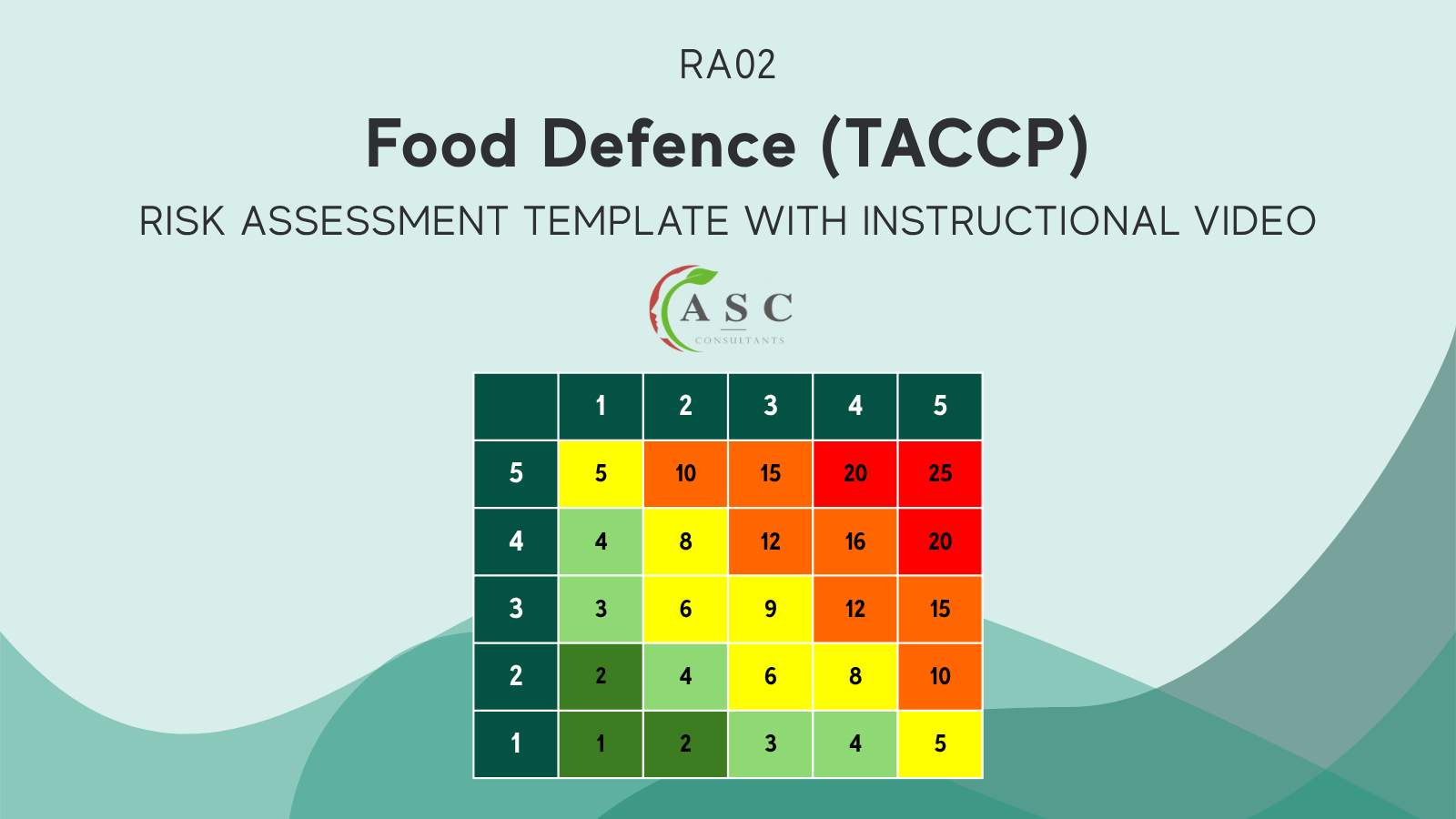
BRCGS Global Standard Food Safety Issue 9 requires a documented food defence threat assessment at clause 4.2, with site security judged at clause 4.1. Most assessments we are asked to review score the supply chain in detail and stop at the factory gate, leaving people, premises and process unassessed. The Food Defence (TACCP) Risk Assessment Template (RA02) is R690 and includes an instructional video.
At a glance
- Scheme requirement
- BRCGS Issue 9 clause 4.2 food defence, read alongside clause 4.1 external standards and site security
- FSSC 22000
- Food defence is one of the FSSC additional requirements. Version 7 was published in May 2026
- TACCP against VACCP
- TACCP assesses threats intended to cause harm. VACCP assesses vulnerability to fraud for economic gain
- Domains a complete study covers
- People, premises, process, product, transport and distribution, information systems
- The finding we see most
- The supply chain is assessed and the facility is not. Doors, yards, tanks, stores and staff access never appear
- South African law
- No regulation names a food defence threat assessment. Section 61 of the Consumer Protection Act 68 of 2008 still imposes liability for harm caused by unsafe goods irrespective of negligence
- Template
- Food Defence (TACCP) Risk Assessment Template (RA02), R690, register plus procedure plus completion guide plus read me, with an instructional video
- Training
- Food Fraud (VACCP) and Food Defence (TACCP), R1,450, self paced online, no VAT charged on training
Check one thing in your current assessment before you read on
Open your food defence file and search it for the words yard, gate, visitor, contractor and tank. If those words do not appear, the study has assessed your suppliers and not your site, and that is the single most common finding we write against food defence. The RA02 pack gives you a register that forces both halves.
Food Defence (TACCP) Risk Assessment Template, R690 Ask ASC to build your threat assessment
In this guide
- Where the TACCP threat assessment sits next to VACCP and HACCP
- Why certification schemes require a threat assessment
- Why most TACCP studies stop at the supply chain
- What a complete TACCP study covers: the six domains
- How to identify credible threats without writing a manual for one
- Assessing insider threat responsibly
- Physical security controls auditors expect to see
- How to score a threat
- What mitigation looks like in a food defence register
- How to test the food defence plan
- What the auditor asks for on the day
- How often to review the assessment, and what triggers a review
- Frequently asked questions
Where the TACCP threat assessment sits next to VACCP and HACCP
The definition sits in our published guide to what food defence and TACCP are, and this article covers the assessment itself. TACCP, threat assessment and critical control point, is the documented study behind food defence. VACCP is the parallel study for food fraud, where the intent is economic gain rather than harm. HACCP addresses hazards nobody intended. BRCGS Issue 9 places food defence at clause 4.2.
The three studies share a shape and answer different questions. A HACCP team fluent in hazard analysis can still produce a weak threat assessment. Hazard analysis asks what the process can do to the product. Threat assessment asks what a person could do, and what your site currently allows a person to do. The second question is uncomfortable, and that discomfort is part of why so many studies drift towards the supply chain, where the subject is somebody else.
| Study | Question it answers | Intent assumed | Main output |
|---|---|---|---|
| HACCP | What hazards can the process introduce, and where do we control them? | None. The hazard is unintentional | Hazard analysis, control measures, critical control points and limits |
| TACCP, food defence | Who could deliberately harm people through our product or our business, and what would let them? | Intent to cause harm | Threat register, access and security controls, response and escalation plan |
| VACCP, food fraud | Where could a material or a claim be falsified for profit before it reaches us? | Intent to profit | Vulnerability register, supplier verification, authenticity testing plan |
If food defence is new to your team, our existing guide to what food defence and TACCP actually require is the shortest way into the terminology, and this article assumes it. The fraud side belongs in its own register, and the Food Fraud Vulnerability (VACCP) Risk Assessment Template (RA18) at R690 is built to cross reference the food defence register rather than compete with it.
Why certification schemes require a threat assessment
Certification schemes require a food defence threat assessment because a food safety management system built only on unintentional hazards has an obvious hole in it. BRCGS Global Standard Food Safety Issue 9, published 1 August 2022, sets the requirement at clause 4.2 and judges site security at clause 4.1. Food defence is also one of the FSSC additional requirements that sit on top of ISO 22000:2018.
Clause 4.2 is not one of the twelve fundamental requirements in Issue 9, so a weakness there does not carry the outright fail that a major against a fundamental does. That is a poor reason to relax. Food defence non-conformances are easy for an auditor to raise and awkward to close, because closing one usually means physical work on the site rather than a document revision. A gate, a lock schedule or a visitor process cannot be corrected by close of business on the Friday your evidence is due.
For FSSC 22000 sites the timing matters this year. Version 7 was published in May 2026. Version 6 audits are permitted until 30 April 2027, the Version 7 upgrade audit window runs from 1 May 2027 to 30 April 2028, and the certification body must complete the upgrade documentation in the FSSC platform by 30 June 2028. Our FSSC 22000 Version 7 guide for South Africa sets out the full transition. Reviewing food defence as part of the upgrade costs you one meeting. Discovering it at the upgrade audit costs you a corrective action window.
South African law approaches this from a different direction. No regulation names a food defence threat assessment. R638 of 2018, the Regulations Governing General Hygiene Requirements for Food Premises, the Transport of Food and Related Matters, published in Government Gazette 41730 on 22 June 2018, is a hygiene regulation, and regulation 3(1) prohibits handling food on premises without a valid Certificate of Acceptability. What sits behind the commercial risk is section 61 of the Consumer Protection Act 68 of 2008, which imposes liability for harm caused by unsafe goods on producers, importers, distributors and retailers irrespective of negligence.
Watch the method, then write the register
The RA02 pack is one of two risk assessment packs we supply with an instructional video, because food defence is the assessment teams most often get wrong on structure rather than content. The video walks through how the register is laid out, how the six domains are worked, and how to score without turning the document into a description of an attack.
Food Defence (TACCP) pack with instructional video, R690 Talk to ASC about a food defence walk of the site
Why most TACCP studies stop at the supply chain
Clause 4.2 of BRCGS Issue 9 asks for a threat assessment of the site. Nine studies in ten assess the supply chain in detail and never once name a door. The study ranks suppliers, considers imported materials and country risk, and then finishes. The site itself, the place where the product is open and the people are, never appears in the register at all.
I understand how it happens. Supply chain thinking is already in the building, because the same team has just finished a food fraud vulnerability assessment and the material is fresh. Suppliers are also comfortable to write about. Scoring your own goods receiving door means writing down that it stands open for the delivery window and that nobody is stationed there, and that sentence has to be shown to your own management team.
A threat assessment that names your suppliers and never names your doors has assessed somebody else’s site.
The result is a document that reads well and answers a question the standard did not ask on its own. When an auditor works through clause 4.2 they will follow the assessment onto the floor. They will ask which threat in the register corresponds to the external door they walked past, or the bulk tank in the yard, or the contractor on the roof. If the register has nothing to say about any of them, the conversation stops being about paperwork.
The register lists suppliers, materials or countries in every row. There is no row whose location is your own site. The words yard, perimeter, visitor, contractor, roof, tank, silo, water, chemical store or key do not appear anywhere. No control in the document is owned by anybody outside the technical department. Nobody from security, human resources, engineering or distribution attended the review. The last revision was made by one person alone.
- Every row in the register names a location, a role or an activity that exists on your site plan.
- The external fabric, the yard and the perimeter are assessed, not assumed.
- Storage of open product, bulk materials, water and chemicals each appear as separate rows.
- Access by employees, agency staff, contractors, drivers, visitors and auditors is assessed separately, because each group is controlled differently.
- Outbound product, loading and transport appear, including the period a loaded vehicle stands unattended.
- The supply chain section is present and is not the whole document.
Two of our risk assessment packs do the facility half of this work in the same register format, so they cross reference cleanly. The Site and Building Fabric Risk Assessment Template (RA07) at R690 covers the perimeter, the external fabric, the roof, doors and openings. The Layout and Hygienic Zoning Risk Assessment Template (RA08) at R690 covers zone boundaries and movement routes, which is where restricted access is actually decided.
What a complete TACCP study covers: the six domains
A complete food defence threat assessment covers six domains, and the RA02 register at R690 works through all six: people, premises, process, product, transport and distribution, and information systems. Working domain by domain is what stops a study collapsing into the supply chain, because five of the six sit inside your own boundary. Use the table below to check your existing register in about ten minutes.
| Domain | What the assessment must ask | Typical controls | Gap we see most often |
|---|---|---|---|
| People | Who holds unsupervised access to open product, materials or packaging? How are employees, agency staff, contractors, drivers and visitors screened, inducted, supervised and removed? | Pre-employment checks proportionate to the role, induction covering food defence, supervision of contractors, visitor sign in and escort, prompt withdrawal of access on exit, a reporting route that gets a response | Contractors and agency staff assessed as if they were employees, and no assessment of how quickly access ends when somebody leaves |
| Premises | Where can a person reach product without being seen or challenged? What is the state of the perimeter, the yard, the roof, external doors, windows and service openings? | Defined and maintained perimeter, controlled external doors, lock and key schedule with a named holder, restricted areas defined on the site plan, lighting, alarm and camera cover where the assessment justifies it | The whole domain is absent. The assessment never leaves the supply chain and never reaches the building |
| Process | At which steps is product open, unattended or accessible? Where is a deliberate act least likely to be noticed before dispatch? | Line supervision at open stages, restricted access to open product areas, two person rules at critical points, controlled access to bulk intake, water and utilities, sealed and reconciled hoppers and tanks | Only the production hall is considered. Intake, standing intermediate storage, out of hours periods and shutdown periods are not |
| Product | Which of our products would attract attention, and how would tampering be detected before or after dispatch? Which packaging formats show interference and which do not? | Tamper evident closures and outer packaging where justified, pack integrity checks at line clearance and dispatch, batch reconciliation, complaint monitoring for tampering signals, traceability that supports rapid withdrawal | Tamper evidence treated as a packaging specification and never linked to a scored threat or to the withdrawal plan |
| Transport and distribution | Who has access to loaded product after it leaves supervision? What happens while a vehicle is loaded, parked, in transit or at a third party site? | Trailer seals with recorded numbers, seal checks at dispatch and delivery, driver identity verification, controlled yard access, secure parking arrangements, agreed procedure when a seal is broken or missing | Seals applied but never recorded or reconciled at the receiving end, so a broken seal has no owner |
| Information systems | Who can change a recipe, a specification, a label file, a batch record or a dispatch instruction? What would a false instruction look like and who would catch it? | Role based access to production and labelling systems, change control with a second approver, removal of accounts on exit, backups and restoration testing, verified process for changes requested by email or telephone | Domain omitted entirely, or reduced to a line saying the IT department manages it |
Close the facility half with the two packs that cover it
If your food defence register is strong on suppliers and silent on the building, the fastest fix is to assess the fabric and the zoning properly and then feed both into the threat register. These two packs use the same register structure as the Food Defence (TACCP) pack, so the cross references write themselves.
Site and Building Fabric Risk Assessment, R690 Browse the risk assessment library Send us your audit report
How to identify credible threats without writing a manual for one
Identify threats by working from access and opportunity, never from method, which is also how clause 4.1 of BRCGS Issue 9 judges external standards and site security. For every point where product, packaging or materials are open or unattended, ask three questions: who can reach this, when can they reach it unobserved, and would anybody notice afterwards. Those three answers give you a scoreable threat without your register describing how an attack would be carried out.
This matters more than it sounds. A food defence file that catalogues techniques is a training document for the wrong reader, and it is held in a shared drive that a great many people can open. Auditors do not want that detail either. What clause 4.2 is testing is whether you understand where you are exposed and what you have done about it.
Record the row as an access condition. “Open product accessible from the packing hall walkway during the night shift, no supervision between 22h00 and 02h00” is a proper threat entry. It is specific, it can be scored, and the control that answers it is obvious. If a passage in your register starts to read like an instruction, cut it back to the access condition it describes.
- Assemble a team that is not only technicalFood defence needs the people who hold the keys, sign the contractors in, plan the loads and manage the staff. Bring engineering, human resources, security, distribution and a production supervisor into the room with the technical team. A study written by one QA manager alone is the study that misses the yard.
- Walk the boundary before you open the registerStart outside. Walk the perimeter, then the yard, then every external door and service opening, then the roof access, then the intake points for bulk materials, water and utilities. Photograph what you find. Do the walk once in daylight with the site busy and once when it is quiet.
- Map every point where product is open or unattendedFollow the product from intake to dispatch and mark each stage where it is exposed, standing between processes, or held overnight. Include rework, samples, retained product and material waiting for disposal, which are the stages that fall out of most process maps.
- List who can reach each point, by groupEmployees by department, agency staff, contractors, maintenance, cleaners, drivers, visitors, auditors and third party service providers. Different groups get different controls, so keeping them separate in the register saves rewriting it later.
- Convert each exposure into a threat statementWrite it as location plus access condition plus period, in one line. Avoid method. Avoid naming any substance or material. The statement should be specific enough that two people who read it would look at the same place on the site plan.
- Score, control, and re-scoreGive each entry a likelihood and a consequence score, record the controls that already exist and the evidence for each, then score again. An undocumented control does not reduce the score.
- Escalate what you cannot control on siteSome entries need capital, a landlord, a shared yard agreement or a customer decision. Put those into the management review with a named owner and a date rather than scoring them down to make the register look finished.
Assessing insider threat responsibly
Insider threat is the part of a food defence assessment most likely to be done badly, because a study that turns into suspicion of individuals damages the reporting culture BRCGS Issue 9 asks you to build under clause 1.1.2. Assess conditions rather than people. Access, supervision, the handling of grievances and the strength of the reporting route are all auditable, and none of them require you to profile anybody.
Start with access itself. In most factories access has accumulated rather than been designed. People hold keys because of a job they did four years ago, a badge still opens a room the holder no longer works in, and a leaver’s account stays live for weeks. Withdrawing access that is no longer needed removes more exposure than any camera, and it costs nothing but administration.
Supervision is the second condition. Ask where a person can work alone, unobserved, next to open product, and for how long. Night shifts, weekend cleaning, maintenance interventions and shutdown periods are where the answer is usually longest. The control is rarely surveillance. Usually it is a change to the shift pattern, a second person on a task, or moving the activity to a time when the area is occupied.
The third condition is disgruntlement, and it is a management issue before it is a security issue. Sites with unresolved grievances, unpaid overtime disputes, an unpopular disciplinary process or a restructuring underway carry a higher score, and the honest control is to manage the grievance rather than to watch the workforce. Where an industrial relations dispute is active, that is a trigger to review the assessment and to tighten access temporarily, in a way that is explained to staff rather than imposed silently.
Somebody almost always notices something before an incident. Whether they say anything depends on whether the last person who raised a concern was thanked or ignored. Write the reporting route into the register as a control, name the person who receives reports, name an alternative for when the concern involves that person, and keep evidence that reports get a response.
This is the same ground as food safety culture. Run the two programmes through people who talk to each other. Our guides to implementing food safety culture and to the BRCGS culture plan under clause 1.1.2 set out how to evidence the behaviours. For the team, the Food Safety and Quality Culture course at R1,195 covers reporting behaviour and speaking up, which is the part of insider threat that no control on a door will fix.
Food defence usually lands on a QA manager who was never taught it
Food defence and food fraud are usually handed to a QA manager who has never been taught either as a discipline. The course covers both studies, the difference between them, and how each register is built and defended in an audit. Self paced online with lifetime access and a QR verifiable certificate, and no VAT is charged on training, so the price shown is the price paid.
Food Fraud (VACCP) and Food Defence (TACCP), R1,450 Ask about team enrolment
Sealed building fabric and a controlled perimeter keep out pests and intruders alike
ASC Pest Control is part of the ASC Food Safety Consultants group, owned and designed by food safety specialists, a SAPCA member with pest control operators registered under Act 36 of 1947, and built around what a BRCGS, FSSC 22000 or R638 audit or inspection actually asks for. Service reports, barcoded device monitoring and trend analysis live in the My ASC Pest Control Hub, so the pest file is audit ready before anyone asks for it. ASC Pest Control serves Gauteng and the Eastern Cape.
Food and beverage pest control by ASC Request a pest control site assessmentPhysical security controls auditors expect to see
Auditors expect physical security to be proportionate and reasoned rather than maximal. Under clause 4.1 of BRCGS Issue 9 they judge external standards and site security directly, and under clause 4.2 they check that the controls chosen follow from your own scored assessment. The list below is what a competent auditor will look for on a food manufacturing site in South Africa.
- Perimeter and yard. A defined boundary, maintained fencing or walls, controlled vehicle entry, and a yard where a visitor cannot reach a building entrance unchallenged.
- External doors and openings. Doors that are closed and controlled rather than propped, service openings and ducts secured, roof access controlled, and windows in product areas fixed or protected.
- Access control. A badge, key or code system with a current holder list, a named owner for the list, and a documented process to withdraw access on the day a person leaves or changes role.
- Visitor and contractor management. Sign in and sign out, identification, induction proportionate to where the visitor is going, escort in product areas, and a record that can be produced for any date.
- Restricted areas. A small number of genuinely restricted areas marked on the site plan and on the door, with the restriction enforced. Restricting everything restricts nothing.
- Storage of materials that need control. Chemicals, cleaning materials, pest control products, packaging and printed labels held in locked or controlled storage with issue records.
- Bulk intake, water and utilities. Bulk tanks, silos, water storage and intake points secured and inspected, with access limited to named roles.
- Tamper evidence. Tamper evident features specified where the assessment justifies them, checked at line clearance and dispatch, and linked to the withdrawal procedure so a report from the market has a route.
- CCTV where justified. Cameras where your assessment shows a high access point that cannot be supervised another way, with defined coverage, recording retention, and somebody who actually reviews footage after an event.
- Dispatch and vehicle security. Seals with recorded numbers, seal checks at both ends, driver identity verification, and a documented response when a seal is missing or broken.
Two points make the difference between a list like this and a defensible programme. Each control must trace back to a scored row in the register, and each must have a named owner and a record. A camera nobody reviews and a visitor book nobody checks are both evidence that the control was bought rather than designed.
How to score a threat
Score a threat on likelihood and consequence, in the same structure as your other risk assessments. Every ASC pack at R690 shares one register format so the structure carries across. Let likelihood carry the work. Consequence for a deliberate contamination is high by definition, so a matrix that scores consequence honestly will show most rows as serious. Likelihood is where access, opportunity and detectability separate a controlled site from an exposed one.
| Scoring dimension | What raises the score | What lowers it |
|---|---|---|
| Access | Many people can reach the point, access is not recorded, external groups reach it without escort, access rights are not withdrawn promptly | Few named roles, recorded entry, escorted external groups, access reviewed and removed on role change |
| Opportunity | Long unsupervised periods, night and weekend work, shutdown and maintenance windows, product open and unattended between stages | Supervised stages, shorter exposure, closed or sealed systems, activities scheduled when the area is occupied |
| Detectability | An interference would not be visible, no reconciliation, no pack integrity check, no complaint monitoring for tampering signals | Tamper evident features, batch and quantity reconciliation, line clearance checks, a complaint process that flags tampering separately |
| Consequence | Product reaches consumers directly, large batch, wide distribution, vulnerable consumer group, no practical recall route | Product is further processed by a customer, small controlled batches, rapid traceability and withdrawal capability |
| Attractiveness | Well known brand, publicised dispute, product with high visibility, recent industry incident of the same type | Low profile product, stable industrial relations, no current dispute or campaign against the business |
Record the raw score before controls, the controls with the document reference and the record that proves each one operates, then the residual score. Where a control exists in a procedure but has no record, leave the residual at the raw level. That single discipline is what keeps a threat register honest, and it is the same discipline we apply across the ASC risk assessment library.
Keep the scale you already use elsewhere. If your allergen and pest registers use a five by five matrix, use five by five here. An auditor who sees three different scales in one management system will ask which one the site actually understands, and that question is harder to answer than any question about food defence.
If food defence is one of forty documents you still owe
Buying assessments one at a time makes sense when you have a specific gap. When the whole system is outstanding, a toolkit costs less than the time. The BRCGS Food Safety toolkit carries 220 or more documents covering the nine sections of Issue 9, indexed and cross referenced in editable Word and Excel, and it includes one hour of premium consultation with one of our consultants.
BRCGS Food Safety Toolkit, R6,550 Send us your audit report and we will close the finding
What mitigation looks like in a food defence register
Mitigation in food defence works on four levers: deter, detect, delay and respond, and clause 4.2 of BRCGS Issue 9 checks that the ones you chose follow from your own scored assessment. A register that only uses one of them is unbalanced, and the most common imbalance is heavy detection with no response plan, which produces a site that will find out about an incident and then improvise. Every control you record needs an owner, a document reference and a record.
The response lever is where food defence meets two other assessments you probably already own. A credible threat that materialises becomes an incident, and an incident becomes a hold, a withdrawal or a recall. The Emergency Preparedness and Response Risk Assessment Template (RA21) at R690 covers incident scenarios and escalation, and the Traceability, Withdrawal and Recall Risk Assessment Template (RA20) at R690 covers whether you could actually get the product back. Cross reference all three, because an auditor who finds them contradicting each other will treat the food defence plan as untested.
How to test the food defence plan
Test the plan rather than reviewing it on paper. Food defence is one of the FSSC additional requirements, carried into Version 7 in May 2026, and a plan that has never been exercised is a set of intentions. Testing has two halves: check that the controls behave as written, and run a desktop exercise on a scenario the register says is credible. Record both, including what failed, because a test with no findings is usually a test that was announced too loudly.
- Check access control against the holder listTake the current list of badge, key and code holders and reconcile it against the current staff and contractor list. Every name that should not be there is a finding and a corrective action, and this test alone justifies the exercise on most sites.
- Verify the visitor and contractor process on an ordinary dayDo not stage it. Look at last month’s records, pick five entries, and follow each one through: who signed them in, who inducted them, who escorted them, and when they signed out. Missing sign out times are the usual result.
- Test the controls at the boundary, safely and with authorisationWalk the perimeter and the external doors out of hours with the site manager’s authorisation and record which are secure and which are not. This is an observation exercise. It is not an attempt to defeat a control, and nobody should be asked to do anything unsafe.
- Check tamper evidence and seal discipline end to endTrace seal numbers from the dispatch record to the customer’s receipt confirmation for a sample of loads. Where the receiving end does not record the number, the seal is a ritual and the register should say so.
- Run a desktop exercise on one credible scenarioTake one high scoring entry from the register and work the response through with the incident team: who is told, in what order, who authorises a hold, what is said to the customer, what is said publicly, and who contacts the local authority. Time each decision.
- Test the reporting routeAsk three people from different departments who they would tell if they saw something concerning, and whether they believe anything would happen. The answers, recorded anonymously, tell you more about your food defence position than the camera schedule does.
- Write the findings into the register, not into a separate reportEvery failure becomes a corrective action with an owner and a date, and every one that changes a score changes the register. A test whose findings never reach the assessment has not closed the loop.
Where the exercise crosses into withdrawal and recall, run it with the traceability test rather than separately. Our guide to food hygiene audits covers how evidence of exercises is examined, and if your team is building internal audit capability the Internal and Supplier Auditing Practices course at R3,500 covers how to audit a programme like this rather than tick it.
What the auditor asks for on the day
Expect the auditor to ask for the assessment, the team that produced it, the controls it points to, and the evidence that each control operates. Clause 4.2 is judged on the connection between those four things rather than on the document alone. The checklist below is close to the sequence a BRCGS auditor follows once they open the food defence file.
- The threat assessment itself, with a revision date, a review date and the names of the team who did it.
- Evidence that the team included people from outside the technical department.
- A site plan showing restricted areas, access points and the boundary, matching what the auditor saw on the walk.
- The access holder list, current, with a named owner and evidence of the last reconciliation.
- Visitor and contractor records for a date the auditor chooses, not a date you choose.
- The key and lock schedule, and the issue records for controlled storage.
- Evidence of the last test or desktop exercise, including findings and closed corrective actions.
- The incident escalation and notification list, current, with names and numbers that are still correct.
- Training records showing that food defence awareness reached operators, cleaners, drivers and contractors, not only management.
- The link between a scored row in the register and each significant control, in both directions.
The last item is the one that separates a strong file from an average one. An auditor will pick a control on the floor and ask which threat it answers, then pick a high scoring threat in the register and ask to see the control on the floor. Both directions need to work. Our review of the most common FSSC 22000 non-conformances shows how often that two way trace is where a system comes apart.
Have us run the threat assessment with your team
If you would rather not write it yourself, we run the boundary walk, chair the assessment with your engineering, human resources and distribution people in the room, score the register and leave you with the document and the corrective action list. Consultation from R480 an hour, and a full project is scoped and quoted as one figure rather than billed by the hour. Gqeberha head office, 14 Brickmakers Kloof Road, +27 41 004 0382. Johannesburg +27 10 500 4661. Cape Town +27 21 300 4024.
Ask ASC for a quote against your site Or buy the RA02 pack, R690
Threat assessments are reviewed after every incident, so keep them with the incident log
ASCloud is the ASC paperless compliance platform: digital checklists, HACCP records and traceability supporting FSSC 22000, BRCGS, HACCP and R638 sites. The printing stops, the evidence sits where an auditor can see it, and where ASC manages your food safety system on the weekly option, your consultant approves the checklists and keeps an eye on the site between visits rather than waiting for the next one. Ask us for a walkthrough on your own checklists.
See ASCloud, the ASC paperless system Ask ASC for an ASCloud walkthroughHow often to review the assessment, and what triggers a review
Review the food defence threat assessment at least annually as a documented exercise, and immediately on a trigger. A certification body reads clause 4.2 of BRCGS Issue 9 for evidence of a live programme, and the annual review is the minimum it will accept. The triggers matter more, because food defence exposure changes with a new door, a new contractor or a dispute far faster than it changes with the calendar.
- Any change to the layout, an access route, a door, the perimeter or the yard.
- A new product, a new process step, a new storage arrangement or a new bulk material intake.
- A new transport arrangement, a new distribution partner or a change of third party storage.
- A security incident, an attempted entry, a theft, or a tamper evidence failure however minor.
- An industrial relations dispute, a restructuring, a retrenchment process or a significant change in staffing.
- A change of security provider, cleaning contractor or agency labour supplier.
- A relevant incident elsewhere in your sector that your customers are asking about.
- A new customer requirement, a new scheme requirement, or a finding raised at any audit.
Put the trigger list into the procedure itself rather than into a meeting minute. When the review happens, record what changed in the register, not only that a review took place. A revision history that shows scores moving, controls being added and rows being closed is the clearest evidence a site can offer that the programme is being run rather than filed. If you are rebuilding the wider system at the same time, our guide to implementing BRCGS Issue 9 works through the nine sections in build order.
Review dates are the cheapest finding an auditor will ever write
A threat assessment with last year’s date on it fails on the date before anyone reads the content. RA02 carries the review trigger list in the procedure, so the register tells you when it is stale instead of the auditor telling you.
Food Defence (TACCP) Risk Assessment Template, R690 Browse the ASC shop Have ASC do it for you
Read next from the ASC risk assessment library
Frequently asked questions
What is the difference between TACCP and VACCP?
Which clause of BRCGS Issue 9 covers food defence?
Does FSSC 22000 require a food defence plan?
Does South African law require a food defence plan?
What is the most common food defence audit finding?
Do we need CCTV to pass a food defence audit?
How do you assess insider threat without accusing staff?
How often should a food defence threat assessment be reviewed?
Can one document cover both TACCP and VACCP?
Key takeaways
- The most common defect in a food defence threat assessment is scope. The supply chain is assessed in detail and the facility is never assessed at all, which leaves the site’s own doors, yards, tanks, stores and access arrangements outside the study.
- BRCGS Issue 9 sets food defence at clause 4.2 and site security at clause 4.1, and food defence is one of the FSSC additional requirements. Neither scheme is satisfied by a supplier ranking exercise.
- A complete study covers six domains: people, premises, process, product, transport and distribution, and information systems. Five of the six sit inside your own boundary.
- Write threats as access conditions, never as methods. Record where a person could reach product unobserved and what you have done about it, and cut any passage that starts to read like an instruction.
- Treat insider threat as access, supervision, grievance handling and reporting culture. Withdrawing access that is no longer needed removes more exposure than any camera.
- Test the plan, write the findings back into the register, and review at least annually and on every trigger. A revision history that shows scores moving is the strongest evidence a site can offer. The Food Defence (TACCP) Risk Assessment Template (RA02) is R690 and includes the instructional video that walks a team through the method.
Finish the half of the assessment your file is missing
You can do it yourself with the RA02 pack, which gives you the register, the procedure, the completion guide, the read me and the instructional video, mapped to BRCGS, IFS and SQF clauses. Or we can run the boundary walk and chair the assessment with your team, then test the plan with you before your next audit. Either way, the target is the same: a register that names your own doors as well as your suppliers.
Food Defence (TACCP) Risk Assessment Template, R690 Ask ASC to build your threat assessment
Published by ASC Food Safety, South African food safety and quality consultants. This article is general guidance and not a substitute for certification-specific advice.