
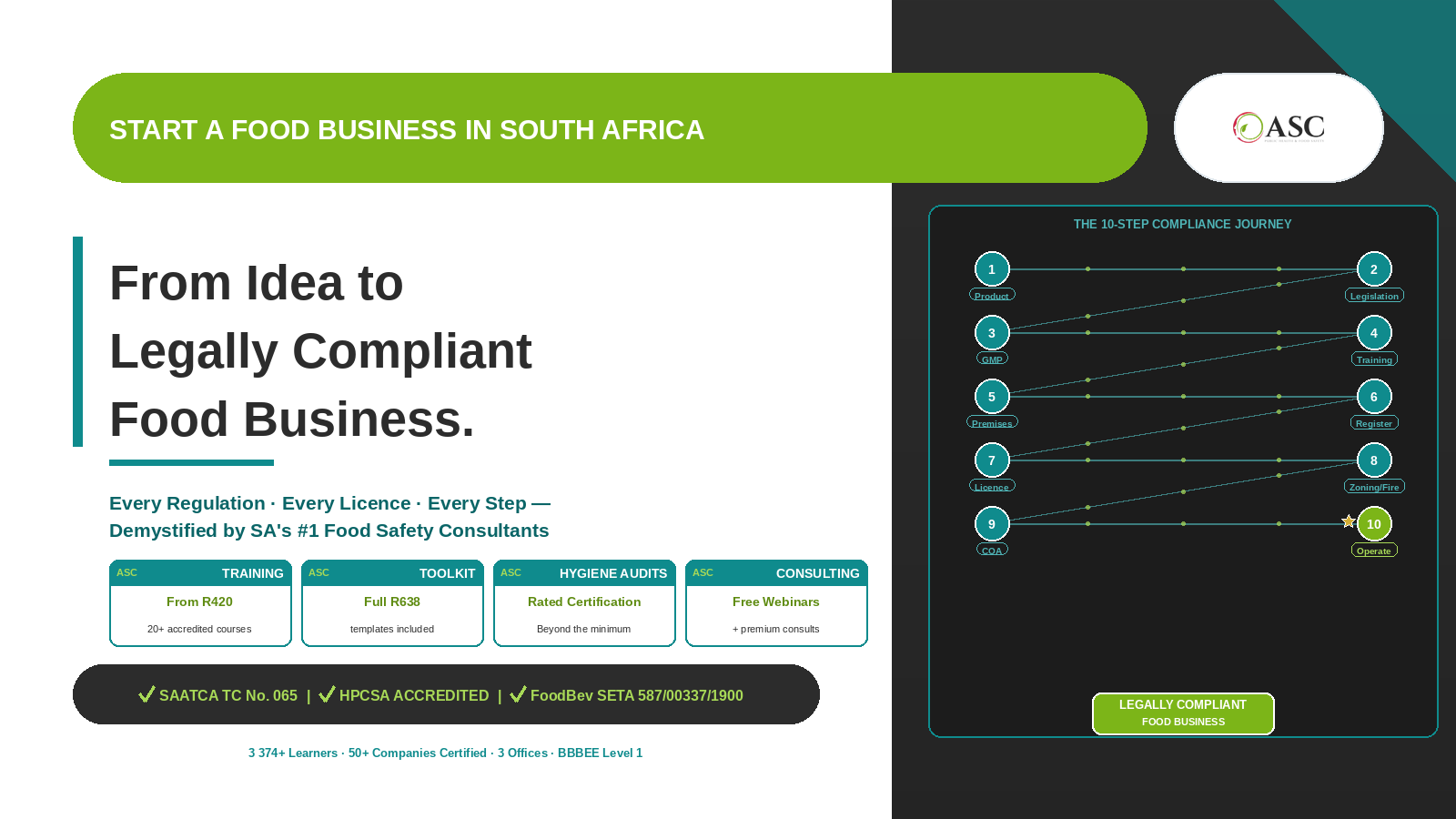
Whether you’re planning a home-based bakery, a food truck, a restaurant, a spaza shop, a packhouse, or a full manufacturing facility, this is the most complete, up-to-date, legally precise guide to launching a food business in South Africa in 2026. We’ll walk you through every regulation, every license, every permit and every certificate you’ll need, plus the accredited training that makes the whole process legal. No gaps. No guesswork. No fluff.
Quick AnswerTo start a legally compliant food business in South Africa you need 10 things: (1) a clearly defined product and process, (2) a CIPC-registered business, (3) compliance with Regulation R638 of 2018 (hygiene), (4) a Certificate of Acceptability (COA) from your municipality, (5) a Business License under the Businesses Act 71 of 1991, (6) a Zoning Certificate if premises aren’t zoned for business, (7) a Fire Compliance Certificate (SANS 10400-T), (8) a Gas CoC if using gas, (9) a Liquor License if selling alcohol, and (10) accredited food safety training for the Person in Charge and every food handler. Training under R638 Regulation 10 is not optional, you cannot get a COA without it. ASC Food Safety Consultants is the only triple-accredited (SAATCA + HPCSA + FoodBev SETA) training and consulting provider in South Africa, offering end-to-end startup support from R649.
1. Why Legal Compliance Is Non-Negotiable in 2026
South African food safety enforcement has sharpened dramatically in the last two years. In March 2025 the City of Tshwane closed a Boxer Superstore in Atteridgeville and fined Burger King outlets for operating without a valid Certificate of Acceptability (COA). The 2017 to 2018 Listeriosis outbreak, which killed over 200 South Africans, remains the world’s largest on record and is fresh in every regulator’s memory. November 2024 inspectors seized 1 059 fake-honey syrups and 388 mislabelled honey products in Johannesburg’s Crown Mines, Kempton Park, Laudium and Marabastad. The spaza shop registration drive of 2024 to 2025 is still closing non-compliant outlets weekly.
- Immediate closure by an Environmental Health Practitioner (no court order required)
- Criminal prosecution under Act 54 of 1972, fines and/or imprisonment
- Voided insurance, a single non-compliant premises nullifies most public liability cover
- Lost retailer listings and supplier contracts
- Civil liability under the Consumer Protection Act 68 of 2008 if a consumer is harmed
- Reputational destruction, one enforcement action makes social media and local news
Done right, compliance becomes a competitive advantage. A visibly displayed COA, an independent hygiene-audit certificate on the wall, and accredited training certificates for your team, together these signal professionalism to customers, suppliers and retailers. Let’s walk through exactly how to get there.
Step 1: Define Your Product, Ingredients & Processes
-
Know what you’re making and how
Everything downstream depends on being precise about your product. A hot sauce business, a take-away, a bakery and a meat processor face entirely different regulatory requirements. Map out:
- Ingredients: every ingredient, including allergens, additives (preservatives, antioxidants, colourings, flavourings, emulsifiers, sweeteners)
- Process: step-by-step from raw receipt to customer dispatch
- Shelf life: shelf-stable vs chilled vs frozen
- Heat treatment: pasteurisation, sterilisation, cooking, none
- Packaging: glass, plastic, paper, vacuum, modified atmosphere
- Sales channels: direct-to-consumer, retailer, export, food service, online
- Target market: local, national, regional, export
A process flow diagram and a product specification sheet are the two foundational documents. Our Basic Food Safety Documents Toolkit includes templates for both.
Opening or running a food business? You need a trained person in charge.
R638 requires the person in charge of the premises to be trained in food hygiene, and the EHP will ask for proof before issuing your Certificate of Acceptability. Our SAATCA registered and HPCSA CPD accredited online course gives you a verifiable certificate the day you pass: R1,699, done from your phone.
Start the Persons in Charge courseStep 2: Identify Every Applicable Law & Regulation
South African food legislation is managed by five national departments: Health (DoH), DALRRD (Agriculture), DTIC (Trade, Industry, Competition via SABS, NRCS, SANAS, NMISA), DFFE (Fisheries, Game, Environment), and local Municipalities. Here are the laws every food business must know:
The Acts
| Act | Administered By | Relevance |
|---|---|---|
| Foodstuffs, Cosmetics and Disinfectants Act 54 of 1972 | DoH | Parent Act, applies to EVERY food business |
| Agricultural Product Standards Act 119 of 1990 | DALRRD | Fresh produce, dairy, eggs, processed foods, honey |
| Meat Safety Act 40 of 2000 | DALRRD | Mandatory for meat, poultry, game operations |
| Marine Living Resources Act 18 of 1998 | DFFE | Commercial fishing, aquaculture, seafood |
| Businesses Act 71 of 1991 | Municipalities | Business license / trading permit |
| Consumer Protection Act 68 of 2008 | DTIC / NCC | Product liability, labelling, marketing |
| Occupational Health and Safety Act 85 of 1993 | Dept of Employment & Labour | Workplace safety in every food premises |
| National Health Act 61 of 2003 | DoH / Municipalities | Basis for Environmental Health Practitioner authority |
| Liquor Products Act 60 of 1989 | DALRRD | Wine, spirits, beer quality if selling liquor |
The Regulations That Apply to ALL Food Businesses
- Regulation R638 of 2018, General Hygiene Requirements, COA and training requirements (THE most important regulation, applies to every food business)
- Regulation R146 of 2010, Labelling & Advertising (being replaced by draft R3337 in 2026 with mandatory front-of-pack warning labels)
- Regulation R1425 of 2016, Miscellaneous additives
- Regulation R692 of 1997, Microbiological standards for foodstuffs
- Regulation R1555 of 1997, Microbiological standards
- Regulation R908 of 2003, HACCP (legally mandatory for peanut processors and RTE meat/poultry; contractually mandatory for most retailers)
Read our complete 5 800-word South African food legislation guide →
Step 3: Implement Good Manufacturing Practices (GMP)
GMP is the foundation of every food safety system. R638 and every HACCP-based scheme sit on top of GMP. The 13 GMP programmes every food business must implement:
Personal Hygiene
Handwashing stations, protective clothing, grooming, illness reporting, health checks.
Sanitation & Cleaning
Written cleaning schedule, approved chemicals, validated concentrations, verification.
Supplier Control
Approved supplier list, specifications, goods-receiving verification, non-conformance handling.
Temperature Control
Cold chain, cooking, cooling, holding, monitored with calibrated thermometers.
Storage (FIFO)
First-in-first-out, separation of raw/cooked, allergen segregation, off-floor storage.
Allergen Management
Allergen matrix, dedicated utensils, cleaning validation, label controls.
Pest Control
Licensed pest control operator, bait map, trend analysis, sighting log.
Raw Material Handling
Receipt inspection, COA review, quarantine, labelling, release protocols.
Cross-Contamination Prevention
Colour coding, dedicated zones, process flow separation, change-over cleaning.
Water Quality
Potable water supply, regular microbiological and chemical testing.
Waste Management
Segregated disposal, food waste separation, wastewater compliance.
Traceability & Recall
One-up-one-down traceability, mock recalls, recall procedure.
Record-Keeping
All monitoring documented, signed, dated, retained per legal minimum.
Step 4: Complete Accredited Food Safety Training
Training is not optional. Regulation 10 of R638 of 2018 makes it a legal requirement that:
- Regulation 10(1)(a), The Person in Charge must have completed accredited food safety training or hold an equivalent qualification (chef, food technologist, food scientist)
- Regulation 10(1)(b), Every food handler must receive regular documented basic food hygiene training
An Environmental Health Practitioner cannot issue a COA without evidence of compliant training. Choose an accredited provider.
ASC Food Safety Training is accredited by SAATCA (TC No. 065), HPCSA (Health Professions Council of SA), and FoodBev SETA (587/00337/1900), the only provider in South Africa with all three accreditations. Your certificate is recognised by every municipality, every retailer, every GFSI scheme and every export market. No questions asked.
The 3 Essential Training Options for Startups
Food Safety Practices for Persons in Charge (R638)
The flagship R638-compliant course. Covers R638 in full, GMP, personal hygiene, legislation, ISO 22000 fundamentals, HACCP principles, microbiology. This is what you need to satisfy Regulation 10(1)(a).
17 hours · Online self-paced · SAATCA + HPCSA · 4.77★
Basic Food Safety for Food Handlers
Satisfies Regulation 10(1)(b) for every kitchen, production, packing, warehouse and cleaning staff member. Compulsory for every food handler.
6 hours · Online self-paced · Accredited
Basic Food Hygiene Awareness
Budget-friendly entry-level awareness course for part-time staff, casual workers, waiters, delivery personnel and new hires.
4 hours · Online self-paced · Accredited
Save with the Basic Food Safety Courses Bundle
Get all three accredited courses together, FS01 Persons in Charge + FS02 Food Handlers + FS04 Basic Hygiene Awareness, at a bundle price. The complete training foundation for any food business startup.
View the Bundle Book a Free ConsultationStep 5: Design Compliant Premises & Equipment
Regulation 5 of R638 of 2018 governs premises. The key requirements:
Location & Layout
- Premises must not be near sources of contamination (waste sites, chemical plants, feedlots)
- Accessible for deliveries and Environmental Health inspections
- Smooth flow from receipt → storage → preparation → cooking → packing → dispatch
- Physical separation of raw and ready-to-eat areas
- Adequate ventilation, lighting, and ceiling height
- Handwashing facilities with hot water, soap and single-use towels at every workstation
- Toilets separated from food preparation areas with proper lobby
- Clear waste disposal area and washable refuse containers
- Pest-proofed, insect screens, sealed drains, proper door seals
Equipment & Food Contact Surfaces
- Food-grade, corrosion-resistant materials (stainless steel, food-grade plastics)
- Smooth, seamless, easy-to-clean surfaces
- No wood on food contact surfaces
- Calibrated thermometers in every refrigerator, freezer and cooking device
- Colour-coded utensils for raw vs ready-to-eat vs allergen-containing
- Regular maintenance schedule with documented records
Signing a lease on premises before checking R638 compliance and zoning. Premises that look perfect can fail Environmental Health inspection because of drain layout, ventilation, handwashing placement, or zoning rules. Always do a pre-lease R638 walkthrough, ASC offers affordable virtual pre-lease consultations.
Step 6: Register Your Business Legally
Before you approach any municipality for a COA or business license, your business must be legally constituted. The core registrations:
| Registration | Issued By | Typical Cost | Timeframe |
|---|---|---|---|
| Company registration (Pty Ltd) | CIPC | R175 | 1 to 5 days |
| Income Tax Number | SARS | Free | Same day |
| VAT registration (if turnover > R1M) | SARS | Free | 21 days |
| UIF registration | Dept of Employment & Labour | Free | 14 days |
| COIDA registration | Compensation Fund | Free | 30 days |
| BBBEE affidavit (EME/QSE) | Commissioner of Oaths | Free | 1 day |
| Public liability insurance | Insurer | R250 to R1 500/mo | 1 to 7 days |
Step 7: Obtain Your Business License
The Businesses Act 71 of 1991 requires a business license before trading if you:
- Sell food for on-site or off-site consumption
- Sell any perishable food
- Operate as a restaurant, café, takeaway, food truck, caterer or bakery
Hawkers and informal traders apply for a trading permit from their local municipality instead. Following the 2024 to 2025 spaza shop registration drive, informal traders must register with their municipality and meet R638 basics.
It is a criminal offence to trade without a valid business license under the Businesses Act. Municipalities are actively enforcing this, closures, fines and prosecutions are common. Apply before opening your doors, not after.
Step 8: Zoning, Fire, Gas & Liquor Certificates
Zoning / Rezoning Certificate
Required if your premises aren’t already zoned for business use (e.g. home-based kitchen). Administered by the municipality’s Spatial Planning & Land Use Management Department. Requires input from Public Health and Transport. Neighbours have a say in residential areas.
Cost: R500 to R2 500
Fire Compliance Certificate
Mandatory under SANS 10400-T (2020) fire safety regulations. Issued after on-site inspection. Must be renewed annually. Required for most insurance cover in the event of a fire.
Cost: R300 to R1 800 · Renewal: annual
Gas Installation Certificate of Compliance
Required if you use permanent gas installations (cookers, ovens, water heaters). Must be issued by an installer registered with the South African Qualification & Certification Committee for Gas (SAQCC Gas). Non-negotiable for insurance.
Cost: R400 to R2 500 depending on installation
Liquor License
If you plan to sell or manufacture alcohol, apply through your provincial Liquor Authority. Different licenses for on-consumption (restaurant), off-consumption (retail) and manufacture. Process takes 3 to 12 months.
Cost: R2 000 to R50 000 depending on province & license type
Signage Permit
External business signage typically requires a signage permit from the municipality, especially for illuminated or large signs. Penalties for non-compliant signs are routine.
Cost: R200 to R1 500
Trade Effluent Permit (if applicable)
Abattoirs, dairies, breweries, large kitchens may need a trade effluent permit under the Water Services Act 108 of 1997. Small food businesses usually don’t but always confirm with your municipality.
Step 9: Apply for Your Certificate of Acceptability (COA)
The Certificate of Acceptability is your license to legally handle food in South Africa. Issued under Regulation R638 of 2018 by your municipality’s Environmental Health Practitioner.
The COA Application Process
-
Prepare your compliance documentation
Food safety policy, GMP procedures, training certificates, process flow diagram, supplier list, cleaning schedule, pest control contract, approved supplier records. Our Basic Food Safety Documents Toolkit gives you every template.
-
Complete the COA application form
Download from your municipality’s website or collect from the Environmental Health office. Provide premises address, Person in Charge details, training certificates, business registration details.
-
Submit your application with supporting documents
Include ID copy of Person in Charge, training certificates, proof of business registration, lease or ownership, process flow, menu (if restaurant).
-
Pay the application fee
R200 to R650 depending on municipality. The fee varies, Cape Town, Johannesburg, Tshwane, Ekurhuleni, eThekwini, Nelson Mandela Bay, Buffalo City and Mangaung each publish their own fee schedule.
-
EHP on-site inspection
The Environmental Health Practitioner visits the premises to inspect for R638 compliance, structure, flow, hygiene controls, training, waste, pest control, and mitigation of contamination risks from surrounding areas.
-
Remediation if needed
If gaps are identified, you have a period (usually 14 to 60 days) to remediate. The EHP may return for re-inspection.
-
COA issued, display visibly
Once compliance is confirmed, the COA is issued. It must be displayed in a public-visible location or immediately available upon request. Cannot be transferred between persons or premises. Must be updated on change of Person in Charge, major renovation, or business change.
Read our complete municipality-by-municipality COA guide covering all 8 metros →
Step 10: Operate, Audit & Continuously Improve
Compliance doesn’t end when doors open. Every successful food business must:
- Keep the COA current and visible
- Complete annual hygiene audits (even when not strictly required, they protect your brand)
- Provide refresher training to the Person in Charge and food handlers
- Stay informed about regulatory updates (the 2026 R3337 labelling regulations are coming)
- Maintain all records, monitoring logs, cleaning schedules, pest control, supplier approvals
- Investigate customer complaints with proper root cause analysis
- Implement corrective and preventive actions
- Prepare for unannounced Environmental Health and by-law inspections
- Scale up to HACCP / FSSC 22000 / BRCGS as you grow and supply bigger customers
How ASC Helps You, End-to-End Services
ASC Food Safety Consultants is uniquely positioned to support you through every step of your food business journey. We’re not just a training provider, we’re a complete food safety consultancy. Here’s what sets us apart:
Accredited Training (20+ Courses)
SAATCA, HPCSA and FoodBev SETA accredited courses from basic food hygiene through advanced HACCP, FSSC 22000, BRCGS, GLOBALG.A.P. implementation.
Basic Food Safety Documents Toolkit
Ready-to-customise templates for every small-business R638 requirement, policy, procedures, checklists, traceability, supplier control, cleaning schedule and more.
Get the ToolkitIndependent Food Hygiene Audits
Third-party hygiene audits with a certified rating system, used by restaurant chains, hotel groups, hospitals and corporate cafeterias across SA. Go beyond the legal minimum.
Learn MoreFSMS & Food Science Consulting
Full Food Safety Management System implementation, HACCP, ISO 22000, FSSC 22000, BRCGS, GLOBALG.A.P., including gap analysis, implementation support, mock audits.
Book ConsultVirtual Consultation Bookings
1-hour virtual consultations including virtual site walk-throughs. Practical advice on premises design, regulatory fit, training requirements, COA preparation.
Book NowFree Startup Webinars
Bi-weekly free live webinars covering how to start a food business in SA. Ask your questions directly. Limited seats, very popular.
Get the LinkAccredited Training Options for Startups, Summary
| Course | Who It’s For | Duration | Price |
|---|---|---|---|
| FS01 Persons in Charge (R638) | Business owner, manager, Person in Charge | 17 hours | R1 650 |
| FS02 Food Handlers | Every kitchen / production staff member | 6 hours | R649 |
| FS04 Basic Food Hygiene Awareness | Part-time staff, waiters, casual workers | 4 hours | R420 |
| FS28 Spaza Shops, Vendors & Informal Traders | Informal traders post 2024 to 2025 registration drive | 3.5 hours | R879 |
| FS33 Implementation of GMP | Once you have basics, build your GMP programmes | 12 hours | R1 950 |
| FS07 Introduction to HACCP | For manufacturers and retailers-supplying businesses | 8 hours | R1 195 |
Start Your R638 Training Today, R1 650
17 hours of SAATCA + HPCSA CPD accredited content. Online self-paced. QR-verified certificate. Everything you need to satisfy Regulation 10(1)(a) and apply for your COA.
Enrol in FS01, Persons in Charge View All CoursesThe Basic Food Safety Documents Toolkit, Your Compliance Shortcut
Building R638 documentation from scratch is overwhelming. ASC’s Basic Food Safety Documents Toolkit is a ready-to-use library of editable templates designed specifically for small food businesses applying for a COA:
- Food Safety Policy
- Hygiene Code of Conduct
- Personal Hygiene Procedure and Checklist
- Cleaning & Sanitation Schedule and Records
- Supplier Approval and Monitoring
- Good Manufacturing Practices Checklist
- Temperature Monitoring Records
- Pest Control Register
- Traceability System
- Training Register
- Complaint Handling and Corrective Action Form
- Allergen Matrix and Management Procedure
- Process Flow Diagram Template
- Product Specification Sheet
- Mock Recall Procedure
Each template is ready to be personalised with your business name and specifics, saving you 40 to 60 hours of document development work. Delivered instantly as downloadable files.
Hygiene Audits, Going Beyond the Legal Minimum
A COA is the legal minimum. A third-party hygiene audit with a public rating certificate is what separates professional food businesses from the crowd.
ASC conducts thorough, evidence-based hygiene audits for:
- Restaurant chains wanting consistent standards across outlets
- Hotel and hospitality groups
- Hospitals and healthcare facilities with on-site catering
- Corporate cafeterias and canteens
- Schools, universities and student residences
- Retirement homes and care facilities
- Food manufacturers preparing for FSSC 22000 or BRCGS certification
- Suppliers to major retailers (pre-audit readiness)
- Companies that want to prevent foodborne illness outbreaks proactively
Our audits use modern, practical, evidence-based methods. Our certified rating system allows businesses to display independent verification of their hygiene standards, a powerful trust signal for customers, guests, patients and B2B buyers.
Read our detailed article on the ASC hygiene audit process and rating system →
Why ASC Is the #1 Partner for New Food Businesses in SA
The ASC Track Record
| Feature | ASC Food Safety | Typical Competitors |
|---|---|---|
| Triple accreditation (SAATCA + HPCSA + FoodBev SETA) | ✓ Only provider in SA | Usually one only |
| Registered Lead Auditor (Exemplar Global & IRCA) | ✓ Founder | Rare |
| SAATCA R638:2018 Lead Implementer | ✓ 1 of 3 in SA | No |
| Full range: training + toolkits + audits + consulting | ✓ | Usually one service |
| Covers micro/spaza to FSSC 22000 manufacturing | ✓ Full spectrum | One segment only |
| Price range starts at R420 | ✓ Accessible | Usually R1 500+ |
| Offices: Gqeberha · Randburg · Cape Town | ✓ 3 offices | Usually 1 |
| BBBEE Level 1 (135% procurement recognition) | ✓ | Usually lower |
| Free bi-weekly webinars | ✓ | Paid only |
Frequently Asked Questions
What licenses do I need to start a food business in South Africa?
Nine documents: CIPC registration, SARS tax, Business License (Businesses Act 71 of 1991), Certificate of Acceptability (COA under R638), Zoning Certificate (if needed), Fire Compliance Certificate (SANS 10400-T), Gas CoC (if using gas), Liquor License (if selling alcohol), and accredited food safety training certificates for Person in Charge and all food handlers.
Can I start a food business from home?
Yes, with a COA, zoning approval, R638-compliant kitchen area separated from family living space, R638 training, a Business License and possibly neighbour consent. Home businesses are legal but scrutinised closely during inspection. See our home-based food business guide.
How long does the whole startup process take?
Realistically 2 to 6 months depending on municipality responsiveness and premises readiness. CIPC takes days, training 1 to 3 weeks, premises prep 2 to 8 weeks, COA application 2 to 8 weeks. Liquor licenses alone can add 3 to 12 months.
What’s the minimum I can spend to be legally compliant?
In addition to premises and equipment, minimum compliance costs typically run R5 000 to R15 000: FS01 Persons in Charge training (R1 650), FS04 hygiene awareness for a handler or two (R420 per person), Basic Food Safety Documents Toolkit, COA application fee, Business License, Fire Certificate, and public liability insurance.
Do food trucks need a COA?
Yes. Food trucks fall under R638 and need a COA just like any other food handling premises. Additional requirements include mobile-specific permits from the municipality. See our food truck startup guide.
Are spaza shops required to register?
Yes, following the 2024 to 2025 spaza shop registration drive, all informal traders must register with their municipality and meet basic R638 requirements. ASC’s FS28 course is specifically designed for the spaza shop market.
What is the cheapest accredited training option?
ASC’s FS04 Basic Food Hygiene Awareness course at R420 is the most accessible accredited training in South Africa, perfect for entry-level staff, waiters, delivery personnel and casual workers. For the Person in Charge, FS01 at R1 650 is required.
Can I run my food business while waiting for my COA?
No. Trading without a valid COA is a criminal offence under Act 54 of 1972. An Environmental Health Practitioner can close the premises on the spot. Wait until your COA is issued before opening to the public.
Do I need HACCP to start my food business?
Legally only if you process peanuts or produce ready-to-eat meat/poultry (Regulation R908). But if you intend to supply retailers (Shoprite, Pick n Pay, Woolworths, Spar, Checkers) or export, HACCP is contractually required. Plan for it from the start.
How can ASC help me specifically?
Book a virtual consultation, 1 hour with a Registered Lead Auditor, virtual walk-through of your premises, and a personalised action plan. Or join our free webinar for group discussion. We’ll match you with the right training, toolkit, hygiene audit, or FSMS consulting package for your specific startup.
Start Today, Every Day of Delay Costs You Money
Launch Your Legally Compliant Food Business with ASC
Training · Toolkits · Audits · Consulting · All under one roof. SAATCA + HPCSA + FoodBev SETA accredited. Trusted by 3 374+ learners and 50+ companies including KFC, Spur and major SA food manufacturers.
Start with R638 Training, R1 650 Book a Free ConsultationPrefer to talk it through? Join our free bi-weekly webinar or call your nearest office
Gqeberha (Head Office): +27 41 004 0382 · Randburg: +27 10 500 4661 · Cape Town: +27 21 300 4024 · info@ascfoodsafety.com
Last reviewed: 24 April 2026 · © 2026 ASC Food Safety Consultants · SAATCA TC No. 065 · HPCSA CPD accredited · FoodBev SETA 587/00337/1900 · BBBEE Level 1. This guide is educational and does not constitute legal advice. Verify current requirements with your municipality and relevant government department, or consult ASC directly.
Accredited online training
Train your team for R638
The EHP will ask who is in charge and how your staff were trained. Our accredited online courses cover both, and your people can start today. Teams of 5 or more get 10% off, and 10 or more get 15% off, on one invoice.
See all online courses and prices or WhatsApp us for a team quote
Key facts
- Legal compliance is non-negotiable: a business needs a CIPC registration, a Business License under the Businesses Act 71 of 1991, and a Certificate of Acceptability (COA) from the municipality before trading.
- All South African food businesses must comply with Regulation R638 of 2018, which covers general hygiene, the COA, and mandatory food safety training.
- The Person in Charge and every food handler must complete accredited food safety training under Regulation 10 of R638.
- Depending on the setup, you may also need a Zoning Certificate, Fire Compliance Certificate (SANS 10400-T), Gas Certificate of Compliance, and a Liquor License.
- The COA requires a documented food safety system plus an on-site inspection by an Environmental Health Practitioner, with the certificate displayed visibly and non-transferable.
- The article estimates the full startup process realistically takes 2 to 6 months, depending on municipal responsiveness and premises readiness.
Frequently asked questions
What licenses do I need to start a food business in South Africa?
You need several key documents: CIPC business registration, a SARS tax number, a Business License under the Businesses Act 71 of 1991, and a Certificate of Acceptability (COA). Depending on your premises and products you may also need a Zoning Certificate, Fire Compliance Certificate, Gas Certificate of Compliance, a Liquor License, and accredited food safety training certificates.
Do I need a Certificate of Acceptability (COA) to trade?
Yes. The COA is issued by your municipality and is mandatory under Regulation R638 of 2018 before you can legally operate food premises. It requires documented food safety procedures plus an on-site inspection by an Environmental Health Practitioner, and it must be displayed in a public-visible location. It cannot be transferred between people or premises.
Can I run my food business while waiting for my COA?
No. According to the article, trading without a valid COA is a criminal offence under the Foodstuffs, Cosmetics and Disinfectants Act 54 of 1972. An Environmental Health Practitioner can order immediate closure without a court order, so you should secure your COA before opening.
Can I start a food business from home in South Africa?
Yes, home food businesses are legal but are scrutinised closely. The article states you still need a COA, zoning approval, an R638-compliant kitchen that is separated from your living space, accredited training, and a Business License.
How long does it take to start a compliant food business?
Realistically, the article estimates the full startup process takes 2 to 6 months. The timeline depends largely on how responsive your municipality is and how ready your premises are for inspection.
Who needs food safety training, and is it a legal requirement?
Training is a legal requirement under Regulation 10 of R638. The Person in Charge must complete accredited training or hold an equivalent qualification such as chef, food technologist, or food scientist, and every food handler must receive regular, documented basic food hygiene training.