
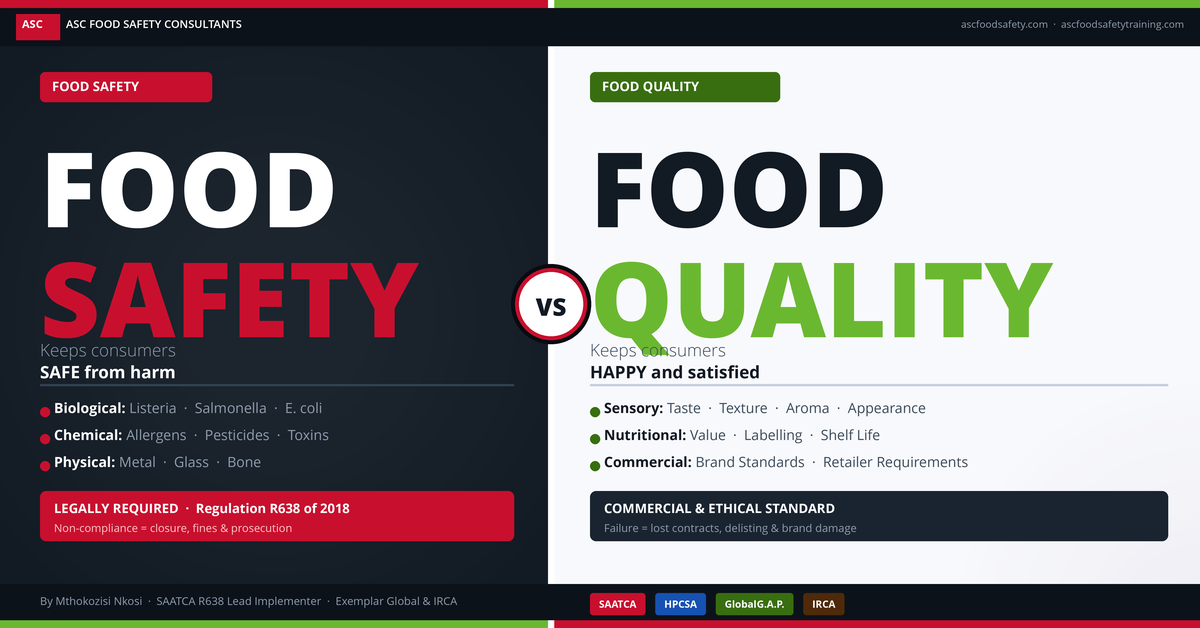
Many South African food business owners use the terms "food safety" and "food quality" interchangeably. They are not the same thing. One determines whether your food can harm a consumer. The other determines whether they enjoy it, come back for more, and recommend your business. One is a legal obligation enforced through Regulation R638, the Consumer Protection Act, and municipal inspections. The other is a commercial and ethical standard that protects your brand, your market access, and your long-term business viability. Understanding the difference — and managing both — is what separates food businesses that grow from those that face fines, recalls, and closures.
Food safety is the science and practice of ensuring food does not cause harm to the consumer. It eliminates, reduces, or controls biological, chemical, and physical hazards throughout the food chain — from farm to fork. In South Africa, food safety is governed by Regulation R638 of 2018 and the Foodstuffs, Cosmetics and Disinfectants Act 54 of 1972. A food safety failure can kill people. It can result in business closure, criminal prosecution, fines exceeding R1 million, and permanent reputational damage.
Food quality refers to the characteristics of a food product that determine its acceptability to consumers — taste, texture, appearance, colour, aroma, nutritional value, shelf life, and consistency. Quality standards are set by product specifications, brand guidelines, retail buyer requirements, and consumer expectations. A food quality failure disappoints consumers and damages brand reputation. A product can be safe but poor quality. A product that is unsafe, however, is automatically of unacceptable quality.
The Precise Definitions — What Food Safety and Food Quality Actually Mean
The Codex Alimentarius Commission — the joint FAO/WHO body that establishes international food standards and whose guidelines underpin South Africa's R638 and all GFSI food safety standards — defines food safety as the assurance that food will not cause harm to the consumer when it is prepared and/or eaten according to its intended use. This definition has three critical elements: assurance (not hope or assumption), harm (physical injury, illness, or death), and intended use (the product must be safe when consumed as designed).
Food quality, by contrast, is defined by the characteristics of a food product that are acceptable to consumers and meet their expectations. These include both extrinsic attributes — size, colour, shape, consistency, and packaging — and intrinsic attributes — taste, texture, aroma, nutritional value, and microbial load within acceptable commercial limits. Unlike food safety, quality attributes are product-specific, market-specific, and consumer-specific. What constitutes acceptable quality for an export-grade citrus packhouse supplying European supermarkets is not the same as what constitutes acceptable quality for a community spaza shop in Soweto. Food safety requirements, however, are universal.
The Three Categories of Food Safety Hazards — The Science Behind Safety Management
Food safety management is built on the systematic identification and control of three categories of hazard. Every food safety management system — from basic R638 compliance to FSSC 22000 certification — begins with understanding these categories and how they interact with your specific food products and processes.
| Hazard Type | Definition | South African Examples | Control Measures |
|---|---|---|---|
| Biological | Microorganisms that cause foodborne illness — bacteria, viruses, moulds, yeasts, and parasites | Listeria monocytogenes (found in BM Foods hummus, recalled by Shoprite Checkers 2024) · Salmonella (common in poultry, eggs) · Campylobacter (undercooked chicken) · E. coli O157:H7 · Aflatoxins from Aspergillus moulds (peanuts, maize) — ButtaNutt peanut butter recalled Feb 2025 · Hepatitis A virus | Temperature control (≤5°C cold, ≥75°C cooking) · HACCP CCP monitoring · Personal hygiene · FIFO stock rotation · Supplier control · Environmental monitoring |
| Chemical | Substances that contaminate food and cause illness — either acute or chronic | Pesticide residues on fresh produce (key concern for EU export compliance) · Cleaning chemical residues · Allergens (undeclared nuts, gluten, sulphites) · Heavy metals — lead, cadmium, mercury · Mycotoxins — aflatoxin, ochratoxin · Migration from food contact packaging · Veterinary drug residues in meat | Allergen management programmes · Chemical storage segregation · Approved pesticide lists · Supplier audit and COA verification · HACCP allergen CCPs · Validated cleaning procedures |
| Physical | Foreign objects that enter food and cause physical injury to the consumer | Glass fragments (broken light fittings above production lines) · Metal fragments (equipment wear, CIP equipment failure) · Bone fragments (meat processing) · Plastic from packaging · Stone and field debris (grain, dried fruit processing) · Wood and pests (rodent contamination) | Metal detection · X-ray inspection systems · Magnets on product lines · Rigorous equipment maintenance · Light fitting covers · Sieving and filtration · Foreign body incident reporting systems |
The Dimensions of Food Quality — What Consumers Are Actually Evaluating
While food safety is binary — food is either safe or it is not — food quality is multi-dimensional, contextual, and partly subjective. Understanding the dimensions of quality is essential for food businesses that want to compete effectively in South Africa's increasingly sophisticated food market, where consumer expectations have been shaped by exposure to international food brands, rising nutritional awareness, and the growing influence of food retail chains with demanding supplier quality requirements.
Sensory Attributes — The Consumer's First Encounter
The sensory evaluation of food — what the consumer sees, smells, tastes, hears (think crunch), and feels in their mouth — constitutes the most immediate quality signal. Colour deviation (a brown banana vs a yellow one), off-odours in meat products, an unexpected bitter note in a confectionery product, or a limp texture in a product that should be crisp are all quality failures that have nothing to do with safety but everything to do with consumer satisfaction, repeat purchase, and brand loyalty.
Intrinsic Quality Attributes
- Taste and flavour profile: Consistency of flavour across production batches is a significant quality control challenge, particularly for processed and value-added products where multiple ingredients and processes interact.
- Texture and mouthfeel: Critical for baked goods, dairy, confectionery, and meat products — texture defines whether a product meets consumer expectations for the category.
- Nutritional composition: The accuracy of nutritional labelling is both a quality and a food safety matter. The Heartland Foods cereal recall by Shoprite in March 2025 — triggered by inaccurate nutritional labelling — demonstrates that labelling errors sit at the intersection of quality and safety: a consumer with diabetes relying on incorrect sugar content information faces a genuine health risk.
- Shelf life and stability: A product that deteriorates faster than its stated shelf life is a quality failure. One that deteriorates to the point of becoming a food safety risk has crossed from quality into safety territory.
Extrinsic Quality Attributes
- Appearance and presentation: Size uniformity, colour consistency, surface integrity, and absence of visible defects. Critical for fresh produce, baked goods, and premium food products.
- Packaging integrity: Damaged, incorrectly sealed, or non-compliant packaging is a quality defect that can also create a safety risk if the packaging breach allows contamination.
- Labelling accuracy: Under the Consumer Protection Act and the Foodstuffs, Cosmetics and Disinfectants Act, labelling inaccuracies constitute both a quality failure and a legal compliance failure. Undeclared allergens in particular convert a labelling quality issue into a potentially life-threatening safety failure.
| Dimension | Food Safety | Food Quality |
|---|---|---|
| Primary concern | Preventing harm to the consumer — illness, injury, death | Satisfying consumer expectations — taste, appearance, consistency |
| Measurement | Objective — microbiological counts, chemical residue levels, physical contaminant presence | Both objective (nutritional values, pH, water activity) and subjective (taste panel scores, consumer feedback) |
| Legal status in SA | Mandatory — Regulation R638, FCD Act 54/1972, Consumer Protection Act | Partially regulated — Consumer Protection Act, labelling regulations, product-specific standards |
| Failure consequence | Business closure, fines, prosecution, recalls, death and injury claims, imprisonment | Consumer complaints, returns, brand damage, retailer delisting, contract loss |
| Primary tools | HACCP, GMPs, PRPs, FSMS, environmental monitoring, temperature control | Quality specifications, sensory panels, QC testing, statistical process control |
| Who sets standards | Government (DAFF, DOH), municipalities, international bodies (Codex, GFSI) | Retailers, brands, consumer expectations, industry standards, export market requirements |
| Key SA frameworks | R638, ISO 22000, FSSC 22000, BRCGS, HACCP, SANS 241 | Product specifications, retailer quality codes, GlobalG.A.P. (fresh produce), export market standards |
| Universality | Universal — applies identically regardless of consumer, market, or product tier | Context-dependent — varies by product, consumer segment, market, and price point |
Where Food Safety and Food Quality Intersect — And Why Both Must Be Managed Together
Despite their differences, food safety and food quality are inseparable in practice. The systems, facilities, personnel, and culture that produce safe food are the same ones that produce high-quality food. A production environment with inadequate temperature control will produce food that is both unsafe (pathogen growth risk) and poor quality (premature spoilage, texture breakdown, off-flavour development). A cleaning programme that is insufficient to eliminate Listeria from a food contact surface is simultaneously a food safety failure and a quality failure.
This convergence is why the world's most sophisticated food safety management frameworks — FSSC 22000, BRCGS, ISO 22000, and GFSI — address both safety and quality management simultaneously. A certified food business is not simply one that avoids poisoning its customers. It is one that has a systematic, documented, and continuously improving approach to delivering food that is both safe and consistently excellent.
Food Safety as a Legal Obligation in South Africa — What the Law Actually Requires
Food safety in South Africa is not optional, aspirational, or best practice. It is a legal obligation backed by enforcement mechanisms that include fines, closure orders, criminal prosecution, and — as recent National Consumer Commission actions demonstrate — referral to the National Consumer Tribunal for penalties exceeding R1 million.
Regulation R638 of 2018
The Regulations Governing General Hygiene Requirements for Food Premises, the Transport of Food and Related Matters (Regulation R638, Government Gazette 41730, 22 June 2018) is the primary national food safety legislation governing all South African food premises. It applies to every business that handles, prepares, processes, stores, serves, or sells food — from a Sandton restaurant and a Cape Town wine estate to a Gqeberha canteen and a North West mine camp kitchen.
The regulation's most operationally critical requirements include:
- Section 10(1)(a): The person in charge of any food premises must hold a valid SAATCA- or HPCSA-accredited food safety training certificate. This is a non-negotiable prerequisite for a Certificate of Acceptability (COA).
- Section 10(1)(b): All food handlers must receive basic food hygiene training from a registered provider.
- Structural hygiene requirements for food premises — floors, walls, drainage, lighting, ventilation, pest exclusion
- Temperature control requirements for chilled (≤5°C) and hot-held (≥60°C) food
- Pest control — documented programme with a registered pest control operator
- Personal hygiene standards for all food handlers
- Potable water supply, waste management, and cleaning and sanitation requirements
Need the R638 training certificate for your COA application?
ASC Food Safety Consultants' HPCSA-accredited R638 Persons in Charge Course is accepted by all South African municipalities. Self-paced, online, from anywhere in South Africa — QR-coded certificate available immediately on passing at ascfoodsafetytraining.com.
The Consumer Protection Act 68 of 2008
Section 55 of the CPA gives South African consumers the right to receive goods that are safe, of good quality, and free from defects. In the food context, this means a product that causes illness, injury, or death due to contamination, or that fails to meet the quality and safety representations made on its label, constitutes a breach of consumer rights. The National Consumer Commission is empowered to investigate, and the National Consumer Tribunal is empowered to impose penalties. The BM Foods hummus recall — which resulted in R1 million-plus fines — proceeded under exactly this framework.
The Foodstuffs, Cosmetics and Disinfectants Act 54 of 1972
This Act governs the manufacture, sale, and import of foodstuffs and provides the regulatory basis for R638. It prohibits the sale of food that is injurious to health, that is adulterated, or that is not of the nature, substance, or quality demanded by the purchaser. Violations carry criminal penalties.
International Food Safety and Quality Standards Operating in South Africa
For food businesses supplying major retailers, exporting to international markets, or seeking formal Food Safety Management System certification, several international standards apply — each addressing both safety and quality dimensions through a structured, audited framework.
Combines ISO 22000:2018 with sector-specific PRPs (ISO/TS 22002-100:2025) and FSSC-specific requirements. Version 6 introduced mandatory food safety culture requirements. Most widely adopted GFSI scheme globally. Required by major SA retailers and for EU/UK export markets. ASC Food Safety Consultants implements and provides pre-certification support.
Originally developed by the British Retail Consortium. Issue 9 current. Widely required for UK and European retail supply chains — critical for South African wine estates, citrus exporters, and processed food manufacturers targeting these markets. Prescriptive standards covering safety, quality, and legal compliance.
International standard for Food Safety Management Systems. Integrates HACCP with ISO management system principles. Flexible — suitable for any organisation in the food chain. Forms the backbone of FSSC 22000. ASC Food Safety Consultants designs and implements ISO 22000 systems tailored to South African operations.
Globally recognised standard for primary agricultural production — citrus, grapes, vegetables, deciduous fruit. Required for supply to major European and UK retailers. Mthokozisi Nkosi is a Registered GLOBALG.A.P. Trainer — one of very few in South Africa.
Hazard Analysis and Critical Control Points. The scientific foundation of all food safety management. Mandatory within every GFSI scheme. First introduced in 1959; adopted internationally as the primary preventive food safety tool. Available as a standalone training course and full implementation service from ASC.
South Africa's primary food hygiene regulation. Applies to all food premises nationally. Enforced by municipal Environmental Health Practitioners. COA application requires compliance. Training certificate required under Section 10(1)(a) — available at ascfoodsafetytraining.com.
HACCP — The Bridge Between Food Safety and Quality Management
HACCP (Hazard Analysis and Critical Control Points) is the most important food safety tool available to South African food businesses, and it is fundamentally misunderstood by a large proportion of the businesses that operate it. HACCP is not a checklist. It is not a document. It is not a training certificate. It is a systematic, science-based approach to identifying where, in your specific production process, with your specific products and ingredients, food safety hazards can occur — and establishing documented, monitored controls to prevent or eliminate those hazards before they reach the consumer.
The seven HACCP principles are:
- Conduct a hazard analysis — identify all biological, chemical, and physical hazards relevant to your products and processes
- Identify Critical Control Points (CCPs) — the steps in the process where control is essential to prevent or eliminate a food safety hazard to acceptable levels
- Establish critical limits — the measurable boundary (temperature, pH, water activity, time) that distinguishes safe from unsafe at each CCP
- Establish monitoring procedures — how, how often, and by whom each CCP is measured and recorded
- Establish corrective actions — what happens when a CCP deviation occurs, including who is responsible and how affected product is controlled
- Establish verification procedures — how the HACCP system is confirmed to be working effectively over time
- Establish documentation and record-keeping — the evidence trail that demonstrates the system is operational
Real-World South African Examples — When Safety and Quality Diverge
Listeria in Certified Hummus: When FSSC 22000 Is Not Enough
BM Foods, a hummus supplier to Shoprite Checkers, held a valid FSSC 22000 food safety management system certificate when Listeria monocytogenes was detected in three batches of Deli Hummus in September 2024. The product was visually normal — a quality assessment would have detected nothing wrong. The contamination was invisible, odourless, and tasteless, identifiable only by microbiological testing. This is the defining characteristic of biological food safety hazards: they operate outside the consumer's sensory ability to detect them. A certification is the record of your system at audit time. What happens in that production environment between audits determines whether Listeria finds its way into a product. The NCC has referred the matter to the National Consumer Tribunal, with fines exceeding R1 million sought.
Labelling Inaccuracies: Where Quality Becomes a Safety Issue
Shoprite, Checkers, Usave, and OK Foods voluntarily recalled all cereals manufactured by Heartland Foods in March 2025 due to inaccurate nutritional labelling. Some products contained higher sugar levels than stated — a safety risk for diabetic consumers who relied on label data to manage their condition. This is the precise intersection of quality and safety: a product that is microbiologically safe, that looks and tastes as expected, that has no biological, chemical, or physical contamination — but whose inaccurate label creates a safety risk for a specific consumer group. It demonstrates that food quality management (labelling accuracy) directly intersects with food safety management (protecting vulnerable consumer groups).
Food Safety Culture — The Human Factor Behind Both Safety and Quality
FSSC 22000 Version 6 introduced food safety culture as a mandatory certification requirement for the first time in 2023. This reflects a fundamental truth that experienced food safety practitioners have always known: systems, documentation, and technology are necessary but not sufficient for genuine food safety performance. The critical variable is the behaviour of people — every person who handles food, manages a process, cleans a surface, receives a delivery, or records a temperature reading.
A food safety culture is the shared values, beliefs, and norms that shape food safety behaviour across an organisation — regardless of who is watching. In a business with a genuine food safety culture, food handlers wash their hands correctly because they understand why it matters, not because a manager is present. A production supervisor rejects an out-of-specification batch because they understand the consumer risk, not because a policy document requires it. A food safety culture is what produces consistent quality and safety performance across all shifts, all seasons, and all staffing configurations.
ASC Food Safety Consultants offers a dedicated Food Safety and Quality Culture Course through ascfoodsafetytraining.com, providing management teams and supervisors with the framework to diagnose their current culture maturity and design programmes that embed safety behaviours organisation-wide.
What South African Food Businesses Must Do — A Practical Action Framework
Understanding the difference between food safety and quality is the starting point. The following framework outlines what every South African food business — from a Sandton restaurant and a Cape Town wine estate to a Gqeberha packhouse and a Durban food manufacturer — must have in place to manage both effectively.
Food Safety Baseline Requirements (All Food Businesses)
Food Quality and Food Safety Elevation (Suppliers, Manufacturers, Exporters)
How ASC Food Safety Consultants Helps — Services That Bridge Safety and Quality
ASC Food Safety Consultants (previously ASC Consultants) is South Africa's leading specialist food safety consulting, training, and auditing firm. With offices in Gqeberha (head office), Johannesburg, and Cape Town, and an accredited online training platform at ascfoodsafetytraining.com, ASC provides every service required to build, implement, verify, and certify food safety and quality management systems across South Africa's nine provinces.
Mthokozisi Nkosi is one of only three SAATCA R638 Lead Implementers in South Africa — publicly verifiable at saatca.co.za/registered-implementers/
Dual SAATCA and HPCSA accreditation — maximum recognition for COA applications across all South African municipalities
Registered Lead Auditor — Exemplar Global and IRCA — the qualifications that qualify ASC to conduct and prepare for third-party food safety certification audits
Registered GLOBALG.A.P. Trainer — one of very few in South Africa — covering fresh produce, citrus, and farm-level food safety for export markets
Registered Assessor (F01/585/ASR00067) — formal SETA recognition for food and beverage sector training delivery
Professional Member, South African Association for Food Science and Technology — peer community recognition of scientific and technical expertise
3,374+ students trained · 50+ companies guided to food safety compliance and certification · Major clients: KFC Africa, SPUR Corporation, McCain Foods, ABInBev, TotalEnergies
Food safety expert commentary for Daily Maverick, SABC News, eNCA, and Carte Blanche — the recognised national voice on South African food safety
Independent, scored food hygiene audit with 5-star rating. Goes beyond R638 legal minimum — detailed findings report, prioritised corrective action plan, publicly verifiable certification. Annual subscription from R9,500/year.
Request a Hygiene Audit →Full HACCP study from hazard analysis to CCP monitoring design — tailored to your specific products, processes, and operating environment. For manufacturers, caterers, distributors, and packhouses.
View Consulting Services →Full system design, documentation, gap analysis, internal audit, and pre-certification support for FSSC 22000, BRCGS, and ISO 22000. Guided by a registered Lead Auditor who knows exactly what certification body auditors look for.
Discuss Your Certification →SAATCA- and HPCSA-accredited courses at ascfoodsafetytraining.com — R638 Persons in Charge (R879), HACCP for Supervisors, Advanced HACCP, Food Safety Culture. Self-paced, from any device, QR-coded certificates.
Browse All Courses →Farm-level food safety training and GlobalG.A.P. implementation support for South African fresh produce producers, citrus packhouses, and agri-processors targeting EU and UK retail supply chains.
Contact the Team →Monthly retainer access to ASC's expert team — fixed-cost, continuous compliance support including regulatory update briefings, document review, hygiene audit scheduling, and priority consulting access.
Book a Consultation →Whether Your Priority Is Compliance, Certification, or Competitive Advantage — ASC Has the Solution
South Africa's leading food safety consultancy. SAATCA and HPCSA accredited. Offices in Gqeberha, Johannesburg, and Cape Town. Online training accessible from anywhere in South Africa's nine provinces.
Frequently Asked Questions
Related Articles From ASC Food Safety Consultants
- What Is a Certificate of Acceptability (COA)? — ascfoodsafety.com
- Common Hygiene Audit Findings in South Africa — ascfoodsafety.com
- Tips to Prepare for a Hygiene Audit — ascfoodsafety.com
- The ASC Hygiene Audit Process and Rating System — ascfoodsafety.com
- How to Start a Food Business in South Africa — ascfoodsafety.com
Registered Lead Auditor — Exemplar Global & IRCA · SAATCA R638 Lead Implementer (1 of 3 in South Africa)
GLOBALG.A.P. Registered Trainer · FOODBEV SETA Registered Assessor (F01/585/ASR00067) · SAAFoST Professional Member
Founder — ASC Food Safety Consultants | ascfoodsafety.com | ascfoodsafetytraining.com
Mthokozisi Nkosi is the founder of ASC Food Safety Consultants (previously ASC Consultants), South Africa's leading specialist food safety consulting, training, and auditing firm. He has trained more than 3,374 food safety practitioners through the ASC online training platform, guided over 50 South African companies through food safety system implementation and international certification, and is recognised as a national food safety authority through his contributions to the Daily Maverick, SABC News, eNCA, and Carte Blanche. His expertise spans R638 compliance, HACCP implementation, FSSC 22000 and BRCGS certification, ISO 22000, and GlobalG.A.P. training across South Africa's nine provinces.
Disclaimer: This article is for informational and educational purposes. Regulation R638 of 2018 and associated legislation are subject to amendment. Always verify current legislative requirements with the relevant South African regulatory authority. Regulation R638 of 2018 (Government Gazette No. 41730) is available from the Department of Health. For specific food safety advice tailored to your operation, contact ASC Food Safety Consultants at ascfoodsafety.com/contact-us/.
Key facts
- Food safety is the science and practice of ensuring food does not cause harm by controlling biological, chemical, and physical hazards from farm to fork.
- Food quality covers the characteristics that make food acceptable to consumers, such as taste, texture, appearance, aroma, nutritional value, and shelf life.
- The core distinction: food safety asks whether food will harm the eater, while food quality asks whether it will satisfy them, so a product can be safe but poor quality.
- Regulation R638 of 2018 is South Africa's primary food safety law, requiring SAATCA- or HPCSA-accredited training for the person in charge and basic hygiene training for handlers.
- Real South African cases like the BM Foods Listeria hummus recall (2024) and Heartland Foods cereal recall (March 2025) show how safety and quality failures play out in practice.
- International standards including FSSC 22000 v6, BRCGS, ISO 22000:2018, GlobalG.A.P., and HACCP support food safety management, with FSSC 22000 v6 making food safety culture a mandatory requirement.
Frequently asked questions
What is the difference between food safety and food quality?
Food safety refers to the practices and conditions that ensure food does not cause harm to the consumer by preventing biological, chemical, and physical hazards. Food quality refers to the characteristics that make a product acceptable to consumers, such as taste, texture, appearance, nutritional value, and shelf life. In short, safety asks whether food will harm the person who eats it, while quality asks whether it will satisfy them, so a product can be safe but poor quality.
What are the three types of food safety hazards?
There are three categories of food safety hazards. Biological hazards include bacteria, viruses, moulds and mycotoxins, and parasites. Chemical hazards include pesticide residues, allergens, cleaning chemical carry-over, heavy metals, and natural toxins. Physical hazards are foreign objects such as glass, metal, bone fragments, stones, and plastic.
Is food safety training compulsory in South Africa?
Yes. Section 10(1)(a) of Regulation R638 of 2018 makes SAATCA- or HPCSA-accredited food safety training compulsory for the person in charge of every food premises in South Africa. In addition, all food handlers must receive basic food hygiene training.
What is HACCP?
HACCP, or Hazard Analysis and Critical Control Points, is the internationally recognised, science-based food safety management system developed from Codex Alimentarius principles. While a formal written HACCP plan is not mandated for all food premises under R638, HACCP principles underpin R638's hygiene requirements. The article describes it as the most important food safety tool available.
What is the difference between FSSC 22000 and BRCGS?
Both FSSC 22000 and BRCGS are GFSI-benchmarked food safety management system standards. FSSC 22000 is ISO-based, combining ISO 22000:2018 with sector-specific prerequisite programmes, and is widely adopted globally. BRCGS was developed by the British Retail Consortium and is particularly required for supply to UK and European retail chains.
Can food be safe but still poor quality?
Yes. According to the article, a product can be safe but of poor quality because safety and quality answer different questions. For example, chicken cooked to a 75°C internal temperature is food-safe regardless of whether it tastes good, while chicken undercooked to 55°C may taste excellent yet still cause life-threatening Campylobacter infection. A food quality failure disappoints consumers and damages brand reputation, whereas a safety failure can cause serious harm.
The food safety is very important topic of discussion that everyone should know about. Thanks for the valuable information on this topic. Subscirbed your blog.
Much appreciated, thank you.
ASC Consultants
Food Safety and Food Quality are different. However, there is overlap within any good QMS (Quality Management System). The Food Safety side is always nonnegotiable – Quality is not as black and white. Implementation of good standards will decrease Quality defects to an acceptable level. There is also a regulatory piece that supports both the Food Safety and Food Quality pillars. In my opinion consumers will repurchase because a positive experience. The price has to be right and the quality has to meet their standards. Food Safety is not up for discussion, as an industry member we have to keep all consumers safe.
Very well put,John!
You’re right, food safety and food quality are definitely not one and the same. That being said, there’s no reason practicing proper food safety can’t lead to higher food quality, right? It seems to me like food quality is a bit more subjective, while there are clearly defined rules for what steps must be followed to ensure food is safe for consumption.
Hi Bobby,
Thanks for leaving us a comment. If food is not safe for human consumption, it is automatically not of high quality either. On the other hand, food can be safe for human consumption, but not necessarily mean it is of high quality.
You are right. Food safety practices are a lot easier to identify than food quality practices. The reason for this is that there are millions of different food and beverage products and each product has its own specification when it comes to food quality.
Some great points on the key differences, but any reputable food business should be able to nail both sides. Keeping food safe shouldn’t mean you should not be able to hit the food quality side as well.
Tell me, are there food safety courses you could recommend for someone looking to ensure their business is meeting all of the criteria?
thanks