
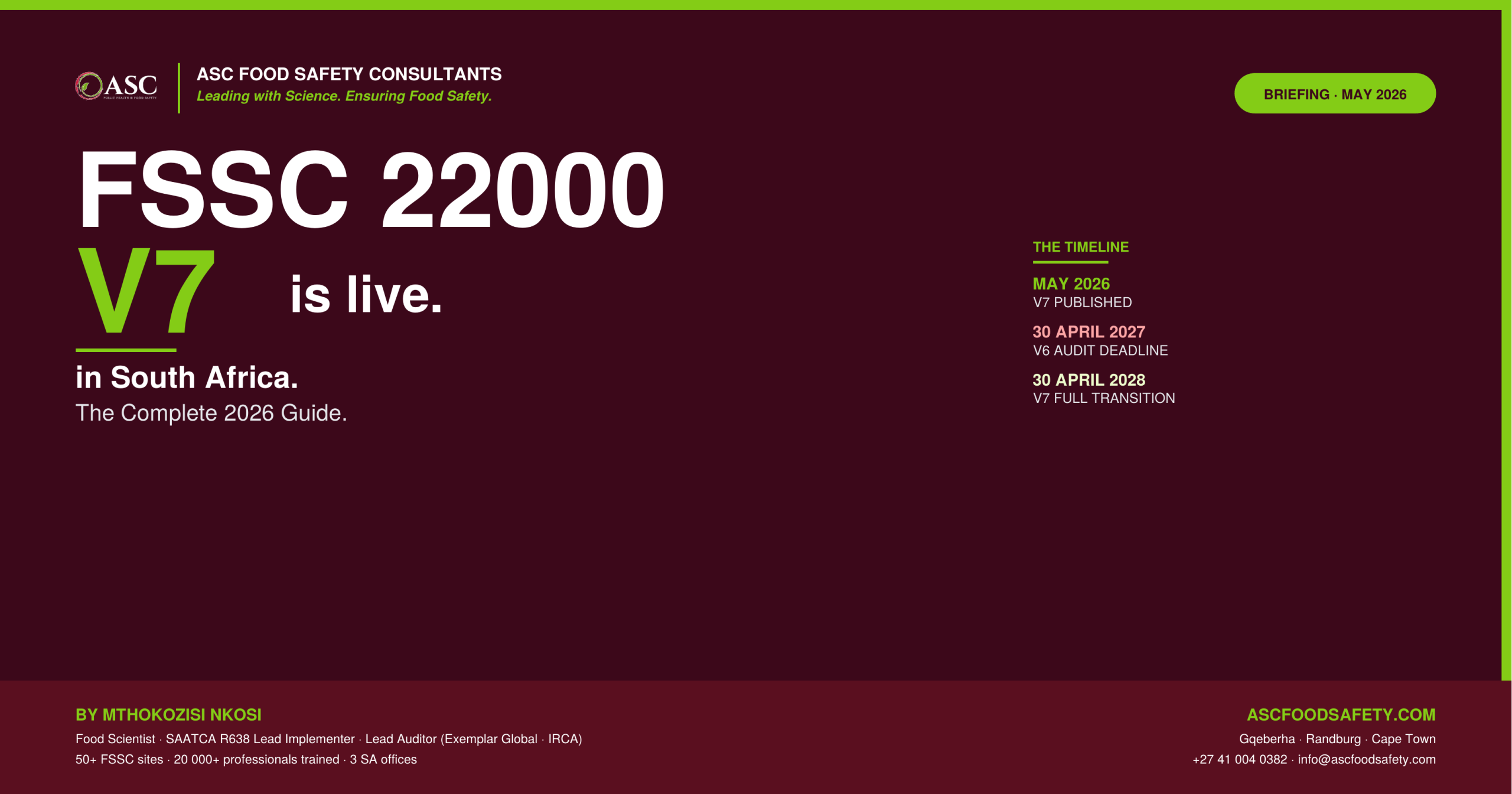
FSSC 22000 V7 in South Africa: The Complete 2026 Guide
What is FSSC 22000 Version 7?
FSSC 22000 (Food Safety System Certification 22000) is the food safety management system standard recognised by the Global Food Safety Initiative (GFSI) and operated by Foundation FSSC based in Gorinchem, the Netherlands. It is one of the most widely adopted food safety certifications in the world, used by retailers, manufacturers, packers, distributors and food service operators across more than 150 countries.
FSSC 22000 Version 7 — published in early May 2026 — represents the scheme's full alignment with the new ISO 22002-x:2025 prerequisite programme series and the Global Food Safety Initiative Benchmarking Requirements 2024. It also strengthens the scheme's contribution to the United Nations Sustainable Development Goals, introduces explicit governance requirements for the use of artificial intelligence in certification, and redefines the food chain category framework so that auditor competence matches the specific products and processes being assessed.
The scheme remains built on three normative foundations: ISO 22000:2018 (the management system), the new ISO 22002-x:2025 series (the prerequisite programmes), and the FSSC Additional Requirements (Part 2). What V7 changes is the depth, specificity and measurability of what auditors will expect to see.
The FSSC 22000 V7 transition timeline
| Date | Milestone | What it means for your site |
|---|---|---|
| Early May 2026 | V7 published | Foundation FSSC released V7.0. New applicants apply directly under V7. |
| 30 April 2027 | V6 audit cutoff | This is the last day any audit may be conducted to the V6 scheme. |
| 1 May 2027 | V7 upgrade audits begin | Every existing V6-certified site begins moving to V7 at its next regular audit. |
| 30 April 2028 | V7 deadline | Every certified site must be fully transitioned by this date. |
There is no big-bang switchover. Each site moves from V6 to V7 at its next regular surveillance or recertification audit during the upgrade window. This means the actual pressure date for your site is your next audit, not 30 April 2028.
The 7 V7 shifts every food safety leader needs to know
ASC's analysis of the official Foundation FSSC V7 release identifies seven structural shifts that every certified site needs to absorb. Each one is covered in depth in our V6 → V7 Change Guide, but here is the executive summary.
Shift 01 — PRPs now have a common spine. ISO 22002-100:2025 becomes the unified baseline. Every certified site, regardless of sector, applies it — and then a sector-specific PRP standard sits on top (-1 manufacturing, -2 catering, -4 packaging, -5 transport, -6 feed, or the brand-new -7 retail/wholesale, which replaces PAS 221:2013). Any procedure in your FSMS that still references "ISO/TS 22002" or "PAS 221" is now legacy and requires rewriting.
Shift 02 — Retail and wholesale finally have a clear path. Category FI now explicitly covers retail, wholesale and linked e-commerce. Category FII covers stand-alone brokering, trading and e-commerce platforms with no physical handling — and FII regular surveillance audits may now be conducted as fully remote audits. For South African supermarket chains, wholesale distributors and online food platforms, this is a major scope clarification.
Shift 03 — Food loss and waste is now audit evidence. Clause 2.5.16 requires every site (except Category I packaging) to have a documented food loss and waste policy with measurable targets, named owners and timelines. The sustainability narrative is over — auditors will now want to see the data set, the trend analysis and the management review evidence.
Shift 04 — Allergen control needs verification testing. Clause 2.5.6 requires risk-based verification testing where products with different allergen profiles share a production area. Surface swabs, air sampling or finished-product testing — whichever proves the controls work. Precautionary "may contain" warning labels do not exempt the organisation from controls.
Shift 05 — AI governance for Certification Bodies. Part 3 Section 9 introduces documented governance, risk assessment, validation and human oversight requirements wherever a CB uses AI tools in the certification process. AI may aid audits. It cannot make the certification decision.
Shift 06 — Sub-categories are finally defined. Table 1.1 splits the broad V6 categories into specific sub-sub-categories. CIV ambient stable products is now six sub-sub-categories. C0 (animal primary conversion) is now stand-alone. Pet food has been completely rebuilt across C0 to CIV depending on raw materials.
Shift 07 — Multi-site sampling has a new formula. Clause 2.5.18 replaces the IAF MD 1 sampling table with a calculation: y = 20 + √(x − 20). Applicable to BIII, E, F and G multi-site programmes. Recalculate today — the new sampling intensity is generally higher than under V6.
What FSSC 22000 V7 means for each food chain category
Eight food chain categories carry V7-specific changes that your gap audit needs to account for. Here is a summary of the most material changes by category.
Category BIII — Handling of plants. The boundary with sub-category CII has been sharpened. Cutting and dicing operations now belong unambiguously in CII, not BIII. New PRP standards: ISO 22002-100:2025 and ISO 22002-1:2025.
Category C — Food manufacturing (the largest restructure). C0 (lairage, slaughter, evisceration, bulk chilling and freezing of carcasses) is now stand-alone. New clause 2.5.14 requires traceability of all edible parts of the carcass — including blood for human consumption — until the carcass is deemed fit for consumption. Pet food has been rebuilt across C0, CI, CII, CIII and CIV depending on raw materials and shelf-life stability. CIV ambient stable products is now six sub-sub-categories (CIV-1 to CIV-6).
Category D — Animal feed and pet food. New PRP standard: ISO 22002-6:2025. Critical scope change: pet food is no longer Category D2 — it now sits across C0/CI/CII/CIII/CIV depending on its formulation.
Category E — Catering / Food service (renamed). Previously just "Catering". The renaming explicitly broadens scope to include restaurants, food trucks, cafeterias, on-board passenger service, event catering, coffee shops, and even reheating operations. New PRP standard: ISO 22002-2:2025.
Category F — Trading, retail, wholesale and e-commerce. FI now explicitly scopes in e-commerce activities linked to physical retail or wholesale. FII covers stand-alone food e-commerce platforms with no physical handling, and FII surveillance audits may now be conducted fully remote. New PRP standard: ISO 22002-7:2025.
Category G — Transport and storage. New PRP standard: ISO 22002-5:2025. Two important clarifications: sister-company storage at the main site now requires Category G to be added; external-customer storage off-site requires its own Category G certification at the additional location.
Category I — Production of packaging materials. The most detailed scope rewrite of any category in V7. Active materials (oxygen absorbers, desiccants), closing materials, disposable tableware, napkins, foils and baking paper are all now explicitly defined. Disposable tableware is eligible only when sold as part of a food product — domestic-use tableware is now out of scope.
Category K — Production of bio/chemicals. Now formally split into K-1 (chemicals: processing aids, additives, colours, flavours, gases, vitamins, food supplements) and K-2 (biocultures and enzymes).
The 17 Part 2 Additional Requirements
The FSSC Additional Requirements (Part 2) is where most of your operational documentation work will happen. The clauses most likely to drive non-conformities at your transition audit are summarised below. For a full breakdown and the related non-conformance patterns, see our companion article The 25 Most Common FSSC 22000 Non-Conformances and How to Avoid Them.
- 2.5.1 Management of services and purchased materials — laboratory analysis per ISO/IEC 17025; emergency procurement procedure; prohibited-substances policy for C0, CI, CIII, CIV.
- 2.5.2 Product labelling and printed materials — labels comply with country of intended sale, not manufacture; six-element artwork management procedure for in-house printing.
- 2.5.3 / 2.5.4 Food defence and food fraud — both reference ISO 22002-100:2025 clauses 16.2 and 16.3.
- 2.5.5 Logo use — marketing-use only. Strictly prohibited on products, labelling, packaging, CoAs and CoCs.
- 2.5.6 Allergen management — documented plan mandatory across all categories. Risk-based verification testing where multiple allergen profiles share a line.
- 2.5.7 Environmental monitoring — risk-based EM programme for BIII, C, I and K.
- 2.5.8 Food safety and quality culture — senior management objectives covering communication, training, employee feedback, engagement and performance measurement.
- 2.5.9 Quality control — quality policy aligned to finished-product specifications; line start-up and change-over controls confirming previous-run labelling and packaging removed.
- 2.5.10 Transport, storage and warehousing — FEFO + FIFO stock management; C0 post-slaughter time and temperature definitions; tanker cleaning controls.
- 2.5.11 Hazard control and cross-contamination — foreign matter management with breakage management for metal, ceramic and hard plastic.
- 2.5.12 PRP verification — routine monthly site inspections / PRP checks for BIII, C, D, E, FI, G, I and K.
- 2.5.13 Product design and development — production and shelf-life trials; validated cooking instructions for ready-to-cook; packaging design principles for food-loss minimisation.
- 2.5.14 Traceability (Category C0) — traceability of all edible carcass parts including blood for human consumption.
- 2.5.15 Equipment management — hygienic-design purchase specification; risk-based change management with documented commissioning evidence.
- 2.5.16 Food loss and waste — documented policy and objectives with measurable targets and timelines (all categories except Category I).
- 2.5.17 Communication requirements — inform the Certification Body within 3 working days of FSMS-impacting events, force-majeure events, public food safety events, regulatory actions, legal proceedings or fraudulent activities.
- 2.5.18 Multi-site sampling formula — y = 20 + √(x − 20) for BIII, E, F and G multi-site programmes.
How FSSC 22000 V7 interacts with South African food law
This is where the South African context becomes critical — and where ASC's local expertise creates significant value over generic international consulting.
FSSC 22000 V7 does not replace South African food safety legislation. It operates alongside it. Your FSMS still needs to demonstrate compliance with:
- The Foodstuffs, Cosmetics and Disinfectants Act 54 of 1972 and its regulations, including R638:2018 (General Hygiene Requirements for Food Premises and the Transport of Food).
- R146 (Regulations Relating to Labelling and Advertising of Foodstuffs) — and now, under V7 clause 2.5.2, labels must comply with the country of intended sale. For SA-based exporters this means harmonising R146 with destination-country requirements.
- SANS 10049 (Food Safety Management — Requirements for Prerequisite Programmes) — which dovetails with the new ISO 22002-x:2025 series.
- The Consumer Protection Act 68 of 2008 — particularly regarding product warnings and allergen disclosures under V7 clause 2.5.6.
- Department of Health environmental health practitioner inspections — which run independently of FSSC audits but increasingly use V7-aligned criteria.
For South African exporters to the EU, UK, Middle East, US and other major markets, V7 alignment also affects supplier qualification processes operated by Tesco, ALDI, Carrefour, Walmart, Costco, Kroger and other GFSI-aligned retailers.
ASC Food Safety Consultants is one of the few SA food safety firms with the integrated technical capability to map all of these frameworks simultaneously — because Mthokozisi Nkosi is registered as a Lead Auditor with both Exemplar Global (USA) and IRCA (UK), holds SAATCA TC No. 065 registration, is a SAATCA R638:2018 Lead Implementer (one of only three in South Africa), and is a GLOBALG.A.P. Registered Trainer.
Why ASC Food Safety Consultants is South Africa's FSSC 22000 V7 authority
When choosing a partner for your V7 transition, the credentials, the track record and the local context all matter. Here is what makes ASC Food Safety Consultants the right choice for South African food businesses — and an increasingly attractive choice for African and international clients.
Credentials that matter for V7 audits
- SAATCA Training Centre No. 065 (Southern African Auditor and Training Certification Authority).
- Mthokozisi Nkosi — Lead Auditor (Exemplar Global, USA + IRCA, UK), SAATCA R638:2018 Lead Implementer (1 of 3 in SA), GLOBALG.A.P. Registered Trainer.
- FoodBev SETA Registered Assessor and Skills Development Provider (Registration F01/585/ASR00067).
- HPCSA-accredited training delivery (Health Professions Council of South Africa).
- B-BBEE Level 1 (135% procurement recognition).
Track record across every food chain category
- 50+ FSSC 22000 implementations across red meat, dairy, bakery, beverage, fresh produce, ready-to-eat, animal feed, catering, packaging and retail.
- 20 000+ food safety professionals trained across Sub-Saharan Africa.
- 3 000+ KFC Africa delegates trained — across 14 African countries.
- Trusted by Spur Corporation, KFC Africa, AB-InBev, McCain Foods, Cerebos, Wits University and other major SA food businesses.
- 100% first-time FSSC 22000 certification success rate across ASC consulting clients.
Three offices for nationwide reach
- Gqeberha (HQ) — 14 Brickmakers Kloof Road · +27 41 004 0382
- Randburg (Gauteng) — 272 Oak Avenue, Ferndale · +27 10 500 4661
- Cape Town (Western Cape) — 183 Albion Springs · +27 21 300 4024
Verify Mthokozisi's SAATCA registration directly at saatca.co.za/registered-implementers/ or view his profile at LinkedIn.
The complete ASC FSSC 22000 V7 toolset
We have built four V7-ready solutions — for documentation, training, implementation support and ongoing FSMS operation. Used together, they replace the typical R150 000+ consulting engagement with a fixed-fee, lifetime-licence stack purpose-built for South African food businesses.
ASC FSSC 22000 V7 Toolkits — a variant for every category
The ASC V7 Toolkit is our flagship documentation product. Every PRP procedure has been rewritten against the new ISO 22002-x:2025 series. Every Additional Requirement from clause 2.5.1 to 2.5.18 has its own template. Food fraud and food defence plans now anchor directly to ISO 22002-100:2025 clauses 16.2 and 16.3.
Because no two food chain categories have the same FSMS architecture, we maintain sector-specific toolkit variants:
- FSSC 22000 V7 Food Manufacturing Toolkit (Category C — perishable and ambient stable products)
- FSSC 22000 V7 Food Packaging Toolkit (Category I — the rewritten packaging scope)
- FSSC 22000 V7 Animal Feed & Pet Food Toolkit (Category D, and C0–CIV variants for pet food)
- FSSC 22000 V7 Catering & Food Service Toolkit (Category E — the renamed broader scope)
- FSSC 22000 V7 Retail & Wholesale Toolkit (Category F — including FI/FII e-commerce variants)
- FSSC 22000 V7 Transport & Storage Toolkit (Category G)
- FSSC 22000 V7 Bio/Chemicals Toolkit (Category K-1 / K-2)
- FSSC 22000 V7 Animal Primary Conversion Toolkit (Category C0 — including the new clause 2.5.14 traceability templates)
Each variant includes the Quality & Food Safety Manual, all 13 PRP procedures, HACCP plan templates, all 18 Additional Requirement templates (2.5.1–2.5.18), VACCP and TACCP plans aligned to ISO 22002-100:2025 clauses 16.2 and 16.3, the allergen management system with verification log, the food safety and quality culture plan with KPIs, the food loss and waste policy and tracker (clause 2.5.16), the environmental monitoring programme, internal audit and management review templates, 50+ registers and forms, and the master document index.
From R6 350 One-off lifetime licence — versus R150 000+ that competing consultancies typically charge. Fully editable in Microsoft Word and Excel. No subscription. No renewals.
ASC V7 Transition Course (FS22) — for V6-certified sites
For sites already certified to V6 facing the May 2027 transition deadline. The course walks through every clause delta between V6 and V7 — what changed, what is new, what has been strengthened, and exactly what your FSMS documentation needs to be updated before your transition audit. Three modules, 8 hours of self-paced online learning, designed by a Lead Auditor with both Exemplar Global and IRCA registrations.
R1 450 per delegate Online · self-paced · accredited · QR-coded certificate · WhatsApp learner support. Group rates for 5+ delegates.
ASC V7 Implementation Course (FS21 V7) — for first-time applicants
For sites pursuing FSSC 22000 certification for the first time under V7. Comprehensive walkthrough of all three V7 components: ISO 22000:2018 management system; the new ISO 22002-x:2025 PRP series; and all 18 Additional Requirements. Includes the Foundation FSSC V7 scheme documents and a self-assessment audit checklist so your team can verify readiness before booking the Certification Body Stage 1 audit.
R1 195 per delegate Online · self-paced · HPCSA-accredited. Bundle with FS33 GMP, FS10 HACCP and any V7 Toolkit for an additional 20% saving.
ASC Food Safety Software — the V7-native FSMS platform
This is the most important addition to the ASC stack in 2026 — and the one we are most excited about. ASC Food Safety Software is a paperless FSMS platform, built in-house in South Africa, purpose-designed for FSSC 22000 V7.
Why ASC Food Safety Software matters for V7 specifically
- Clause 2.5.16 built in. V7 demands measurable food loss and waste targets with owners and timelines. The software tracks every kilogram automatically, builds the management review dashboard, and produces the audit evidence pattern Certification Bodies want to see.
- Clause 2.5.8 operationalised. Food safety and quality culture is no longer a poster on the wall. The software runs culture surveys, tracks behavioural KPIs, and gives senior management the measurable evidence the auditor will demand.
- ICT-aligned, SDG-aligned, paper-zero. FSSC 22000 V7 explicitly strengthens the scheme's contribution to the United Nations Sustainable Development Goals and recognises Information and Communications Technology as a sustainability enabler. Every paper register your facility eliminates is a quantifiable SDG contribution that auditors can see — and that ESG-conscious retail buyers care about.
- Clause 2.5.17 communications built in. When a force-majeure event, regulatory action or public food safety incident occurs, the software has the CB-notification template pre-built for the 3-working-day rule.
Why ASC software, not international software
International food safety software platforms charge R15 000 – R50 000 per month per site, route your support tickets to a helpdesk in another time zone, and bill you in US dollars or euros. ASC Food Safety Software changes that equation completely:
- Built in South Africa, priced in South African rand. No currency exposure. No exchange rate surprises in your monthly subscription.
- Direct support from ASC Lead Auditors. Not an outsourced helpdesk. The people answering your questions are the same people running the V7 gap audits.
- In-house, not outsourced. Every line of code, every module, every roadmap decision is made in ASC's offices. We are not reselling someone else's product with our logo on it.
- V7 clauses are the architecture. The software was designed from clause 2.5.1 outward — not a generic FSMS retrofitted with V7 fields.
- Customisation by direct conversation. Need a custom report? Call the team building the software. We do not have a "feature request portal" with a 6-month queue.
For international food businesses: FSSC 22000 V7 applies globally
While this article addresses the South African context, the FSSC 22000 V7 transition is a global event. Foundation FSSC operates the scheme across more than 150 countries, with significant certified populations in the Netherlands, the United Kingdom, the United States, Germany, France, Italy, China, India, Brazil, Australia, New Zealand and across the Sub-Saharan African continent.
The V7 changes summarised above — the new ISO 22002-x:2025 PRP series, the Part 2 Additional Requirements, the food chain category restructure, the multi-site sampling formula, the AI governance requirements — apply identically regardless of where your site is located.
What ASC offers international clients is a uniquely cost-effective combination: Lead Auditor expertise registered with the major international bodies (Exemplar Global in the United States and IRCA in the United Kingdom), implementation experience across more than 50 sites and 14 African countries, and South African pricing that is typically 60–80% lower than equivalent consulting engagements in Europe or North America — without compromising on the quality of the documentation, the training or the audit-defence experience.
For international enquiries, email info@ascfoodsafety.com or book a virtual consultation at ascfoodsafety.com/contact-us/appointments.
Get the free 26-page FSSC 22000 V7 Briefing ebook
Everything in this article — plus the full transition timeline visual, the seven V7 shifts in swipe-deck format, the category-by-category change cards, the complete 17 Part 2 audit requirement summary, the V7 readiness self-check, and the full ASC V7 toolset overview — is also available as a 26-page editorial briefing PDF.
The briefing is designed for forwarding to your QA team, your senior management, your Certification Body contact and your supply chain partners. Copy-protected. Print-ready. Optimised for both desktop and mobile reading.
Send Me the Free V7 Briefing →
Get the Free FSSC 22000 V7 Briefing
Complete the form below and we’ll send the 26-page briefing to your inbox.
Frequently asked questions about FSSC 22000 Version 7
When was FSSC 22000 V7 published?
FSSC 22000 Version 7.0 was published by Foundation FSSC in early May 2026, following a public consultation period and pre-announcement on 3 March 2026.
When does FSSC 22000 V6 expire?
V6 audits are permitted until 30 April 2027. After that date, no new audits may be conducted to the V6 scheme. V7 upgrade audits run from 1 May 2027 to 30 April 2028, during which every existing certified site must transition.
Do I need a new auditor for V7?
You may continue to use the same Certification Body, provided they are accredited to operate V7. Confirm with your CB this week which version (V6 or V7) your next audit will be conducted to.
What is ISO 22002-100:2025?
ISO 22002-100:2025 is the new unified prerequisite programme (PRP) baseline standard that every FSSC 22000 V7 certified site must apply, regardless of food chain category. It replaces the previous patchwork of ISO/TS 22002-x and BSI PAS standards as the common foundation. A sector-specific PRP (such as ISO 22002-1:2025 for food manufacturing) then sits on top.
What is the multi-site sampling formula in V7?
Clause 2.5.18 of V7 introduces the formula y = 20 + √(x − 20), where x is the total number of sites in the multi-site programme and y is the audit sample size. This applies to BIII, E, F and G multi-site programmes and generally results in higher sampling intensity than under V6.
Does V7 require new documentation across all 18 clauses?
Yes — but not always from scratch. Some clauses (such as 2.5.5 logo use) carry minor wording changes; others (such as 2.5.16 food loss and waste, 2.5.6 allergen management, 2.5.8 food safety culture) require substantively new documentation, measurable targets and trended verification evidence. The ASC V7 Toolkit covers all 18 clauses with V7-aligned templates.
Is pet food still in Category D under V7?
No. Pet food has been completely rebuilt across Categories C0, CI, CII, CIII and CIV depending on the raw materials used and the shelf-life stability of the finished product. This is a major scope change that affects pet food manufacturers worldwide.
What does V7 say about AI in food safety audits?
Part 3 Section 9 of V7 introduces explicit governance requirements for Certification Bodies using AI tools in the certification process: documented governance, risk assessment, validation, monitoring and stakeholder communication. AI may support audit activities; it cannot make the certification decision itself.
How much does V7 transition cost?
For a single-site V6-certified manufacturer, a typical V7 transition involves: documentation refresh (the ASC V7 Toolkit, from R6 350), team training (FS22 V7 Transition Course at R1 450 per delegate), and a gap audit (ASC fixed-fee R10 000). Total: under R20 000 for most single-site operations — versus R150 000+ that competing consultancies charge for an equivalent engagement.
Where can I download the FSSC 22000 V7 scheme documents?
The official V7 scheme documents are available free at fssc.com. For implementation-ready V7-aligned templates and procedures, see the ASC FSSC 22000 V7 Toolkit.
Next steps for South African (and international) food businesses
If you operate an FSSC 22000 certified site, here is your action list this week:
- Confirm with your Certification Body when your next audit is scheduled and whether it will be V6 or V7.
- Identify which ISO 22002-x:2025 sector standard applies to each of your operations.
- Identify your V7 sub-sub-category code per Table 1.1 — this affects auditor competence and audit duration.
- Book a V7 gap audit if you have not already. ASC offers fixed-fee gap audits from R10 000. Book at ascfoodsafety.com/contact-us/appointments.
- Choose your toolkit variant based on your category and order the ASC V7 Toolkit. Lifetime licence. Editable. Used by 50+ certified SA sites.
- Enrol your team in the FS22 V7 Transition Course (for V6 sites) or FS21 V7 Implementation Course (for first-time applicants).
- Book a 30-minute demo of ASC Food Safety Software to see what V7-native FSMS automation looks like.
V7 will reward prepared teams. It will expose teams who only update documents after the auditor asks. From every V7 gap audit ASC has been engaged in so far, one pattern is consistent: the strongest systems prepare before the transition window becomes pressure.
Observe the gap. Not just the certificate.
About the author
Mthokozisi Nkosi is a Food Scientist (BSc Agriculture Honours in Food Science, MPH, MBA, BCom Honours in Supply Chain), a Registered Lead Auditor with both Exemplar Global (USA) and IRCA (UK), one of only three SAATCA Registered R638:2018 Lead Implementers in South Africa, and a GLOBALG.A.P. Registered Trainer. He has personally trained over 20 000 food safety professionals across Sub-Saharan Africa and has implemented BRCGS, FSSC 22000 and IFS Food at South African manufacturers across red meat, dairy, bakery, beverage, fresh produce and ready-to-eat. He is the founder of ASC Food Safety Consultants.
ASC Food Safety Consultants is a South African food safety consulting and training firm with offices in Gqeberha (HQ), Randburg and Cape Town. SAATCA Training Centre Registration No. 065. FoodBev SETA F01/585/ASR00067. HPCSA-accredited. B-BBEE Level 1 (135% procurement recognition).
Contact ASC Food Safety Consultants:
- Email: info@ascfoodsafety.com
- Phone: +27 41 004 0382 (Gqeberha) · +27 10 500 4661 (Randburg) · +27 21 300 4024 (Cape Town)
- Web: ascfoodsafety.com · ascfoodsafetytraining.com
- LinkedIn: linkedin.com/in/mthokozisi-nkosi-0738a0a7
Related ASC articles
Article last updated: 11 May 2026 · ASC Food Safety Consultants · Leading with Science. Ensuring Food Safety.
Key facts
- FSSC 22000 Version 7 was published in early May 2026 and brings full alignment with the new ISO 22002-x:2025 prerequisite programme series.
- Version 6 audits end on 30 April 2027, upgrade audits run from 1 May 2027 to 30 April 2028, and the full transition deadline is 30 April 2028.
- Seven major changes include a common ISO 22002-100:2025 PRP baseline, measurable food waste targets (Clause 2.5.16), risk-based allergen verification testing (Clause 2.5.6) and new AI governance rules.
- Food chain categories were restructured, including a stand-alone Category C0 for slaughter, pet food moving into Categories C0-CIV, and clearer retail, wholesale and e-commerce distinctions in Category F.
- For South African sites, V7 operates alongside local legislation such as R638:2018, the Foodstuffs, Cosmetics and Disinfectants Act 54 of 1972 and the Consumer Protection Act 68 of 2008.
- ASC Food Safety Consultants offers V7 toolkits, transition and implementation courses, and a V7-native FSMS software platform, citing 50+ FSSC 22000 implementations and a 100% first-time certification success rate.
Frequently asked questions
When does FSSC 22000 V7 take effect and what is the transition deadline in South Africa?
FSSC 22000 V7 was published in early May 2026. The last day for Version 6 audits is 30 April 2027, and V7 upgrade audits run from 1 May 2027 to 30 April 2028. The full transition deadline is 30 April 2028, with each site transitioning at its next regular surveillance or recertification audit during the upgrade window rather than on a fixed date.
What are the main changes from FSSC 22000 V6 to V7?
V7 introduces seven major changes. These include a common ISO 22002-100:2025 prerequisite programme baseline for all sites, clearer retail and wholesale distinctions with e-commerce in Category F, measurable food waste targets under Clause 2.5.16, risk-based allergen verification testing under Clause 2.5.6, new AI governance rules in Part 3 Section 9, more specific food chain sub-categories, and a new multi-site sampling formula (y = 20 + √(x − 20)).
How does FSSC 22000 V7 relate to South African food safety legislation?
FSSC 22000 V7 operates alongside South African law rather than replacing it. The article notes it works with the Foodstuffs, Cosmetics and Disinfectants Act 54 of 1972, R638:2018 (General Hygiene Requirements), R146 (Labelling and Advertising), SANS 10049 and the Consumer Protection Act 68 of 2008. Under V7 clause 2.5.2, labels must comply with the country of intended sale, which is critical for South African exporters.
What does FSSC 22000 V7 require for food safety culture and allergen management?
For food safety culture, Clause 2.5.8 requires senior management objectives covering communication, training, employee feedback, engagement and performance measurement. For allergens, Clause 2.5.6 requires risk-based verification testing where products with different allergen profiles share a production area, using methods such as surface swabs, air sampling or finished-product testing.
How can ASC Food Safety Consultants help South African sites transition to V7?
ASC offers FSSC 22000 V7 toolkits with category-specific document templates (R6,350 lifetime licence), an FS22 V7 Transition Course for V6-certified sites (R1,450 per delegate), an FS21 V7 Implementation Course for first-time applicants (R1,195 per delegate), and a V7-native FSMS software platform built in South Africa. The article cites 50+ FSSC 22000 implementations and a 100% first-time certification success rate for its consulting clients, with offices in Gqeberha, Randburg and Cape Town.