
Food Labelling and Regulatory Advisory Services in South Africa
Your label is a legal document, a marketing asset and your first line of defence against recalls, port detentions and retailer delistings. ASC Food Safety's regulatory team takes products from concept to compliant: under R146 today and ready for the draft R3337 regulations tomorrow. Send us the artwork and a senior regulatory consultant returns a line by line report against R146, with every finding tied to the regulation it comes from and the fix written next to it. Standard review in five to seven business days, and 48 hours on the express option when you are already at the printer.
Official food safety and compliance advisor to Kellogg's. Trusted on regulatory and labelling work by Adcock Ingram, KFC Africa (Yum! Brands), Spur Group, SPAR, Pick n Pay, Shoprite and 40+ leading brands, including international manufacturers importing into South Africa.
Regulatory and labelling work trusted by
Kellogg's · Adcock Ingram · KFC Africa / Yum! Brands · Spur Group · SPAR · Pick n Pay · Shoprite · Clicks · AB InBev · Sea Harvest · Dr Oetker · Cerebos · Peppadew · Lancewood · Woodlands Dairy
Named clients are published with their agreement.
One wrong word on a label can cost you the shelf
South African food labels are policed by more than one regulator. The Department of Health enforces R146 of 2010 under the Foodstuffs, Cosmetics and Disinfectants Act. The Department of Agriculture (DoA, formerly DALRRD) enforces product standards and marking under the Agricultural Product Standards Act. The NRCS enforces compulsory specifications and net-quantity rules under the Legal Metrology Act. Port Health can detain your consignment at the harbour. Retail technologists can delist you before a regulator ever calls.
The biggest proposed change in a generation is still on the table. Draft regulation R3337 would introduce mandatory front of pack warning labels, restrictions on marketing to children and stricter claim rules. As at 8 September 2026 it remains a draft: it was published for public comment on 21 April 2023, the comment period closed on 21 September 2023, and no commencement or transition date has been gazetted. R146 of 2010 remains the law in force. Brands that assess their portfolio now can phase changes into their normal artwork cycles instead of paying for an emergency relabel later.

Recalls and withdrawals
Undeclared allergens remain the leading cause of food recalls worldwide. One missed "contains" statement can trigger a national withdrawal.
Port detentions
Imported products with non-localised labels are routinely detained by Port Health, and demurrage bills grow daily while artwork is fixed.
Retailer delisting
Major SA retailers audit supplier labels. Non-compliant claims or missing mandatory information can cost you the listing you fought for.
One team for the whole label, from the ingredient list to the claim on the front
Unlike single-service labelling agencies, ASC combines regulatory advisory with food science, auditing, FSMS implementation and an accredited training academy, so your label, your factory and your paperwork all tell the same compliant story.

Get a label approved before it goes to print
The core work. Artwork in, compliant artwork out.
Food Label Compliance Review
Line-by-line review of your label artwork against R146, the Agricultural Product Standards Act, Legal Metrology and retailer requirements, returned as a redlined report with corrected wording you can hand straight to your designer. 48-hour express option available.
Request a label review →New Label Development
Launching a product? We build the full compliant label from scratch: name of the food, ingredient list in descending order, allergen declarations, date marking, net quantity, country of origin, nutritional information table and permitted claims.
Start a new label →NRV Tables, Nutritional Analysis and Claims Substantiation
Artwork-ready Nutrient Reference Value (NRV) tables developed or verified from your formulation and lab results, with documented calculation working files. Plus claims assessments that rate every proposed claim Permissible, Modify or High-risk, with risk-reduced alternative wording. We are advisors, not a testing laboratory: analysis is performed by accredited third party labs, and we scope the testing, interpret the results and turn them into compliant labels. See what you can and cannot say in a health or nutrition claim.
Read our claims guide →Bring product into South Africa
For importers and international brands localising to South African law.
Import Compliance (Into South Africa)
Our specialist lane. We localise international labels to South African law, advise on import permits (DoA, ITAC), NRCS compulsory specifications and Port Health requirements, so your consignment clears instead of sitting in detention. Start with our step by step guide to importing food into South Africa.
Read our import guide →Regulator Engagement
Where regulations are silent or ambiguous, we engage the Department of Health, the Department of Agriculture, the NRCS and municipal health authorities on your behalf and document the outcome: clarity in writing, not opinion in a corridor.
Ask us to approach the regulator →Protect the portfolio and defend a claim
For the risks that sit above a single label.
Regulatory Advisory and Opinions
Written regulatory opinions on ingredient permissibility, product classification, additives, fortification, GMO declarations and borderline products (food vs supplement vs medicine): the paper trail that protects you in an inspection or dispute.
Ask our regulatory team →R3337 Readiness Programme
A portfolio-wide gap assessment against the draft R3337 regulations: which SKUs will need front-of-pack warning labels, which claims will fall away, where reformulation beats relabelling. You get a costed transition roadmap for your board. Read what the draft R3337 labelling regulations propose before you commit budget.
Get R3337-ready →Marketing, Tagline and Claims Risk Frameworks
Portfolio-wide "claims boundary" frameworks for functional benefits (energy, immunity, vitality), tagline risk assessments with retain/amend/remove recommendations, and do/don't guardrails your teams apply to every future label and campaign.
Protect your claims →Independent Expert Reports and Regulatory Defence
Evidentiary-standard expert reports for disputes, recalls, regulator engagements and legal matters. Every finding is referenced to primary scientific literature and South African law, with the regulation quoted verbatim at the point of reference.
Request an expert report →Build the capability behind the label
So the factory and the paperwork say what the label says.
Labelling Training and Workshops
Accredited, practical training for NPD, QA, marketing and procurement teams. Start with Essentials of Food Labelling Claims, online and self paced, or book a customised in house workshop built around your own product labels.
View training →Independent Technical and Reformulation Assessments
Changing a recipe, a supplier or a co-manufacturer? We deliver board-ready technical assessments of reformulations (formulation change review, vitamin stability, caffeine and sweetener compliance, sensory methodology, raw-material specifications) with clear go/no-go recommendations for each variant.
Request an assessment →Food Safety Compliance Behind the Label
The label is only as good as the factory behind it. FSMS implementation (HACCP, FSSC 22000, ISO 22000), auditing, R638 hygiene compliance and foodborne-illness investigation: one accountable partner for the whole picture.
All ASC services →Deliverables built to survive scrutiny
Our reports are written the way regulators, auditors and boards read: every finding tied to the applicable regulation (quoted verbatim at the point of reference), and every recommendation practical enough to hand to your designer, factory or legal team the same day.
Prioritised findings, a risk register with ratings and rationale, and recommended label edits and mark-ups.
Final NRV table formatted for artwork insertion, plus calculation notes, assumptions and rounding conventions.
Every claim rated Permissible / Modify / High-risk, with rationale and risk-reduced alternative wording.
Independent go/no-go opinions on reformulations and trials, referenced to legislation and ISO standards.
A formal ASC compliance statement for retailers, auditors, import files and tender packs.
Who will actually do your work
Your work is led by Mthokozisi Nkosi, Managing Director and Principal Consultant: completing a PhD in Public Health, MPH, BSc (Agric) Hons in Food Science and Technology, MBA, PCQI, Registered Lead Auditor (Exemplar Global and IRCA), SAATCA Lead Implementer, 2026 SAAFoST and Nelson Mandela University Food Safety Symposium speaker and national media commentator, supported by a multidisciplinary team of food scientists, biochemists and FSSC 22000 Lead Auditors. He is registered with the HPCSA as an Environmental Health Practitioner. That registration is personal to him and is not a company accreditation. ASC itself is SAATCA registered, a FoodBev SETA Accredited Provider under No. 587/00337/1900, and B-BBEE Level 1.
We cover every regulator that can touch your label
Food labelling in South Africa is not enforced by a single body. Here is who does what, and what ASC handles for you at each point.
| Authority | Key legislation | What we handle for you |
|---|---|---|
| Department of Health | R146 of 2010 (labelling and advertising); draft R3337; Foodstuffs, Cosmetics and Disinfectants Act 54 of 1972 | Full label compliance, allergens, claims, advertising review, R3337 readiness |
| Department of Agriculture (DoA, formerly DALRRD) | Agricultural Product Standards Act 119 of 1990 + product-specific regulations | Grading, marking and composition standards for regulated products; import permits |
| NRCS / DTIC | Compulsory specifications such as VC 8014 and VC 8019; Legal Metrology Act 9 of 2014 for net quantity | Compulsory-spec compliance, net content marking, e-mark guidance |
| Port Health | Imported foodstuff inspection at points of entry | Pre-shipment label localisation, documentation packs, detention resolution |
| Municipal Health / EHPs | R638 of 2018 hygiene requirements and the Certificate of Acceptability | Premises compliance so the product behind the label is as compliant as the label |
| SAHPRA (borderline products) | Medicines and Related Substances Act 101 of 1965, as amended | Food vs supplement vs medicine classification opinions before you print |
South African food labelling: the essential facts
A quick reference your team can trust. These are the rules as they stand under R146 of 2010. Draft regulation R3337 would tighten several of them, but it remains a draft as at 8 September 2026.
What must appear on every food label
The mandatory particulars do not all sit in one regulation, which is where most label projects go wrong. Regulation 9 of R146 carries the core list, and country of origin, batch identification, date marking and allergens each have their own regulation. This is the position as at 8 September 2026.
| Particular | Regulation | Notes |
|---|---|---|
| Name of the food | Regulation 9 | Must appear on the main panel |
| Name and address of the manufacturer, importer or seller | Regulation 9 | |
| Instructions for use | Regulation 9 | Where applicable |
| List of ingredients in descending order of mass | Regulation 9 | Where applicable |
| Special storage conditions | Regulation 9 | Where applicable |
| Net contents in SI units | Regulation 9 | |
| Country of origin | Regulation 10 | |
| Batch identification | Regulation 11 | |
| Date marking | Regulation 12 | Best before, use by or sell by |
| Allergen declaration | Regulation 43 | |
| Nutritional information table | Regulation 50(12) | Mandatory once a nutrition claim is made, with values determined by a reputable laboratory |
Instructions for use is the particular most often left off a label, and it is a regulation 9 requirement wherever the food needs them.
The allergens South Africa recognises
South African law requires declaration of the common allergens: egg, cow's milk, crustaceans and molluscs, fish, peanuts, soybeans, tree nuts, and cereals containing gluten (wheat, rye, barley, oats and their hybrids such as spelt and kamut). Regulation 43 requires the allergen to be shown in brackets after the ingredient where it is not self evident from the name, or in a "Contains" block close to the ingredient list. R146 uses the term "significant cereals" for the gluten group. Precautionary "may contain" statements should only be used where a documented risk assessment supports them. Sulphur dioxide is not a common allergen under regulation 43, but regulation 38 requires it to be declared where it is present at 10 mg per kilogram or more in the food as packed or ready to eat, and at any level in certain cases such as transfer from packaging materials and treated fresh produce. Read the complete guide to allergen management and labelling in South Africa.
The three date marks, in one breath
Best before is a quality promise: the food is at its best until that date but not automatically unsafe after it. Use by is a safety line for perishable foods and must be respected. Sell by is stock rotation guidance for retailers. All three are permitted under regulation 12 of R146, and the only abbreviation the regulation allows is "BB" for best before. There is no regulatory reform of date marking in draft or before Parliament as at 8 September 2026. Separately, the SABS published draft SANS 2088, a voluntary standard on food donation and redistribution, for public comment between 17 April and 16 June 2026, which clarifies how the three date marks apply to donated food without changing labelling law. Read our full guide on best before vs use by dates.
The labelling terms every food business should know
Who we do this for
Food and beverage manufacturers, dairies, bakeries, meat and fish processors, snack and confectionery brands, beverage and energy drink companies, supplement and functional food producers navigating the SAHPRA borderline, importers and international brands entering South Africa, exporters aligning to Codex and destination-market rules, retailers and private-label teams, franchisors and QSR groups, and the agencies that design their packaging.
The Acts, regulations and standards behind every ASC opinion
Food labelling in South Africa is not one law. It is a web of Acts, regulations and national standards enforced by different authorities. These are the instruments we work with daily, and what each one means for your pack.
The parent Act for food labelling. It empowers the Minister of Health to make labelling regulations and makes the sale of falsely described or misleadingly labelled foodstuffs a criminal offence. Every label opinion we issue traces back to this Act.
The core labelling regulations in force today: mandatory particulars, ingredient lists, allergen declarations, date marking, nutritional information format, claim criteria and prohibited statements. Applies to advertising as well as packaging.
Published for public comment on 21 April 2023 as a proposed replacement for R146: front of pack warning labels for high sugar, sodium and saturated fat, restrictions on marketing to children, and stricter claim and allergen rules. As at 8 September 2026 it remains a draft and its final content may differ from the version published for comment. We run portfolio readiness assessments against it now.
Governs quantity declarations on prepackaged goods. Administered by the NRCS, it replaced the old Trade Metrology Act 77 of 1973 and gives net-content marking its legal force. Short-measure prepackages are an offence, and inspectors check them.
The full title is "Labelling requirements for prepackaged products (prepackages) and general requirements for the sale of goods subject to legal metrology control". It is incorporated under the Legal Metrology Act 9 of 2014 by Notice 877 in Government Gazette 41854 of 24 August 2018, and the notice incorporates the standard as amended, so the current published edition applies. It sets how net quantity must be declared: permitted units, minimum digit heights, placement and prominence. Quantity control of the contents themselves sits in SANS 1841, incorporated by the same notice. Most net content failures we correct are details in these two standards.
The consumer's law with real teeth for labels. Section 24 covers product labelling and trade descriptions. Section 41 covers false, misleading or deceptive representations. Section 55 gives the consumer a right to safe, good quality goods and section 58 requires warnings about the fact and nature of risks. Section 61, headed "Liability for damage caused by goods", imposes liability on producers, importers, distributors and retailers for harm caused by unsafe goods, product failure, defects or hazards, or by inadequate instructions or warnings, irrespective of negligence. A compliant label is a liability defence.
Administered by the Department of Agriculture, which separated from the Department of Agriculture, Land Reform and Rural Development on 1 April 2025 by Proclamation 199 of 2024. The Act carries product specific composition, grading, packing and marking regulations for products such as dairy, meat, fruit juice, honey and grains. Your product name and grade claims often live here, not in R146. The Act was amended by the Agricultural Product Standards Amendment Act 12 of 2023, sections 1 to 5 of which commenced on 22 August 2025 by Proclamation 279 in Government Gazette 53210.
R.733 of 10 September 2012 governs sweetener use and its label statements, including the "non-nutritive sweetener" descriptor, the laxative statement for polyols above 50 g per kilogram, and "Contains phenylalanine" where aspartame is used. The Regulations Relating to Soft Drinks, R.1769 of 9 August 1985, were amended by Notice R.317 of 17 April 2012 in Government Gazette 35265. Where a soft drink contains more than 150 mg of caffeine per litre, the main panel must carry "High caffeine content" in letters at least 3,0 mm high, and the label must carry "Not recommended for children under 12 years of age; pregnant or lactating women; persons sensitive to caffeine" in letters at least 1,3 mm high, with the caffeine content declared in milligrams per single serving and per 100 ml. Fortification is mandatory under R.504 of 7 April 2003, as amended by R.1206 of 2008, and it applies to wheat flour, maize meal and wheat bread.
The Regulations Governing General Hygiene Requirements for Food Premises, the Transport of Food and Related Matters, Notice R.638 of 22 June 2018 in Government Gazette 41730. Regulation 3(1) prohibits the handling of food on premises without a valid Certificate of Acceptability, which is issued by the local authority and must be displayed on the premises. The claims on your pack assume a compliant facility behind them, and we keep both sides aligned.
Compulsory specifications apply to regulated categories: canned fish, canned marine molluscs and canned crustaceans under VC 8014, canned meat products under VC 8019, processed meat products under VC 9100, frozen fish and frozen marine molluscs under VC 8017, and smoked snoek under VC 8021. For exporters, Codex Alimentarius standards and destination market rules set the benchmark. We align labels to all of them in one review.
How a label review works
A clear, five-step path from artwork to a compliance letter you can put in front of any retailer or auditor.
Send us your artwork, recipe/spec and target market. We confirm scope and turnaround: standard or 48-hour express.
Line-by-line assessment against every applicable regulation, not just R146.
You receive a marked-up label plus corrected, regulation-referenced wording your designer can paste in.
We re-check the corrected artwork until it's right. Included, not billed again.
A formal ASC compliance statement for retailers, auditors and import documentation.
Why food and beverage brands bring their labels to ASC
Checking a label is one job. Standing behind the product it goes on is another, and it takes food science, factory knowledge, documentation and people who can defend all three in front of an auditor.
Adcock Ingram, KFC Africa and Yum! Brands, Spur Corporation, AB InBev and Clicks. We publish our client list because our work survives their audits.
Labelling, regulatory opinions, FSMS implementation, auditing, food science and accredited training: one team, one accountable partner.
A dedicated lane for international manufacturers entering South Africa: label localisation, permits, compulsory specs and Port Health, end to end.
Print deadline tomorrow? Our express lane returns redlined artwork in two business days.
The people reviewing your label are food scientists and registered lead auditors, not designers working from a printout. SAATCA registered, FoodBev SETA Accredited Provider No. 587/00337/1900, and SAAFoST members. Every finding in your report cites the regulation it comes from, which is what makes it usable in front of a retailer or a regulator.
Teams in Gqeberha, Johannesburg, Cape Town and Durban. B-BBEE Level 1 with 135% procurement recognition, which is good for your scorecard too.
Free checklists our own consultants use
The checklists and guides our own consultants use, free for your QA, NPD and marketing teams.
SA Food Label Compliance Checklist
The 60-point checklist our consultants use as a first pass: mandatory information, allergens, claims, date marking, net quantity and R3337 readiness flags.
Download PDF of the SA Food Label Compliance Checklist (PDF)Allergen Labelling Checklist
Every declaration, precautionary statement and cross-contact control point to verify before your label goes to print.
Download PDF of the Allergen Labelling Checklist (PDF)Importing Food into South Africa: Regulatory Roadmap
The step-by-step route from international artwork to cleared cargo: permits, compulsory specs, label localisation and Port Health.
Download PDF of the guide to importing food into South Africa (PDF)R3337 Readiness Gap-Assessment Checklist
Score every SKU against the draft R3337 requirements (warning-label exposure, claims at risk, child-marketing restrictions) before your competitors do.
Download PDF of the R3337 Readiness Gap Assessment Checklist (PDF)Health and Nutrition Claims Quick-Reference Guide
What you can and can't say on a South African label, with the wording traps that trigger regulator and retailer pushback.
Download PDF of the Health and Nutrition Claims Quick Reference Guide (PDF)Labelling and Regulatory Services Brochure
A shareable overview of every service, our process, turnarounds and client track record, built for procurement and QA managers.
Download PDF of the Labelling and Regulatory Services Brochure (PDF)Worked through a checklist and want a second pair of eyes on the result? Book a virtual consultation with a senior regulatory consultant from R480 an hour, or send us the artwork for a full review.
Training brochures: Half-day Essentials One-day Claims and Framework Two-day Comprehensive (SA and Codex) Full training prospectusUpskill your team on our accredited training platform
Our food safety training page carries our accredited course list, in person, virtual and self paced online, including Essentials of Food Labelling Claims for Food Manufacturing, built for NPD, QA and marketing teams who sign off labels. The labelling course is online, self paced, four hours, HPCSA accredited for continuing professional development, and issues a downloadable certificate on completion. Enrol in Essentials of Food Labelling Claims.
Prefer in house? We run customised labelling workshops (virtual or on-site) using your own product labels as the case studies.
Essentials of Food Labelling and Claims Compliance. A 4-hour workshop: mandatory requirements, claims, real-world labels and a compliance toolkit. For marketing, regulatory, NPD and packaging teams. Brochure (PDF)
Labelling Claims and Regulatory Framework. A full day across the regulatory landscape, decoding claims, risk management strategy and a hands-on practical workshop. Built for QA, R&D, regulatory and brand teams. Brochure (PDF)
Comprehensive Labelling Regulations (SA and Codex). The 2-day flagship: regulatory sources, labelling fundamentals, additives and risk strategy, ending with audit-ready compliance dossiers built on your own labels. Certificates issued. Brochure (PDF)
Send us the artwork
The fastest way to start is to send the label itself. A senior regulatory consultant comes back to you with a scope, a price and a start date, usually the same working day.
What to send
Print ready artwork as a PDF or AI file, the full ingredient breakdown including compound ingredients and additives with their INS numbers, the net contents, and any claim you intend to make on pack. If something is missing we will tell you what we need rather than guess.
What you get back
A Label Compliance and Risk Assessment Report: prioritised findings, each tied to the regulation it comes from, with corrected wording your designer can paste straight in. Standard in five to seven business days, 48 hours on the express option. One re-check of the corrected artwork is included.
Confidentiality
Artwork, formulations and specifications stay inside the ASC regulatory team. They are not shared, published or used as examples. We will sign your own non disclosure agreement before you send anything.
Email your artwork to ASC Use the enquiry form instead Book a consultation, from R480 an hour
Prefer to call? Gqeberha +27 41 004 0382, Johannesburg +27 10 500 4661, Cape Town +27 21 300 4024.
Frequently asked questions
Which regulations govern food labelling in South Africa?
How long does a label compliance review take?
Can you help international companies import food into South Africa?
Is R3337 already law?
Do you review marketing material and websites too?
What does a label review cost?
What do I need to send you?
Is my artwork kept confidential?
If we make the changes, do you check the label again?
Do you approve the label, or do we still carry the risk?
What must appear on a South African food label?
Which allergens must be declared in South Africa?
What is the difference between best before and use by dates?
What happens if my food label is not compliant?
Food labelling consultants in Gqeberha, Johannesburg, Cape Town and Durban
Offices in Gqeberha, Johannesburg and Cape Town, with on site project teams in Durban and virtual support anywhere in the country. We serve food manufacturers, importers and retailers across every province, on site and virtually, with the same senior consultants and the same turnaround promises wherever you are. See all ASC office locations and contact details.
Gqeberha (Head Office)
14 Brickmakers Kloof Road, South End, Gqeberha, 6001, Eastern Cape
+27 41 004 0382Durban and the rest of SA
On-site projects in KwaZulu-Natal, Free State, Mpumalanga, Limpopo, North West and Northern Cape, plus virtual support nationwide.
After-hours: 079 068 1045Labelling and regulatory insights from our consultants
Practical guides written by the team that reviews labels for South Africa's biggest brands. Browse all our articles on the ASC blog.
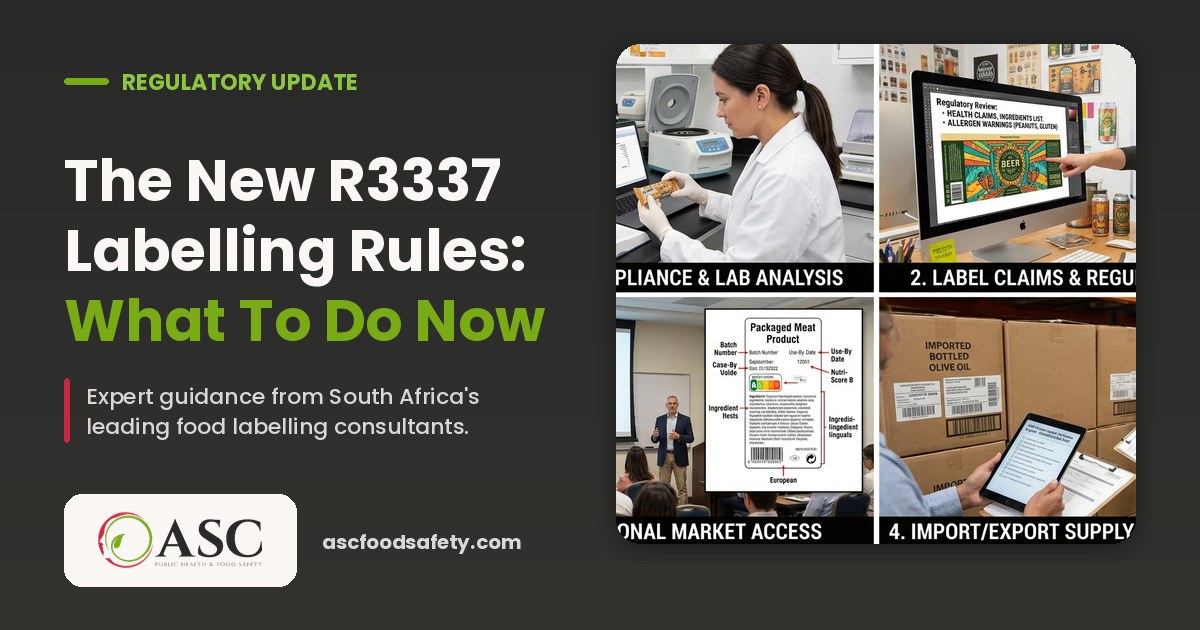
New R3337 Labelling Regulations: What To Do Now
The changes coming to every SA label and a preparation roadmap.

Best Before vs Use By: What the Law Says
Date marking rules, the 2026 reform debate and defensible shelf life.
What front of pack warning labels would mean under draft R3337
Which products will carry warning triangles and what to decide now.
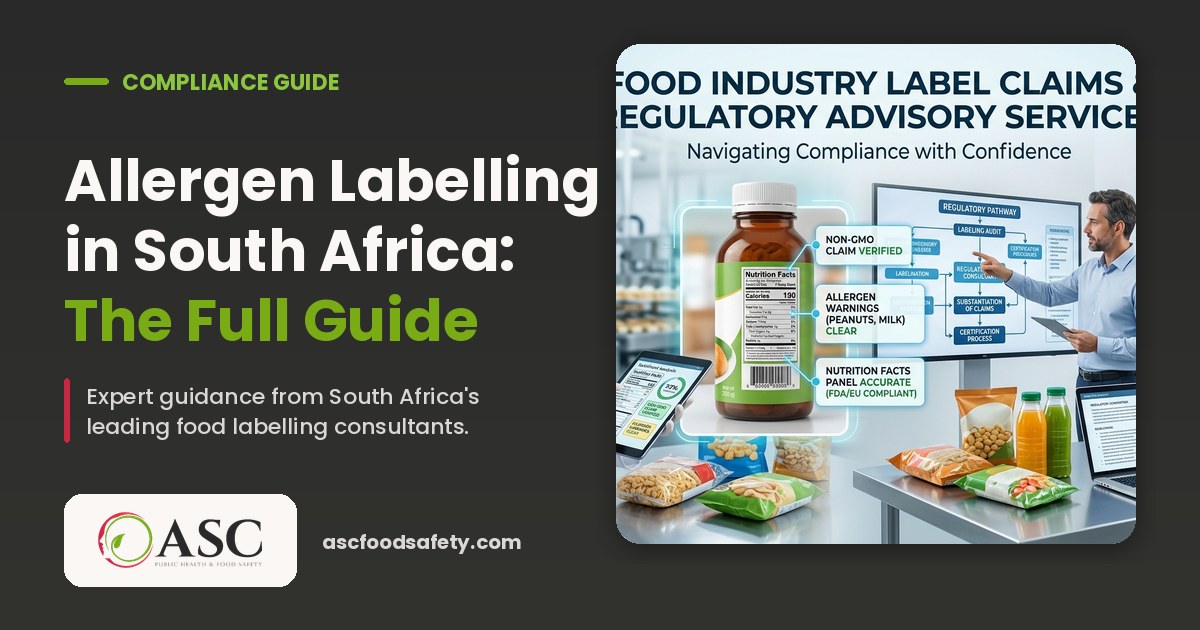
Allergen management and labelling: the complete guide
Every declaration and precautionary statement, done correctly.
How to Import Food into South Africa
Permits, label localisation and Port Health clearance, step by step.
The 12 Most Common Food Label Mistakes
The errors behind recalls and rejections, and how to fix each one.
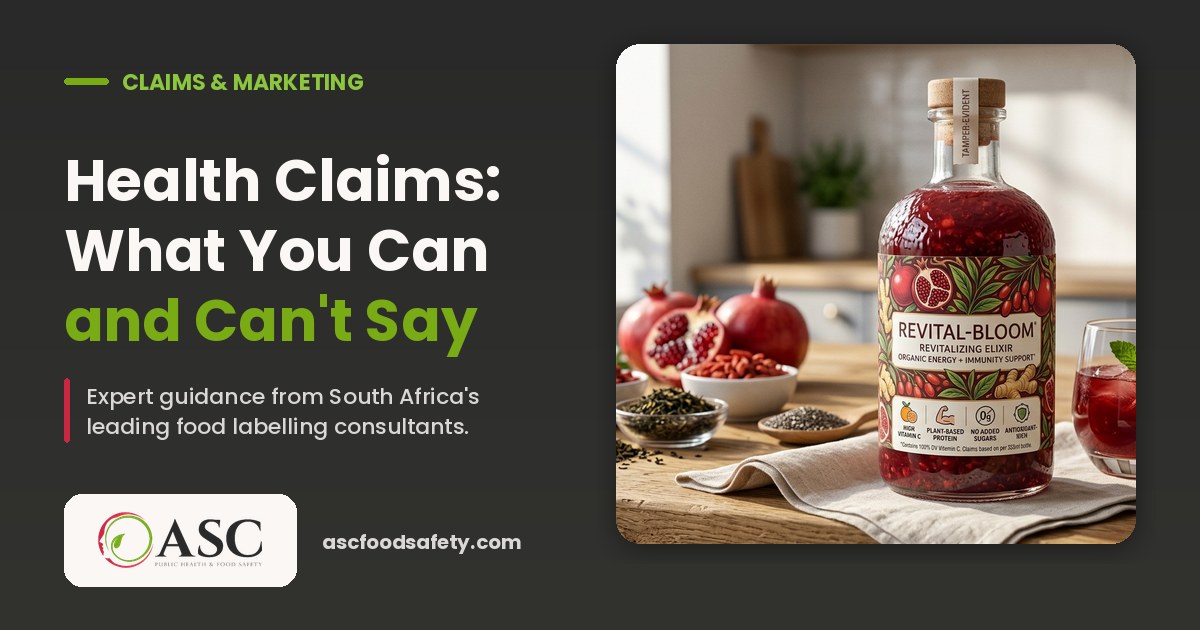
Health and Nutrition Claims: What You Can Say
Permitted claims, prohibited wording and substantiation.
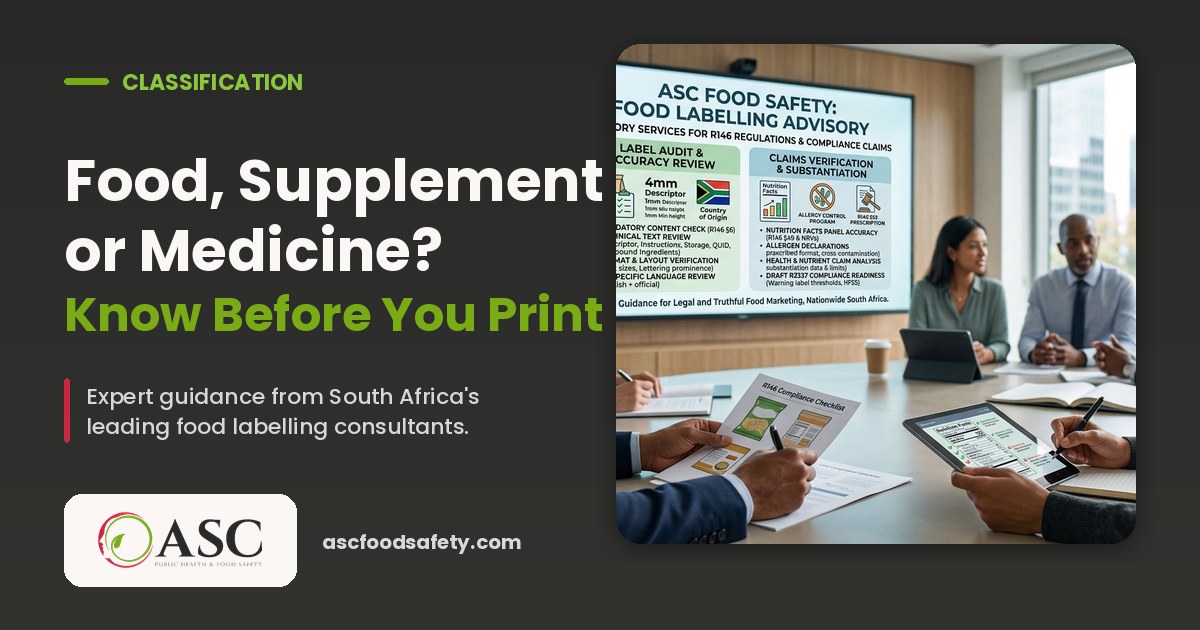
Food, Supplement or Medicine?
Classify your product correctly before artwork or shipping.
Send us the artwork. We will tell you what has to change before it goes to print.
Send us your artwork today and a senior regulatory consultant will come back to you with a scope, a price and a start date, usually the same working day. If you would rather talk first, book an hour with a consultant at R480. An hour is the entry point. A full labelling project is scoped over several days and quoted as one figure, not billed by the hour.
info@ascfoodsafety.com · Gqeberha (HQ): 14 Brickmakers Kloof Rd, South End · +27 41 004 0382 · Johannesburg: Atrium Terraces, 272 Oak Ave, Ferndale, Randburg · +27 10 500 4661 · Cape Town: 183 Albion Springs, Rondebosch · +27 21 300 4024 · After-hours standby: 079 068 1045 · Durban and nationwide service on request