
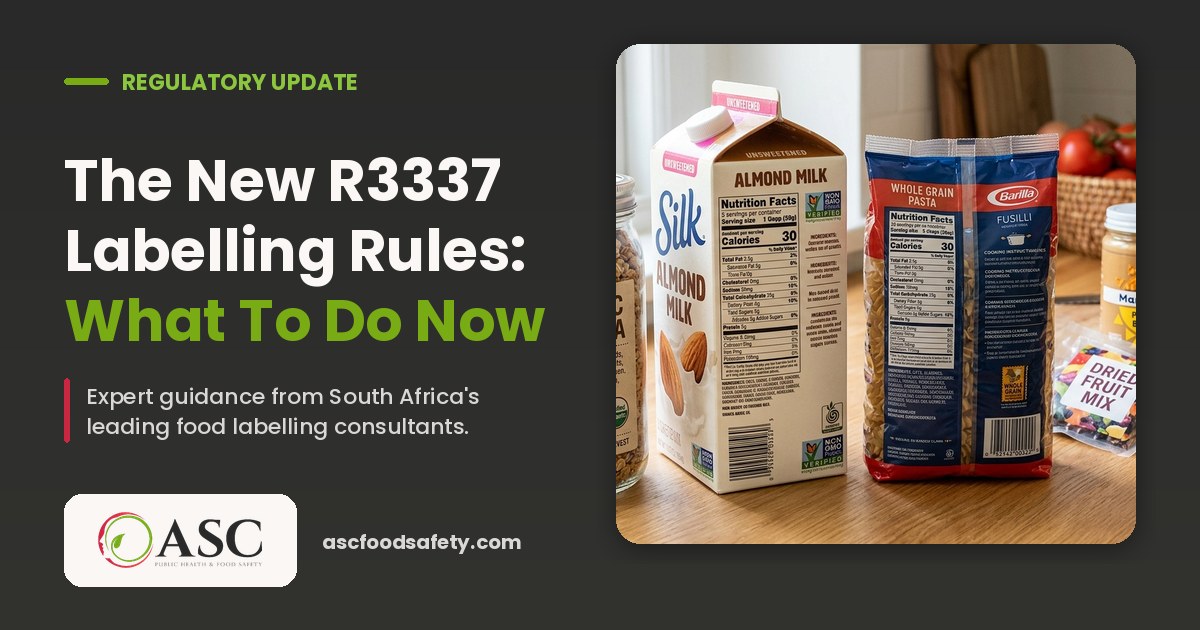
New R3337 Food Labelling Regulations: What Every South African Food Business Must Do Now
By Mthokozisi Nkosi, Food Safety & Regulatory Consultant, ASC Food Safety

If you manufacture, pack, import or retail food in South Africa, the single biggest regulatory shift of the decade is heading your way. Draft R3337, published for public comment in late 2023, is set to replace R146 of 2010 as the country’s food labelling law. To be clear from the outset: R3337 is still a draft as of mid-2026 and is not yet in force. R146 remains the law you must comply with today. But finalisation is expected, and the businesses that treat the draft as a planning document rather than a distant rumour will be the ones that keep their products on shelf without a last-minute scramble.
At ASC Food Safety, our regulatory work for leading pharmaceutical and FMCG brands, including names like Adcock Ingram, KFC Africa / Yum! Brands, Spur Corporation and Kellogg’s, has taught us one consistent lesson: labelling transitions are never as far away as they feel, and artwork pipelines are always slower than anyone budgets for. This article sets out where R3337 stands, what is changing, and a practical roadmap to get ahead of it.
Where R3337 Stands Right Now
South African food labels are currently governed by R146 of 2010: the Regulations Relating to the Labelling and Advertising of Foodstuffs, made under the Foodstuffs, Cosmetics and Disinfectants Act 54 of 1972. R146 has been the backbone of label compliance for over fifteen years, covering everything from ingredient lists and allergen declarations to date marking and prohibited claims.
Draft R3337 was published by the Department of Health for public comment in late 2023 and is intended to replace R146 entirely. The comment period generated significant industry response, and the Department has been working through submissions since. As of mid-2026, the regulation has not been finalised or gazetted into force, but finalisation is expected, and the direction of travel is unmistakable. When it lands, there will be a transition period, and every label in your portfolio will need to be reviewed against the new requirements.
The mistake we see repeatedly is businesses treating “still a draft” as “nothing to do yet”. The draft tells you, in considerable detail, what the Department of Health intends to require. Ignoring that signal is a commercial risk, not a saving.
R3337 vs R146: The Key Changes
1. Mandatory front-of-pack warning labels
The headline change. Draft R3337 introduces mandatory front-of-pack warning labels, modelled on Chile’s black warning system, for products high in sugar, sodium or saturated fat, and for products containing artificial sweeteners. If your product exceeds the thresholds, a prominent warning must appear on the front of the pack. For many South African brands, this is the first time the front of the pack (the marketing real estate) becomes regulated compliance territory. We unpack this fully in our companion article on front-of-pack warning label preparation.
2. Restrictions on marketing to children
Products carrying front-of-pack warnings face restrictions on marketing directed at children: think cartoon characters, toys, celebrity endorsements aimed at minors, and child-directed claims. For confectionery, snacks, cereals and beverages, this cuts to the heart of long-standing brand strategies.
3. Stricter allergen and gluten-free claim rules
R146 already requires declaration of common allergens: egg, cow’s milk, crustaceans and molluscs, fish, peanuts, soybeans, tree nuts, and gluten-containing cereals. Draft R3337 tightens the framework further, including stricter rules around gluten-free claims and how allergen information must be presented. If your allergen management programme is built on habit rather than validated controls, now is the time to fix it.
4. Tighter nutrition and health claims
The draft imposes a far more rigorous regime for nutrition and health claims. Claims that products high in sugar, sodium or saturated fat currently carry, such as “source of energy” and “with added vitamins”, face restriction where the product qualifies for a warning label. Substantiation requirements become sharper across the board. Every claim on every pack in your range will need to be re-justified, not just re-typeset.
5. A full-portfolio artwork impact
Beyond the headline items, R3337 revises requirements across the label: nutritional information presentation, ingredient declarations, and the interaction between claims and warnings. In practice, very few labels will pass unchanged. Multiply that across a 40-SKU portfolio, add design, translation, proofing, plate-making and packaging stock run-down, and you begin to see why early planning matters.
Key Takeaways
- R146 of 2010 is still the law. Draft R3337 is not yet in force, but it is expected to be finalised and will replace R146.
- The biggest changes: front-of-pack warning labels, marketing-to-children restrictions, stricter allergen and gluten-free rules, and tighter nutrition and health claims.
- Almost every label in a typical portfolio will need review. Artwork pipelines take longer than transition periods feel.
- Early movers protect shelf space, avoid packaging write-offs, and can reformulate on their own timeline instead of the regulator’s.
- A gap assessment against the draft now is the cheapest insurance you can buy.
Your R3337 Preparation Roadmap
Here is the phased approach we run with clients, from single-product start-ups to JSE-listed manufacturers.
Phase 1: Portfolio gap assessment (do this now)
Audit every SKU against both R146 (current compliance: you would be surprised how many labels fail the existing law) and draft R3337. For each product, establish: Would it trigger a front-of-pack warning? Which claims would fall away? What allergen presentation changes apply? The output is a risk-ranked register of your entire range.
Phase 2: Reformulate or relabel decisions
For every product that would carry a warning, you face a strategic choice: reformulate below the thresholds, or accept the warning and adjust positioning. Reformulation takes months: recipe trials, shelf-life validation, sensory work, costing. That is precisely why this decision cannot wait for the final gazette. Products that reformulate early avoid the warning entirely; products that wait wear it while their competitors do not.
Phase 3: Claims and artwork pipeline
Rebuild your claims register with substantiation files, then sequence artwork changes by commercial priority and packaging stock levels. Coordinate with procurement so you are not writing off millions of rands in printed film and cartons when the transition deadline arrives.
Phase 4: Train your people
Your NPD, marketing, QA and procurement teams all touch labelling decisions. A marketing manager who understands why “high in energy” is a regulatory claim, not just copy, saves you redesign cycles. Our accredited training arm offers the Essentials of Food Labelling Claims for Food Manufacturing course online and self-paced, alongside 25+ other food safety courses.
Phase 5: Monitor finalisation and execute
When R3337 is gazetted, the businesses with a completed gap assessment and pre-approved artwork concepts simply press go. Everyone else joins the queue at design agencies, printers and consultants, all at once.
Why Acting Before Finalisation Wins Shelf Space
Retail buyers do not wait for gazettes. Major South African retailers are already asking suppliers about R3337 readiness, because a supplier who cannot transition on time is a supplier who leaves a gap on shelf. Demonstrating a documented readiness plan is becoming a listing advantage.
There is also the enforcement dimension. Non-compliant labels expose you to product recalls, Port Health detentions at the point of entry for imported goods, and National Consumer Commission action. None of these are hypothetical. They are the routine consequences of labels that fail inspection. And every one of them costs multiples of what proactive compliance costs.
Finally, there is the quiet competitive upside: a reformulated product that avoids a warning label, launched before the regulation bites, effectively gets a head start the market will not see coming until it is too late to copy.
Book a Label Compliance Review
Get every SKU assessed against R146 and draft R3337 by the team trusted by Adcock Ingram, KFC Africa, Spur and Kellogg’s, with a 48-hour label review option available.
For the full picture of how we support labelling and regulatory compliance end to end (label reviews, claims substantiation, import support and Port Health readiness), visit our Labelling & Regulatory Advisory service page.
Frequently Asked Questions
Is R3337 already law in South Africa?
No. R3337 is a draft regulation published for public comment in late 2023. As of mid-2026 it has not been finalised, and R146 of 2010 remains the current food labelling law. Finalisation is expected, however, so preparation should already be underway.
What is the biggest change in draft R3337 compared to R146?
Mandatory front-of-pack warning labels for products high in sugar, sodium or saturated fat, modelled on Chile’s system, together with restrictions on marketing those products to children, stricter allergen and gluten-free claim rules, and tighter nutrition and health claims.
How long will businesses have to comply once R3337 is finalised?
The final regulation is expected to include a transition period, but its length is not yet confirmed. Experience with previous labelling transitions shows that artwork, reformulation and packaging stock run-down consume transition periods faster than expected, which is why gap assessments should happen before finalisation.
Does R3337 affect imported foods?
Yes. Imported foods sold in South Africa must comply with South African labelling law, and non-compliant consignments risk Port Health detention at the point of entry. Importers should assess their ranges against both R146 and the draft now.
What should my business do first?
Commission a portfolio gap assessment against R146 and draft R3337. It identifies which products would trigger warnings, which claims are at risk, and where reformulation makes commercial sense, giving you a risk-ranked action plan before the final regulation lands.
ASC Food Safety Consultants. Leading with Science. Ensuring Food Safety. Serving clients from Gqeberha, Johannesburg, Cape Town and Durban, with nationwide virtual support. Rated 4.9/5 from 1,200+ Google reviews.