
Pre-COA Audit for Food Businesses
A Pre-COA audit is one of the smartest steps a food business can take before applying for a Certificate of Acceptability.
ASC Food Safety Consultants
Leading with Science. Ensuring Food Safety.
Browse our articles in the Other category, covering diverse topics in food safety, quality management, and industry best practices.
A Pre-COA audit is one of the smartest steps a food business can take before applying for a Certificate of Acceptability.

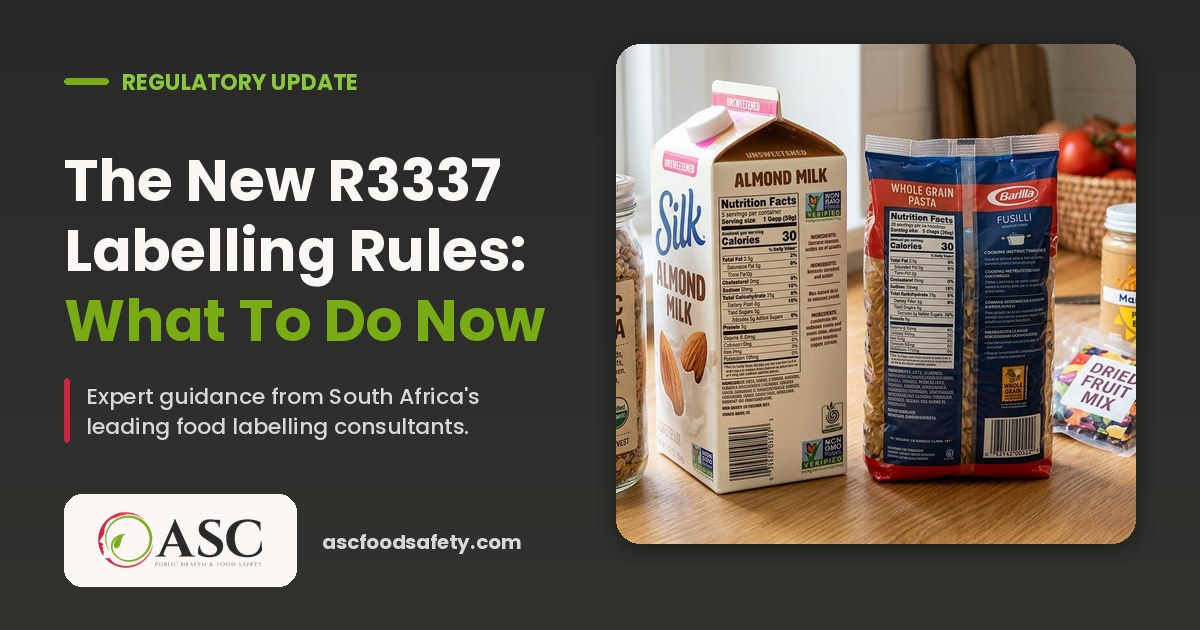
New Codex guidance pushes precautionary allergen labelling toward risk-assessment-based approaches, reinforcing existing BRCGS Gluten-Free requirements. Plus: book your spot on our 8-10 September virtual BRCGS Implementation training.

By Mthokozisi Nkosi, Food Safety & Regulatory Consultant, ASC Food Safety Date marking has become one of the most debated topics in South African food policy in 2026, and for good reason. Commentators are calling for reform because the numbers are hard to look at: South Africa wastes roughly a …
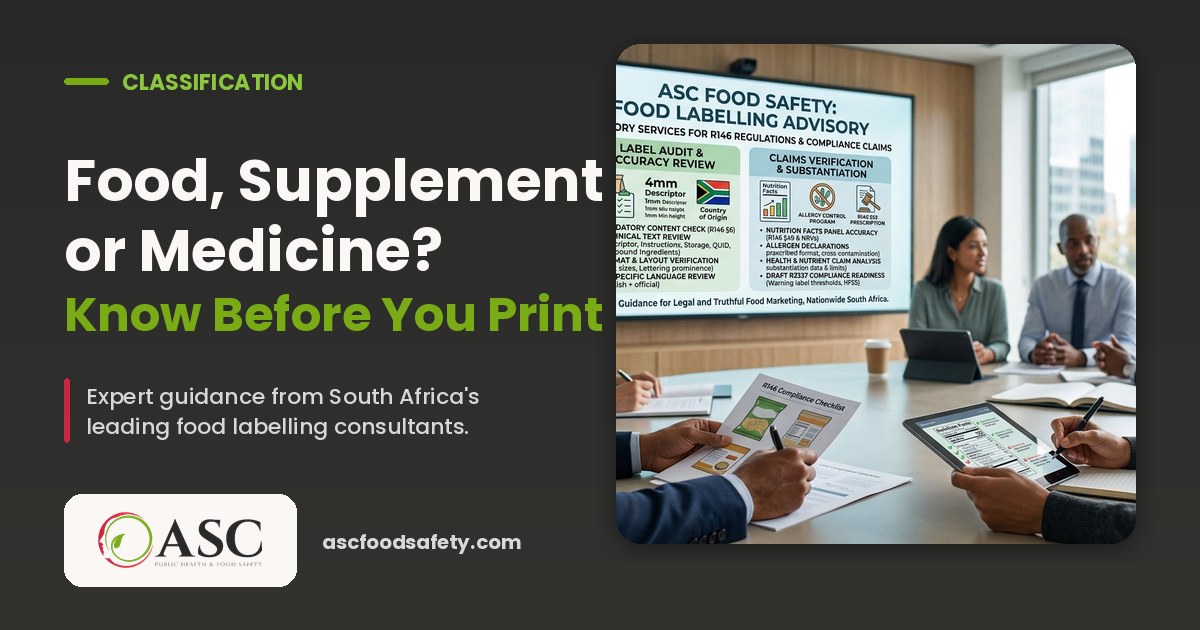
By Mthokozisi Nkosi, Food Safety & Regulatory Consultant, ASC Food Safety Before you design a label, register a facility, book a shipping container or brief an advertising agency, one question decides everything that follows: what is this product, in the eyes of South African law? Food or medicine classification in …
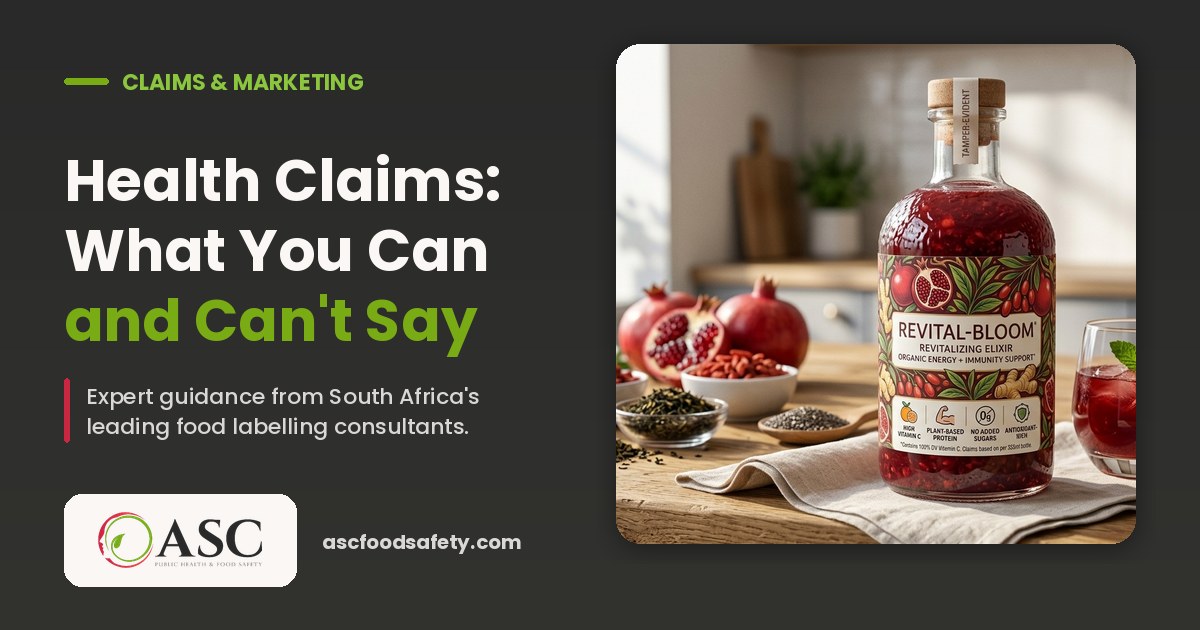
By Mthokozisi Nkosi, Food Safety & Regulatory Consultant, ASC Food Safety Claims sell. “High in protein” moves product off the shelf; “sugar-free” wins the comparison at eye level; “supports immunity” speaks straight to what consumers want to hear. Which is precisely why claims are the most tightly policed words on …
A food hygiene audit is an independent, evidence-based assessment of a food-handling facility’s compliance with hygiene, sanitation, food handling, documentation and structural requirements – measured against South African law (most importantly Regulation R638 of 2018 under the Foodstuffs, Cosmetics and Disinfectants Act 54 of 1972) and recognised international standards such …
BRCGS ISSUE 9 · CLAUSE 1.1.2 · CULTURE PLAN A poster on the wall is not a culture plan. BRCGS Issue 9 Clause 1.1.2 expects a measurable, action-driven, annually-reviewed food safety culture programme, built around the 5 GFSI culture dimensions and validated by auditor interviews with line operators, not just …
DECISION FRAMEWORK · BRCGS · FSSC 22000 · IFS · SQF Four GFSI-benchmarked food safety standards. One global supply chain. Choosing wrong costs you customers, audit cycles and capital. This is the decision framework South African food manufacturers need, built around your customer base, your geography, and your existing management …
BRCGS ISSUE 9 · AUDIT PREPARATION · 90 DAYS OUT A practical, week-by-week, day-by-day BRCGS Food Safety audit preparation roadmap. From 90 days out to the morning of audit day. The countdown auditors actually want, built around the 8 Fundamentals, the 12 Fundamental clauses (when counting all sub-clauses), and BRCGS’s …
FSSC 22000 · Audit Findings · Authority Guide An evidence-based playbook drawn from real FSSC 22000 (May 2026) transition gap audits, mock audits and post-CB-audit reviews, clause by clause, with severity grading, root cause analysis and the corrective action that closes each finding cleanly. By Mthokozisi Nkosi, Food Safety Specialist …

Published: 24 April 2026 By: Mthokozisi Nkosi · Food Scientist · Registered Lead Auditor (Exemplar Global & IRCA) · SAATCA R638:2018 Lead Implementer Reading time: 26 minutes Every Act, every regulation, every department that touches your food business, decoded in plain English by one of only three SAATCA Registered R638 …

Part 7: Understanding the requirements for the use of the FSSC logo. Learn more about the FSSC 22000 V6 additional requirements in this 20-part series!
(Act No. 107 of 1998) This South African regulation primarily focuses on setting standards for integrating climate change considerations into applications for environmental authorisations, atmospheric emission licences, and waste management licences, ensuring that environmental impact assessments account for greenhouse gas emissions, mitigation strategies, and climate-resilient planning.

Food poisoning occurs when food is contaminated with microorganisms that produce toxins leading to illnesses. To ensure the food is safe, the consumer has a responsibility to take necessary precautions to prevent food poisoning. Below are the 10 tips to prevent food poisoning: 1. Separate food The first thing one …

South Africa’s most accredited online R638 Person in Charge course, 8 hours of self-paced video learning across 4 modules, finishing with a live Zoom video-call assessment by a SAATCA-credentialed assessor. Triple-accredited by SAATCA (TC No. 065), FoodBev SETA (F01/585/ASR00067) and the HPCSA. Lifetime course access. QR-coded HPCSA certificate accepted at …