Paperless food safety management, legal, auditable and priced in rand.
Printing is a cost centre. Paperless is a compliance strategy. Compare what your paper system really costs per year, in rand, against the subscription that replaces it. Then see what going paperless does for your ESG reporting, your audits and your certification, because the world your customers buy from is moving digital either way.

A paperless food safety management system replaces printed checklists, logs and document files with time-stamped digital records captured on phones, tablets and computers. In South Africa the Electronic Communications and Transactions Act 25 of 2002 gives data messages legal force, so HACCP, R638 and FSSC 22000 records can be kept, signed off and audited digitally. ASCloud does this from R499 per site per month.
A paperless office is not the same as a paperless food safety system
Document management software, the kind most "paperless office" guides describe, scans and stores files. A food business needs more than storage: the checks themselves have to be done on screen, at the time, by a named person, against the standard you are audited to.
| What you need on audit day | Paperless office (document management) | Paperless food safety system (ASCloud) |
|---|---|---|
| Scanned policies and procedures | version controlled, read and signed | |
| Daily CCP, cleaning and temperature checks done on screen | No | scheduled per line and shift |
| Alert when a check is missed | No | escalated to the person you name |
| HACCP, R638, FSSC 22000 or BRCGS requirements pre-loaded | No | with scheme updates included |
| Corrective actions linked to the failed check | Rarely | |
| Audit pack by clause or date | Manual | one export |
See the full paper, checklist app and FSMS comparison.
Printing versus digital, line by line
| What it costs you | Paper and printing | ASCloud, paperless |
|---|---|---|
| The visible cost | Paper, toner, printer leases and service, binders, archive boxes and offsite storage, every month, forever | One subscription per site, published in rand, price held 12 months |
| The hidden cost | Hours spent filing, retrieving, photocopying for auditors and re-writing damaged sheets | Records file themselves. Any record found by search in seconds |
| Legibility and damage | Grease, water, fading ink and torn pages. A wet checklist is a lost record | Digital records do not fade, tear or go missing |
| Backfilling risk | Paper can be completed after the fact, and auditors know it. Suspiciously tidy files invite deeper digging | Time-stamped entries by named users, with late or edited entries flagged, exported as an audit pack |
| The missed check | Discovered at month end, or worse, by the auditor | Escalated the same shift on the completion calendar |
| Audit day | A trolley of files and a nervous afternoon of page-turning | An audit pack in one export. The traceability test from linked batch records with the traceability module |
| Disaster recovery | Fire, flood or a lost archive box is unrecoverable | Hosted in South Africa, encrypted, backed up daily |
| ESG reporting | Paper consumption is a scope 3 line item you keep having to explain | A measurable, reportable reduction, with the numbers to prove it |
The printing versus paperless calculator
Type your own numbers. Defaults are conservative industry averages for a single South African production site. Your print and admin figures may be higher.
Estimates only, using approximately 5 g per A4 sheet and 8,000 sheets per tree. Consumable pricing varies by device and volume. Setup fees excluded on both sides: the paper system needed setting up too. All amounts exclude VAT.
What paperless does for your ESG story
ESG reporting stopped being a listed-company problem. Retailer supplier scorecards, export customer questionnaires and lender due diligence now reach ordinary food businesses, and every one of them asks about resource use and governance evidence.
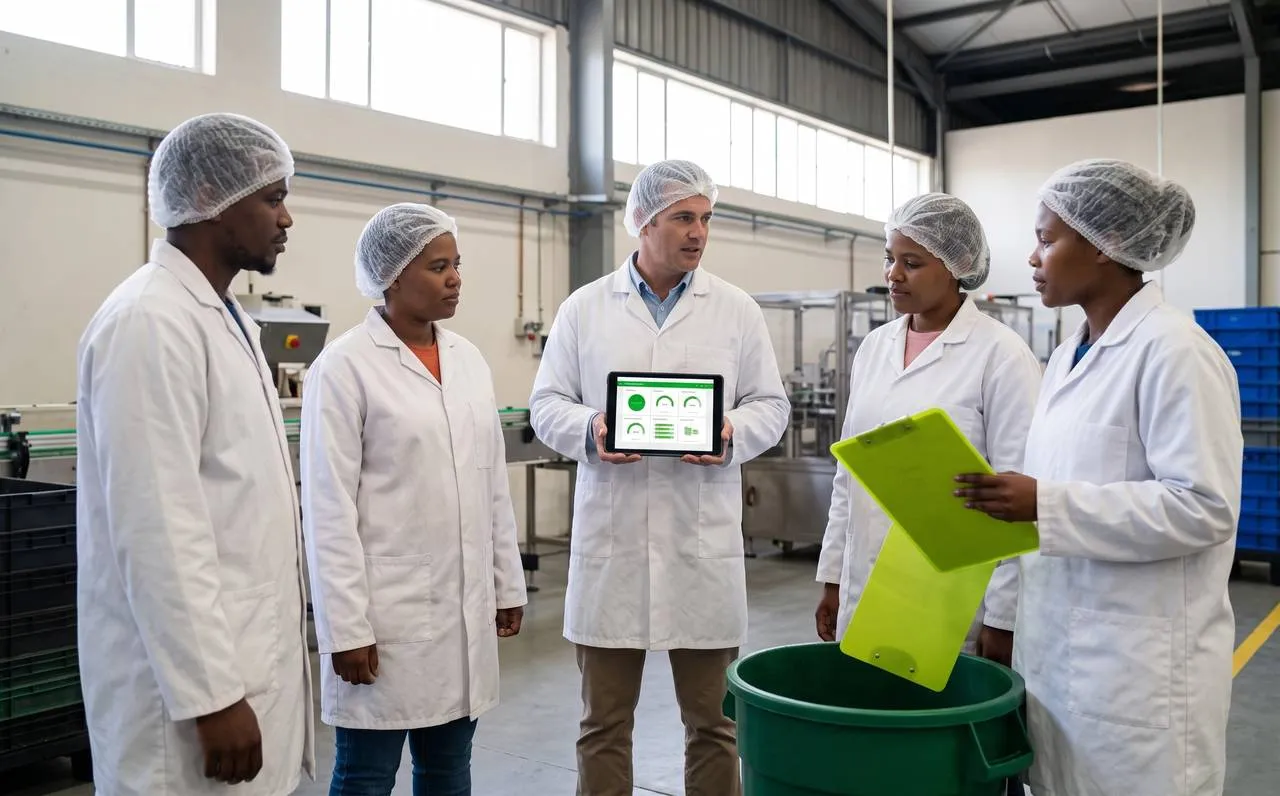
Environmental, measured
A paper checklist system consumes paper, toner cartridges, printer energy and courier or storage kilometres. Going paperless converts that entire line into a measurable reduction you can put in a sustainability report, with the page counts to prove it, straight from the calculator above.
Social, evidenced
Worker training records, hygiene and safety checks and ethical audit evidence (SIZA on farms, retailer codes in factories) live in the same system, signed and dated. The social pillar of ESG is mostly proof of care for people; ASCloud is where that proof accumulates.
Governance, built in
King V asks boards to govern information and technology and to report with integrity. An attributable, time-stamped record system with role-based access is governance you can demonstrate on screen. Management review packs generate from live data.
Retailer scorecards
Woolworths, Shoprite, Pick n Pay and SPAR supplier programmes increasingly score sustainability alongside food safety. Documented paper reduction and digital traceability answer the questions their questionnaires actually ask.
Standards are moving too
FSSC 22000 V6 added food loss and waste and strengthened environmental monitoring expectations, and Version 7, published in May 2026, continues in the same direction. Remote and ICT-assisted audit rules in the GFSI-recognised schemes work best when records are digital. The schemes themselves are telling you where this goes.
Exporters feel it first
EU customers report under CSRD and push data requests down their supply chain. The US FSMA 204 traceability rule requires electronic sortable records for listed foods, with compliance due from 20 July 2028. If you export, digital record-keeping is becoming a market access requirement.
Why auditors prefer the paperless site
Evidence that verifies itself
Every record carries the person, the date and the time it was actually made, so a late entry shows as late. Auditors spend their sampling time confirming your system works instead of hunting for gaps, and a clean, verifiable trail sets the tone for the whole audit.
The traceability test, on demand
BRCGS requires a timed traceability test; FSSC expects mass balance on request. With the traceability module, digital batch records linked from intake to dispatch run these exercises in minutes, on any day of the year.
Trends, not snapshots
Certification schemes increasingly ask what you do with your data: trending, verification and management review. Paper answers with anecdotes. A dashboard answers with the actual completion rates, breaches and closure times.
Remote and hybrid audits
GFSI-recognised schemes formalised remote auditing, and a certification body can review digital records off-site. A paper site cannot participate in that world without couriering files.
Is a paperless record legally valid in South Africa?
Yes. The Electronic Communications and Transactions Act 25 of 2002 was written for exactly this. The sections that matter for food safety records are these.
| ECT Act section | What it says | What it means for your records |
|---|---|---|
| Section 11 | Information is not without legal force and effect merely because it is in the form of a data message. | A digital temperature log is a real record. |
| Section 12 | A requirement for writing is met by a data message that is accessible for subsequent reference. | Records must be findable later, which ASCloud's search and audit pack provide. |
| Section 13 | Where parties have not agreed a signature type, a method that identifies the person and shows their approval is enough. Where a law requires a signature of no stated type, an advanced electronic signature is needed. | Named-user sign-offs cover scheme requirements. Ask ASC about the rare legal signatures. |
| Section 15 | A data message may not be refused as evidence merely because it is a data message. | Digital records stand up in a dispute or an inspection. |
| Section 16 | A duty to retain records is met by a data message that is accessible, accurate and shows its origin, date and time. | Keep records in their original format, time-stamped, with the author recorded. |
Source: Electronic Communications and Transactions Act 25 of 2002, SAFLII. This is general information and is no substitute for legal advice.
Do auditors accept electronic food safety records?
Certification bodies audit the evidence, whatever it is stored on. FSSC 22000 introduced rules for ICT-assisted audits in 2020, in which documents and records can be reviewed remotely before on-site verification. What every auditor checks is the same: is the record complete, made at the time, attributable to a person, and protected from silent changes. A paperless system shows all four on screen, and shows a late entry as late.
Source: FSSC 22000, requirements for the use of ICT. For exporters to the United States, the FDA's FSMA 204 traceability rule calls for an electronic sortable spreadsheet within 24 hours of a request, with compliance required from 20 July 2028 (FDA).
How to go paperless in a food business, in 7 steps
- List every form you print. Walk the site with a clipboard one last time. Every checklist, log, register and form goes on the list, with how often it is filled in and who signs it.
- Map each form to the requirement it proves. Tie each record to its HACCP step, R638 regulation or scheme clause. Forms that prove nothing can go, and gaps show up before the auditor finds them.
- Choose a system that already holds your standard. A system with the requirement set pre-loaded saves you writing it. ASCloud loads R638, HACCP, GFSI Global Markets, GLOBALG.A.P., FSSC 22000, BRCGS, SQF or IFS before your first login.
- Move the live daily records first. Start with the checks done every shift: temperatures, CCPs, cleaning, pre-starts. They carry the most paper and the most audit risk.
- Scan the legacy records you must keep. Keep old paper records for the period your scheme and the law require, scanned in a readable format with their dates, so section 16 of the ECT Act is met.
- Train each shift on its own device. Operators learn one checklist at a time on the phone or tablet they will use. A supervisor verifies the first week of records on screen.
- Verify for a month, then retire the printed forms. Run a month of internal checks on the digital records. When they are complete and verified, remove the printed forms from the floor for good.
Paperless records and POPIA
Section 14 of the Protection of Personal Information Act says personal information must not be kept longer than necessary, and must then be destroyed or de-identified. Training records, medical fitness certificates and incident reports all hold personal information. A digital system sets review dates and limits access by role, which a filing cabinet cannot do. Source: POPIA section 14.
What a paperless food safety system costs in South Africa
ASCloud costs from R499 per site per month for R638 and Certificate of Acceptability records, and from R3,800 for a full document FSMS covering HACCP, FSSC 22000 or BRCGS. Add-on modules start from R650. Setup is once-off from R3,850. Prices exclude VAT, are invoiced in rand and can be shown in your currency. It runs on the web and as apps for Apple iPhone and iPad and Android.
Going paperless: questions answered
Are electronic records legally valid in South Africa?
Yes. Section 11 of the Electronic Communications and Transactions Act 25 of 2002 says information is not without legal force and effect merely because it is in the form of a data message. Section 12 meets a legal requirement for writing when the record is accessible for later reference, and section 16 meets a legal duty to retain records when the stored record is accessible, accurate and shows its origin, date and time.
Do FSSC 22000 and BRCGS auditors accept digital records?
Yes. Certification bodies audit the evidence, whatever it is stored on. FSSC 22000 has allowed ICT-assisted audits since 2020, in which documents and records are reviewed remotely before on-site verification. What auditors check is that records are complete, attributable to a person, dated and cannot be changed without trace.
Is an electronic signature valid on a HACCP record?
A sign-off required by your food safety standard is met by a method that identifies the person and shows their approval, as section 13(3) of the ECT Act describes. ASCloud does this with a personal login and a time stamp. Where a law itself demands a signature without saying what type, section 13(1) requires an advanced electronic signature, and ASC advises on those cases.
How do I go paperless in a food factory?
List every form you print, map each one to the HACCP, R638 or scheme requirement it proves, choose a system that holds those requirements, move live daily records first, scan the legacy files you must keep, train each shift, then verify for a month and retire the printed forms. The seven steps are set out on this page.
Is a paperless food safety system cheaper than printing?
Usually, once staff time is counted. Printing, filing, finding and rewriting records costs most sites more each year than a subscription. The calculator on this page works it out with your own page counts, costs and admin hours.
What happens to digital records during load shedding?
Checklists already open on a device can be completed without signal and upload when the connection returns, with the real time of the check kept. Keep devices charged, because records waiting to sync stay on the device until then.
How much does a paperless food safety system cost in South Africa?
ASCloud costs from R499 per site per month for R638 and Certificate of Acceptability records and from R3,800 for a full document FSMS covering HACCP, FSSC 22000 or BRCGS. Modules start from R650. Setup is once-off from R3,850. Prices exclude VAT and are invoiced in rand.
Does going paperless help with POPIA?
It can. Section 14 of POPIA says personal information must not be kept longer than necessary and must then be destroyed or de-identified. Staff training and medical fitness records hold personal information, and a digital system can set review dates and access by role, which paper archives rarely manage.
How does going paperless help with ESG reporting?
It turns paper, toner and storage into a number you can report, gives named and dated evidence of training and welfare checks for the social pillar, and gives the board an audit trail for governance. The ESG section on this page sets out each pillar.
 Reviewed by Mthokozisi Nkosi, FSSC 22000 and BRCGS Lead Auditor and founder of ASC Food Safety Consultants. Updated 3 October 2026.
The record exists. Now it can be found.
Twenty minutes online, your standard loaded before the call, your own last audit findings shown inside the system. Setup by lead auditors, live in five working days, with every price published before you commit.