
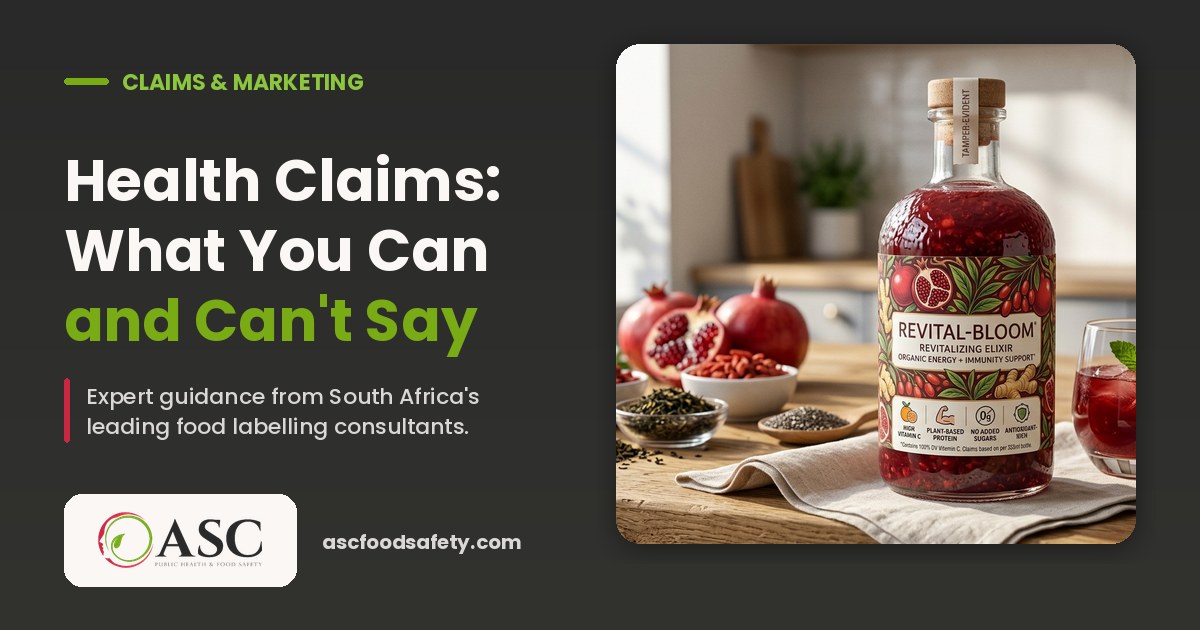
Health & Nutrition Claims on South African Food Labels: What You Can and Can’t Say
By Mthokozisi Nkosi, Food Safety & Regulatory Consultant, ASC Food Safety

Claims sell. “High in protein” moves product off the shelf; “sugar-free” wins the comparison at eye level; “supports immunity” speaks straight to what consumers want to hear. Which is precisely why claims are the most tightly policed words on a South African food label, and the area where marketing ambition and regulatory reality collide most often.
In our advisory work for leading pharmaceutical and FMCG brands, claims reviews are where we reject the most copy. Not because the rules are obscure, but because claims decisions are usually made in marketing meetings without a regulatory voice in the room. This guide sets out what South African law currently allows, what it prohibits outright, what evidence you need to hold, and how the coming regulatory changes are likely to raise the bar.
Key takeaways
- R146 of 2010 is the current law governing claims on food labels and in food advertising, and it applies to your website and social media, not just the pack.
- Claims that a food treats, prevents or cures a disease are prohibited, full stop.
- Every nutrition claim must be substantiated, typically by accredited laboratory analysis you keep on file and refresh after reformulation.
- Draft R3337 is expected to tighten claims rules significantly, including front-of-pack warning labels that will disqualify some products from making claims at all. It is not yet in force.
The legal framework: claims under R146
Claims on South African food labels are governed by R146 of 2010: the Regulations Relating to the Labelling and Advertising of Foodstuffs, made under the Foodstuffs, Cosmetics and Disinfectants Act 54 of 1972. Two points about its scope are routinely underestimated:
- It covers advertising, not just labels. The same rules that govern your pack govern your website, your Instagram captions, your influencer briefs and your point-of-sale material. A claim you would never print on pack does not become legal because it appears in a caption.
- The overarching test is that labelling may not mislead. Even a technically true statement can be non-compliant if its presentation creates a false impression about the product’s nature, composition or benefits.
Within that framework, it helps to think of claims in three bands: prohibited claims (never allowed), regulated claims (allowed only when defined criteria are met and substantiated), and grey-zone wording that requires case-by-case judgement.
What you can’t say: prohibited claims
Disease treatment and prevention claims
The bright red line: a food label may not claim or imply that the product treats, prevents or cures a disease or medical condition. “Fights diabetes”, “lowers cholesterol”, “prevents cancer”, “cures flu”: all prohibited, however the sentence is dressed up. Softer phrasings that imply the same thing (“clinically supports healthy blood sugar”) do not escape the rule; implication counts.
There is a second danger here. A product marketed with therapeutic claims can be regarded as a health product rather than a food, pulling it toward SAHPRA’s jurisdiction, with registration requirements no food business wants to discover mid-launch. If your marketing team is drifting into medicine’s vocabulary, that is a strategic risk, not just a labelling one.
Misleading descriptors and implied claims
Words like “natural”, “pure”, “traditional” and “fresh” are regulated descriptors that must reflect the actual product. Imagery counts too: a pack design that implies the product is something it is not (bursting with fruit it barely contains, for instance) can be misleading labelling even if no written claim is made.
What you can say, if you qualify
Nutrient content claims
Claims such as “low fat”, “sugar-free”, “high in fibre”, “source of protein” or “reduced sodium” are permitted only where the product meets the defined compositional criteria for that specific claim. The thresholds are precise. “Low”, “free”, “reduced”, “source of” and “high in” each mean something specific, and a product that misses the threshold by a fraction does not qualify, no matter how close it came.
Making a content claim also brings obligations with it: the relevant nutritional information must be presented so the consumer can see the basis for the claim. A claim on the front commits you to the numbers on the back.
Comparative claims
“25% less sugar” and similar comparative claims are among the most abused on the shelf. A compliant comparative claim must compare like with like, be based on a genuine and meaningful difference, and make clear what the comparison is against: your own standard product, not a conveniently sugary outlier. A vague “now with less sugar!” with no stated reference point is the kind of claim that regulators, retailers and competitors all know how to challenge.
Substantiation: the evidence behind every claim
The rule our consultants repeat most often: if you can’t prove it, you can’t print it. Every claim needs an evidence file, built before the artwork goes to print:
- Accredited laboratory analysis confirming the product meets the compositional threshold for each content claim, not supplier brochure values, not recipe calculations alone for contested claims.
- Re-testing after reformulation. A claim substantiated for last year’s recipe is not substantiated for this year’s. Every formulation change should trigger a claims review.
- Batch-representative sampling. Nutrient levels vary between production runs; your evidence should reflect the product as sold, not a golden sample.
- A documented claims register. Every claim, on every SKU and every channel, mapped to its evidence. When a retailer’s technologist or an inspector asks, the answer should take minutes, not weeks.
Endorsement logos and third-party marks
Endorsement logos (health-association marks, certification symbols, association seals) are a form of claim, and they are regulated as such. Two rules of thumb keep you safe. First, only use a mark under a current, valid agreement with the endorsing body, on the products the endorsement actually covers. Second, remember that an endorsement cannot legitimise an otherwise non-compliant message: a logo implying a health benefit does not override the prohibition on disease-risk claims. Audit your endorsements annually: expired agreements quietly surviving on artwork is a mistake we find more often than you would expect.
What draft R3337 is expected to change
Draft R3337, published for comment in late 2023, is intended to replace R146 in its entirety. It remains a draft as of mid-2026 (it is not yet in force, and R146 remains the law today), but finalisation is expected, and the direction on claims is unmistakable:
- Mandatory front-of-pack warning labels for products high in sugar, sodium or saturated fat, modelled on Chile’s warning system. Critically, products carrying warning labels are expected to face restrictions on making positive nutrition and health claims: a product cannot boast on one panel while warning on another.
- Restrictions on marketing to children, including how claims and characters may be used on products aimed at younger consumers.
- Stricter allergen and gluten-free claim rules, raising the evidentiary bar for “free-from” positioning.
- Tighter nutrition and health claim criteria overall, narrowing the space for creative wording.
The practical implication: a claims strategy built for the loosest reading of R146 is a strategy with a short shelf life. Brands reformulating or redesigning packaging now should stress-test their claims against the draft’s proposals. It is far cheaper to future-proof today than to re-run artwork across a whole range under a compliance deadline. Our team tracks the draft’s progress and runs exactly this gap analysis for clients.
Build the capability in-house
The businesses that get claims right are the ones where marketing, NPD and quality all understand the rules, not just the one person who once read R146. That is why we built a dedicated online course, Essentials of Food Labelling Claims for Food Manufacturing, on our accredited training platform. It takes your team through claim categories, qualification criteria, substantiation and the practical review process, self-paced and online. Explore it at ascfoodsafetytraining.com. For full artwork and claims reviews by our consultants, see our Labelling & Regulatory Advisory service.
Not sure your claims would survive a challenge?
Book a label compliance review. We audit every claim on your pack and in your marketing against R146, flag the risks, and show you what to fix before a regulator or retailer does.
Book a Label Compliance Review
Call +27 41 004 0382 or email info@ascfoodsafety.com
Frequently asked questions
Can I say my product “boosts immunity” in South Africa?
No. Claims that a food treats, prevents or cures a disease or medical condition are prohibited under R146, and immune-boosting claims sit squarely in that territory. Implied versions of the same message are equally non-compliant.
What proof do I need for a “low fat” or “sugar-free” claim?
Laboratory analysis from an accredited laboratory confirming the product meets the defined threshold for that specific claim, kept on file and refreshed whenever the formulation changes. Recipe calculations alone are risky for contested claims.
Do claims rules apply to my website and social media?
Yes. R146 governs the advertising of foodstuffs as well as labels, so the same claims rules apply to your website, social media content, influencer marketing and point-of-sale material.
Are comparative claims like “25% less sugar” allowed?
They can be, but only when the comparison is genuine, meaningful, made against a clearly identified reference product, and substantiated. Vague comparisons with no stated reference point are non-compliant.
Has R3337 replaced R146 yet?
No. R3337 was published as a draft for comment in late 2023 and is expected to replace R146 once finalised, but as of mid-2026 it is not in force. R146 remains the current law, though prudent brands are already testing their claims against the draft’s stricter proposals.
By Mthokozisi Nkosi, Food Safety & Regulatory Consultant, ASC Food Safety. ASC advises leading pharmaceutical and FMCG brands on labelling, claims and regulatory strategy from Gqeberha, Johannesburg, Cape Town and Durban, with nationwide virtual support.