
By Mthokozisi Nkosi, Food Safety Specialist & Lead Auditor, ASC Food Safety · 9 min read
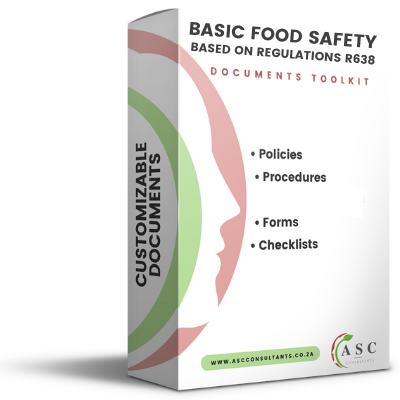
Every food business in South Africa has to manage food safety, but not every business needs a full certification scheme to do it. For food handlers, small manufacturers, takeaways and spaza operations, the priority is a clean, compliant, well-documented operation. A basic food safety document templates toolkit gives you exactly that: the essential policies, procedures and records to run a hygienic, R638-ready business.
At a glance
- Level
- Foundational food safety and hygiene documentation
- Supports
- Regulation R638 and Certificate of Acceptability readiness
- Best for
- Food handlers, small manufacturers, takeaways, retailers and start-ups
- Covers
- Hygiene, cleaning, pest control, personal hygiene and basic records
- Format
- Fully editable Microsoft Word & Excel, instant download, yours to keep
In this guide
What is the basic food safety toolkit?
The basic toolkit is a practical set of food safety documents for businesses that need solid fundamentals rather than a full certification system. In South Africa, food premises must comply with Regulation R638 under the Foodstuffs, Cosmetics and Disinfectants Act, and obtain a Certificate of Acceptability from the local authority. Behind that sits a set of everyday practices, hygiene, cleaning, pest control, temperature control and record-keeping, that an environmental health practitioner expects to see.
The toolkit gives you those documents, ready to use. It includes the basic food safety policy, the good hygiene and manufacturing practice procedures, and the simple forms and registers you need to show that your business operates safely. You add your details, put the procedures into practice, and keep the records.
Why documented hygiene matters
It is easy to think that a small operation does not need paperwork, but an environmental health practitioner, a landlord, an insurer or a customer will all ask the same thing: can you show that you manage food safety? Clean premises and good habits are essential, but without written procedures and simple records there is nothing to demonstrate. The documentation is what turns a tidy kitchen into a defensible, compliant business.
A clean kitchen keeps food safe; documented hygiene keeps your business safe. You need both.
Writing those policies and records from scratch is off-putting for a small team. The toolkit removes that hurdle by giving you the essentials already written in plain, practical language, so you can get compliant quickly and get back to running the business.
What is inside the toolkit
- A basic food safety and hygiene policy
- Good hygiene practice and personal-hygiene procedures
- Cleaning and sanitation schedules and procedures
- Pest control, waste management and maintenance basics
- Temperature control, receiving and storage procedures
- Simple monitoring forms, cleaning records and training registers
The toolkit and R638
Regulation R638 sets the legal baseline for food premises in South Africa, and the Certificate of Acceptability process is how local authorities check it. The basic toolkit is built around exactly what an environmental health practitioner looks for: documented hygiene and cleaning, pest control, personal hygiene, temperature control and the records that show these are actually happening. It is the most direct way to get a small business inspection-ready.
Building from scratch vs starting with a toolkit
| From a blank page | With the ASC toolkit | |
|---|---|---|
| Time to compliant paperwork | Days of writing a small team cannot spare | Ready to personalise in a few hours |
| Inspection readiness | Nothing documented to show the EHP | Documented, inspection-ready system |
| Simplicity | Over-complex or missing key areas | Practical procedures a small team can keep |
| Cost | Consulting fees hard to justify | An affordable, practical starting point |
| Growth path | Restart later for HACCP | A clean base you build into HACCP |
How the toolkit helps your business
How to use the toolkit, step by step
- Add your business detailsPersonalise the policy and procedures with your premises, products and people.
- Put the procedures into practiceFollow the hygiene, cleaning, pest control and temperature procedures every day.
- Keep the simple recordsUse the cleaning, temperature and training records so you can prove compliance.
- Prepare for inspectionCheck your premises against the toolkit before the environmental health practitioner visits.
- Grow when you are readyStep up to the HACCP and PRPs toolkit as customers ask for more.
Common mistakes to avoid
Having good habits but no written procedures; cleaning records that are filled in once and forgotten; no evidence of pest control or temperature checks; and untrained staff with no training record. The toolkit gives you simple documents to keep; the key is to actually use the records, little and often.
Who needs the basic toolkit in South Africa?
This toolkit is for the many South African food businesses that are not chasing a GFSI certificate but still need to be clean, safe and compliant. That includes food handlers and small kitchens, takeaways and restaurants, spaza shops and informal traders formalising their operations, small manufacturers, and any business preparing for an R638 inspection or a Certificate of Acceptability. It is also a strong first step for a growing business that will later move up to HACCP or a full certification.
Why choose the ASC toolkit
ASC Food Safety works with small South African food businesses getting inspection-ready every day, so the basic toolkit is written in plain, practical language that a small team can actually follow. The documents are simple, current with what environmental health practitioners look for, and fully yours to keep and adapt. ASC can help you get inspection-ready or plan your next step whenever you want support.
Read our plain-English guide to what a food safety document toolkit is, then get your basics in place.
Related toolkits, guides and training
Frequently asked questions
Does the basic toolkit help with R638 and a Certificate of Acceptability?
Is this enough, or do I need HACCP?
Is it suitable for spaza shops and small traders?
Do I need training as well as the documents?
Can I upgrade later?
Can ASC help us get inspection-ready?
Key takeaways
- The basic toolkit gives small South African food businesses the essential hygiene documents and records.
- It is built around R638 and the Certificate of Acceptability, so it gets you inspection-ready fast.
- The documents are simple and practical enough for a small team to keep up with, and ready in hours.
- It is a clean foundation you can later build into HACCP or a full certification.
Get your food business clean, safe and compliant
Start with the essential documents every South African food business needs.
Get the Basic Food Safety toolkit Talk to a consultantPublished by ASC Food Safety, South African food safety and quality consultants. This article is general guidance and not a substitute for certification-specific advice.