
Environmental Monitoring Audit Nonconformities Under FSSC 22000, BRCGS, SQF and IFS, and How to Close Them
By Mthokozisi Nkosi, Food Safety Specialist & Lead Auditor, ASC Food Safety · 24 min read
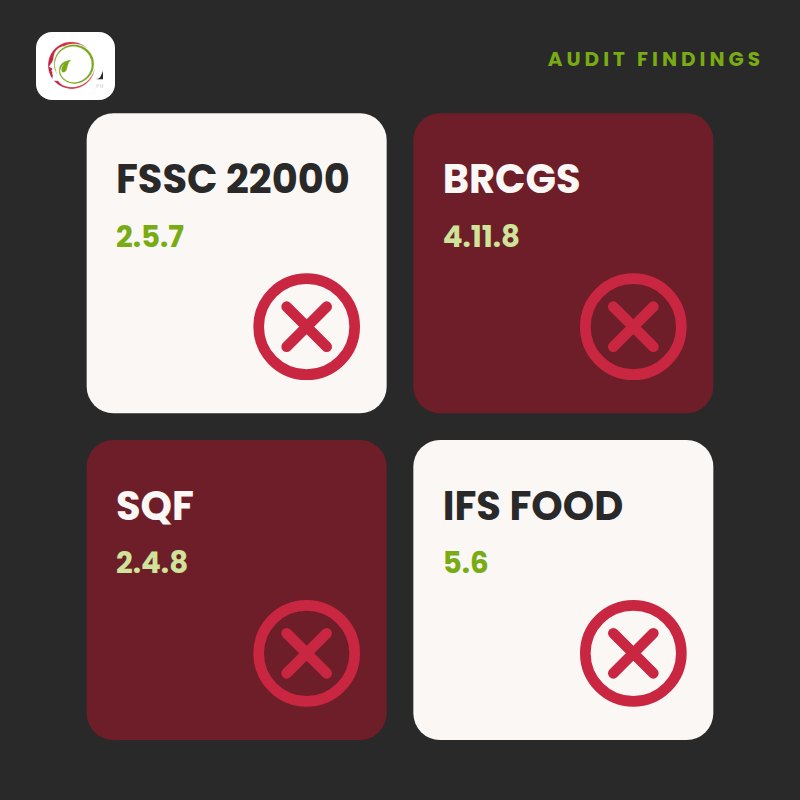
Environmental monitoring nonconformities under FSSC 22000 (clause 2.5.7), BRCGS Food Safety Issue 9 (4.11.8), SQF Edition 9 (2.4.8) and IFS Food Version 8 (5.6.2) come from the same few gaps: no risk basis, zone 1 not sampled, swabbing only after cleaning, no trend analysis and weak root cause work. You close them with evidence, not promises. ASC’s Automated EMP tool (R1 450, about USD 89 · EUR 77 · GBP 66 · AED 326, per site per year) produces that evidence, and our EMP consultants help you close open findings on time.
At a glance
- Clauses
- FSSC 22000 2.5.7 and 2.5.1 (a); BRCGS Issue 9 4.11.8; SQF Edition 9 2.4.8 and 2.5.3; IFS Food Version 8 5.6.2, 5.6.3, 5.6.5 and 5.6.8
- How common
- FSSC’s 2024 data ranked environmental monitoring 7th of its 15 most common nonconformities, and it also appears in the top 15 major findings
- Closure windows
- FSSC 22000 and BRCGS 28 calendar days; SQF 30 calendar days; IFS action plan back within four weeks of receiving it from the auditor
- Unannounced audits
- Required under all four schemes: at least one in every three years (FSSC 22000, BRCGS, SQF) or every third audit (IFS)
- What closes a finding
- Risk register, zone map, schedule, results log, trends, CAPA records, review log, laboratory and training evidence
- ASC support
- Automated EMP tool R1 450 (about USD 89 · EUR 77 · GBP 66 · AED 326) per site per year; RA19 template R690 (about USD 42 · EUR 37 · GBP 31 · AED 155); EMP consulting for closure
Your auditor wants records, so let the system write them
The Automated EMP tool builds your risk assessment in the RA19 structure, sets sampling frequency from residual risk, keeps the results log, draws trend charts and logs review triggers. It runs in your browser for R1 450 (about USD 89 · EUR 77 · GBP 66 · AED 326) per site per year.
In this article
- Why environmental monitoring findings keep coming up
- What each scheme requires, side by side
- How findings are graded and how long you have
- Findings in programme design
- Findings on laboratories, limits and positives
- Findings on corrective action, trends and review
- Findings on execution, people and records
- The closure evidence pack
- Writing a root cause and corrective action plan that gets accepted
- Preparing for an unannounced audit
- How ASC helps you close the finding
- Frequently asked questions
Why environmental monitoring findings keep coming up
Auditors grade environmental monitoring often because the clause asks for a working system backed by data, and data gaps are easy to see. FSSC’s own 2024 figures for Version 6 put environmental monitoring seventh among the fifteen most common nonconformities, and it also appears among the most common major ones.
Those rankings come from the Foundation FSSC Insights webinar of 25 March 2025, which also ranked nonconformity and corrective action third among major findings. In our audit work, the same dozen findings appear under every scheme.
South Africa’s 2017 to 2018 listeriosis outbreak reached 1 060 cases with 216 deaths where the outcome was reported, linked to a ready to eat processed meat product contaminated with Listeria monocytogenes sequence type 6 (WHO). Environmental monitoring finds that organism in drains and equipment before it reaches product.
For a clause walk through with auditor tips, read our FSSC 22000 environmental monitoring (2.5.7) guide; for design basics, see microbiological risk assessment and environmental monitoring.
What each scheme requires, side by side
All four schemes ask for the same core: a risk based programme for the relevant organisms, defined sites, frequencies and methods, limits with corrective action, trend analysis and periodic review. The emphasis differs. FSSC 22000 lists review triggers, BRCGS sets a minimum scope, SQF details the schedule and IFS links it to testing plans.
Check your audit version before quoting clause numbers. FSSC 22000 Version 7 was published on 7 May 2026, but Version 6 audits continue until 30 April 2027; clause 2.5.7 keeps its number and four elements in Version 6 and Version 7. SQF Edition 10 was released in March 2026, but Edition 10 audits start on 2 January 2027. IFS Food Version 8 has been mandatory since 1 January 2024, and BRCGS Issue 9 remains the audited issue while Issue 10 is still in development. See which scheme version applies in 2026.
| Scheme and clause | What the requirement asks for | What auditors ask to see |
|---|---|---|
| FSSC 22000 2.5.7 (a), (b), for food chain categories BIII, C, I and K | A risk based programme for relevant pathogens, spoilage and indicator organisms, and a documented procedure to evaluate all controls against contamination from the manufacturing environment, including microbiological controls | The risk assessment behind organism, site and frequency choices, and a procedure covering what, where, when, how and who |
| FSSC 22000 2.5.7 (c), (d) | Data with regular trend analysis; review at least annually and on five triggers: significant changes, no positives over an extended period, out of specification product trends, repeat pathogen detection, alerts, recalls or withdrawals | Trend charts with actions, and a dated review record naming each trigger |
| FSSC 22000 2.5.1 (a) | Analyses of parameters critical to food safety done by a competent internal or external laboratory using validated methods, in accordance with the applicable requirements of ISO/IEC 17025 | Accreditation schedule, or ISO/IEC 17025 operation and proficiency testing |
| BRCGS Issue 9 4.11.8.1 | Risk based programmes for relevant pathogens or spoilage organisms, covering at least all areas with open and ready to eat products: sampling protocol, locations, frequency, target organisms, test methods, recording and evaluation of results | Each element visible in the documented programme, and the risk assessment behind it |
| BRCGS Issue 9 4.11.8.2, 4.11.8.3 | Documented control limits with corrective action on failures or adverse trends; review at least annually and on triggers such as processing changes or programme failure | Limits per test and zone, breach records, and annual and change driven reviews |
| SQF Edition 9 2.4.8 | Risk based programme (2.4.8.1); schedule with organisms, sample numbers, frequency, locations, rotation and handling of undesirable results (2.4.8.2); results tracked and trended with preventive action (2.4.8.3) | The schedule, results against it, trend records and preventive actions under 2.5.3 |
| IFS Food Version 8 5.6.2 | “Based on risks, the criteria for environmental monitoring program shall be documented, implemented and maintained” (as quoted by DQS) | The risk assessment, programme criteria and evidence they are followed |
| IFS Food Version 8 5.6.3, 5.6.5, 5.6.8 | Food safety analyses preferably by laboratories with ISO/IEC 17025 accredited methods (5.6.3); timely evaluation of results by competent staff, immediate correction and a defined frequency for identifying trends (5.6.5); regular review and update of testing and monitoring plans (5.6.8) | Laboratory evidence, signed result and trend reviews, and the plan review record |
Our FSSC 22000 Additional Requirements for Food Manufacturing course (8 hours, R1 950, about USD 120 · EUR 104 · GBP 89 · AED 439) covers clause 2.5.7, and Introduction to BRCGS for Food Safety (8 hours, R1 195, about USD 73 · EUR 64 · GBP 55 · AED 269) explains the BRCGS standard and audit. Both are online and self paced.
How findings are graded and how long you have
Each scheme grades findings by severity and gives a fixed window for evidence. FSSC 22000 and BRCGS allow 28 calendar days, SQF Edition 9 allows 30, and IFS Food Version 8 gives four weeks from receipt of the auditor’s action plan. Critical findings and failed knock out requirements stop certification.
| Scheme | Grades | Closure window and what to send |
|---|---|---|
| FSSC 22000 | Minor, major, critical. A critical involves direct adverse food safety impact with no appropriate action, or legality or certification integrity at stake | Under Version 6 rules, as set out by BSI, minors approved and majors closed within 28 calendar days of the last audit day, and a minor’s effectiveness is checked at the next audit. A critical means suspension within 3 working days, evidence within 14 calendar days and a follow up audit between six weeks and six months after the audit. Confirm Version 7 details with your certification body |
| BRCGS Issue 9 | Minor, major, critical. A critical means no certificate | Corrective action implemented and reported with evidence within 28 calendar days of the audit, with a root cause analysis and a preventive action plan (BSI certification requirements). The preventive action may still be in progress at the certification decision |
| SQF Edition 9 | Minor, major, critical. A critical at a certification audit is an automatic failure | Minors and majors closed within 30 calendar days, with a documented root cause analysis for each; where a major needs structural work, the time can be extended with temporary controls in place (Part A) |
| IFS Food Version 8 | A, B, C and D scores, major nonconformities and knock out (KO) requirements | The auditor sends the action plan within two weeks of the last audit day, and the site returns it within four weeks of receipt with the proposed corrective actions and evidence that corrections are in place (IFS Food Version 8, Part 1). A single major means a follow up audit between six weeks and six months after the audit before a certificate can issue; a KO scored D or more than one major means the audit is not passed |
Twenty eight days is short when a pathogen result can take a week, so start the day the auditor leaves and send further verification as a dated plan. The timelines below are ASC’s estimates, not scheme rules; agree any overrun with your certification body before the deadline.
Findings in programme design
Design findings matter most because every result rests on the design. The four we see most often are no risk basis, zone 1 never sampled, sampling only after cleaning, and no neutraliser matched to the sanitiser. Any one can make years of negative results meaningless.
Finding 1: no risk basis or organism justification
What the auditor sees. A swab list copied from a template, such as aerobic plate count and coliforms on a ready to eat line with no Listeria spp. testing, or only Listeria in a dry products plant whose hazard analysis names Salmonella.
The requirement it breaks. FSSC 22000 2.5.7 (a), BRCGS 4.11.8.1, SQF 2.4.8.1 and IFS 5.6.2 all require a risk basis for the organisms and sites chosen.
The evidence that closes it. A documented risk assessment that names each organism and why, scores inherent and residual risk for every site and zone, derives frequency from the score and links to the HACCP hazard analysis, as our RA19 template does. For dry products, see our guide to environmental monitoring for Salmonella and Cronobacter spp.
Realistic closure timeline. One to two weeks, plus the first sampling round.
Finding 2: zones not defined or zone 1 not sampled
What the auditor sees. No zone map. Every swab is on a floor, drain or wall; food contact surfaces are skipped because a positive “would mean holding product”.
The requirement it breaks. FSSC 2.5.7 (b) covers all controls against environmental contamination, and FSSC’s environmental monitoring guidance defines zone 1 as product contact surfaces. BRCGS 4.11.8.1 and SQF 2.4.8.2 require defined sample locations, BRCGS across at least all open and ready to eat product areas.
The evidence that closes it. A zone map on the layout drawing, a site register with an ID and zone for every site, and zone 1 sites scheduled at a justified frequency, with the product decision rule written before the first sample. See our hygienic zoning risk assessment.
Realistic closure timeline. About a week, then one to two weeks for the first zone 1 results.
Finding 3: sampling only after cleaning
What the auditor sees. Every sample taken before start up, straight after sanitation, and years without a Listeria spp. positive in a wet ready to eat area.
The requirement it breaks. Post clean samples verify cleaning but do not find organisms surviving in harbourage, which is the point of 2.5.7 (b). SQFI’s guidance says pathogen swabbing “should be performed during production, not immediately after cleaning and sanitizing”, after at least 3 to 4 hours of production.
The evidence that closes it. A revised protocol stating each sample type’s purpose, in production samples a few hours into the run, rotation across shifts and days, and sample times on the results log.
Realistic closure timeline. Days for the protocol, then two to four weeks of in production results.
Finding 4: no neutraliser matched to the sanitiser
What the auditor sees. Dry swabs or swabs moistened with sterile water, and a sanitiser change with no check that the swab still works.
The requirement it breaks. No clause names the neutraliser, so auditors raise this under methods: BRCGS 4.11.8.1 asks for defined test methods and FSSC 2.5.1 (a) for validated ones. Li and colleagues (2020) found that at a very high quaternary ammonium concentration, Letheen broth did not neutralise effectively while Dey/Engley and HiCap broths did (BMC Microbiology).
The evidence that closes it. A method record per area naming the sanitiser and concentration, the swab or sponge and the neutralising broth, backed by the supplier specification or laboratory confirmation. ISO 18593:2018 is a sound reference for surface sampling procedure, and our surface swabbing guide explains the choices.
Realistic closure timeline. One to two weeks, mostly waiting for the right swabs.
Rebuild the design once, properly
The RA19 Environmental Monitoring Risk Assessment Template (R690, about USD 42 · EUR 37 · GBP 31 · AED 155) gives you a scored risk register, procedure and completion guide. In the Practical Pathogen Environmental Monitoring (EMP) and Surface Swabbing course (Advanced, 9 hours, R1 750, about USD 108 · EUR 93 · GBP 80 · AED 394) delegates build their own RA19 risk assessment and get a free EMP package.
Get RA19 for R690 Enrol in the EMP courseR690 is about USD 42 · EUR 37 · GBP 31 · AED 155.
Findings on laboratories, limits and positives
A sound design still fails if results cannot be trusted or nobody knows what they mean. The two findings here are an unfit laboratory or method, and no action limits or product decision when a food contact surface tests positive for a pathogen.
Finding 5: laboratory not competent or method not fit
What the auditor sees. No accreditation or proficiency testing record for the tests used, or an unvalidated in house rapid pathogen test.
The requirement it breaks. FSSC 22000 2.5.1 (a) requires a competent laboratory. FSSC’s interpretation article says ISO/IEC 17025 accreditation is not mandatory, but the laboratory must operate to it, validate methods and should do proficiency testing annually, covering all methods over four years; environmental monitoring is in scope. IFS 5.6.3 prefers laboratories with ISO/IEC 17025 accredited methods.
The evidence that closes it. A SANAS accreditation certificate and schedule listing your methods, or proficiency testing results and method validation.
Realistic closure timeline. One to three weeks if the laboratory holds the evidence. If you change laboratory, submit the new contract and its accreditation schedule inside the window.
Finding 6: no action limits, or no product decision on a zone 1 positive
What the auditor sees. A log that says “positive” and “area re-cleaned” with nothing about product made on that line.
The requirement it breaks. BRCGS 4.11.8.2 requires documented control limits and corrective action, SQF 2.4.8.2 a plan for undesirable results, and IFS 5.6.5 immediate correction. Annex I of Codex CXG 61-2007 advises a response to every positive, scaled to the likelihood of product contamination, from no action through intensified cleaning and source tracing to holding and testing product. Codex is guidance, not South African law, and CXG 61 was revised in 2026.
The evidence that closes it. Alert, action and escalation levels per test and zone, a zone 1 pathogen hold and release rule agreed in advance by the food safety team, and one completed positive record, real or rehearsed, from detection to product disposition.
Realistic closure timeline. About a week. A documented mock exercise is often the fastest proof of use.
An open finding and a 28 day clock?
ASC’s environmental monitoring programme consultants review the finding and your evidence, write the root cause and corrective action plan with you and assemble the pack your certification body needs, from Gqeberha, Johannesburg and Cape Town or remotely.
Findings on corrective action, trends and review
These findings show a programme that runs but does not learn. Positives are cleaned and swabbed again with no root cause, results are filed but never trended, and the programme is years old despite new lines and long runs of negative results.
Finding 7: corrective action says “cleaned and re-swabbed”
What the auditor sees. Every positive closed with “area re-cleaned, re-swab negative”, no vector sampling or investigation, and the same drain positive a few months later.
The requirement it breaks. SQF 2.5.3.1 requires root cause identification and 2.4.8.3 preventive action on unsatisfactory trends. BRCGS 4.11.8.2 requires corrective action, and for FSSC 22000, ISO 22000:2018 clause 10.1 applies.
The evidence that closes it. An investigation record: correction, intensified vector sampling around the site, causes checked, root cause, corrective action, verification sampling over a defined period and sign off.
Realistic closure timeline. Correction on the day and investigation within two weeks. Verification sampling often runs two to six weeks, so submit the first results with a dated plan.
Drains, cracks and damp voids that keep testing positive also shelter flies, cockroaches and rodents, so ask whether pests carry material to open product. ASC Pest Control, a SAPCA member serving Gauteng and the Eastern Cape, can inspect and treat those areas; see also our pest control risk assessment.
Finding 8: no trend analysis
What the auditor sees. Laboratory reports filed as PDFs. “Trending” is a yearly count of positives.
The requirement it breaks. FSSC 2.5.7 (c) requires regular trend analysis, SQF 2.4.8.3 tracking and trending, and IFS 5.6.5 a defined frequency for trend review. SQFI’s guidance lists trend analysis evidence among auditor checks.
The evidence that closes it. Monthly positive rate by zone, a repeat site list, positives by area and count results against limits, with dated minutes of actions taken.
Realistic closure timeline. A few days if the data exists, two weeks if it must be rebuilt.
Finding 9: review not done annually or after triggers
What the auditor sees. A programme dated three years ago, despite a new line, a recall and eighteen months of zero positives.
The requirement it breaks. FSSC 2.5.7 (d) requires review at least annually and on five triggers, BRCGS 4.11.8.3 at least annually, and IFS 5.6.8 updates based on results, legislation and other changes.
The evidence that closes it. A review log with the date, trigger, scope, decisions and the new version of the risk register.
Realistic closure timeline. One to two weeks.
The Automated EMP tool draws these trend charts, reminds you of the annual review, flags long runs without positives and repeat detection, and logs the other 2.5.7 (d) triggers. Compare options in EMP software versus a spreadsheet.
Findings on execution, people and records
The last group is about doing what the written programme says: following the schedule, training the samplers and keeping records that agree. Each is often graded minor alone, but together they tell an auditor the programme is not under control.
Finding 10: sampling schedule not followed
What the auditor sees. Weekly zone 1 sampling with gaps in peak season, and the same ten sites every time.
The requirement it breaks. FSSC 2.5.7 (b) and IFS 5.6.2 require the programme to be implemented, BRCGS 4.11.8.1 sets test frequency, and SQF 2.4.8.2 requires frequency, locations and rotation.
The evidence that closes it. A four week schedule matrix rotating by shift and day, a monthly planned versus completed check, and make up samples for anything missed.
Realistic closure timeline. A week for the corrected schedule and check; we usually submit two to three weeks of on schedule sampling.
Finding 11: samplers not trained
What the auditor sees. The sampler cannot explain the sample area, neutraliser, aseptic handling or labelling, and there is no training record.
The requirement it breaks. ISO 22000:2018 clause 7.2 (competence) for FSSC 22000, which appeared in FSSC’s 2024 top 15, and IFS 5.6.5 and 5.6.6 on competent personnel.
The evidence that closes it. A sampling work instruction, training records with an observed practical assessment, and a refresher interval. Our EMP and surface swabbing course certificates can be filed at once.
Realistic closure timeline. One to three weeks.
Finding 12: records inconsistent
What the auditor sees. Site IDs on laboratory reports that do not match the register, missing dates, typing errors and three versions of the schedule.
The requirement it breaks. ISO 22000:2018 clause 7.5 (documented information) for FSSC 22000, BRCGS 4.11.8.1 (recording and evaluation of results) and SQF 2.4.8.3.
The evidence that closes it. One results log keyed to site ID and laboratory reference, controlled versions of the register and schedule, and a reconciliation of past reports.
Realistic closure timeline. One to two weeks to reconcile, then ongoing control.
Paperless records that agree every time
ASCloud, ASC’s paperless compliance system, keeps checklists, monitoring, traceability and dashboards in one place, so swab, cleaning and corrective action records carry the same site and date. Pair it with the Automated EMP tool.
The closure evidence pack
A closure evidence pack is the set of records proving a finding is corrected, its cause removed and the fix working: usually the risk register, zone map, schedule, results log, trend charts, positive and corrective action records, review log, and laboratory and training evidence.
| Evidence | What gets sent back | What gets accepted |
|---|---|---|
| Risk basis | A new procedure listing swab sites | Scored register per site, zone and organism, frequency from residual risk, signed off |
| Zones and sites | “Zone 1 will be added” | Zone map, site register and the first zone 1 results |
| Timing and method | A promise to change swab times | Revised protocol, sample times on the log, neutraliser named per sanitiser |
| Laboratory | The laboratory’s brochure | Accreditation schedule listing the methods, or proficiency testing and validation |
| Limits and positives | “Positives will be escalated” | Alert, action and escalation levels, hold and release rule, a completed positive record |
| Corrective action | “Area re-cleaned and swabbed again” | Investigation, vector sampling, root cause, corrective action, verification results |
| Trends and review | A new issue date on the procedure | Trend charts with minutes, and a review log naming the trigger and changes |
| Execution and people | An email reminding staff | Planned versus completed records and training with practical assessment |
Build the pack in the tool, export it for the auditor
The Automated EMP tool produces most of this pack and exports it as an RA19 style Excel workbook. A site licence costs R1 450 (about USD 89 · EUR 77 · GBP 66 · AED 326) per year. It saves to the server, sends graded positive result alerts and runs the positive drill with star burst (vector) sampling, root cause and CAPA. For setup help, choose the first year with a one hour online onboarding call with an ASC consultant for R1 950 (about USD 120 · EUR 104 · GBP 89 · AED 439).
Writing a root cause and corrective action plan that gets accepted
An accepted plan separates correction from corrective action, names a root cause that explains why the gap existed, removes that cause and proves the fix works. Plans that restate the finding as the cause, or just say “retrain staff”, come back.
- Contain and correctRecord what you did at once: product assessed or held, area sanitised, missing zone 1 sites added to this week’s schedule.
- Define the problem“Zone 1 surfaces on Line 2 were not sampled from March to August” is usable. “EMP not adequate” is not.
- Find the root causeUse five whys or a fishbone, testing each cause against evidence. Root causes are usually systemic: no risk method, no review owner, an unadapted template.
- Check the reachCould the same cause affect other lines or sites?
- Remove the causeChange the system: a scored risk assessment, review ownership in a job profile, the programme on the management review agenda.
- Assign owners and datesEvery action gets a name and a due date inside the window, or a reason it needs longer.
- Prove it worksAttach the verification you have, such as first in production results, a review log entry or an internal audit, and date what is still to come.
A weak root cause for Finding 3 reads: “Staff swabbed at the wrong time.” A strong one reads: “The procedure did not define the purpose or timing of each sample, and the schedule followed the sanitation shift, so every sample was taken after cleaning. No review tested whether the programme could detect harbourage.”
The Root Cause Analysis One-Day course (Intermediate, 8 hours, R1 250, about USD 77 · EUR 67 · GBP 57 · AED 281) teaches the tools certification bodies expect, and Internal and Supplier Auditing Practices based on FSMS (Intermediate, 20 hours, R3 500, about USD 215 · EUR 187 · GBP 160 · AED 787) helps you find gaps before your auditor does. See all courses.
Preparing for an unannounced audit
All four schemes require at least one unannounced audit in each three year cycle, so environmental monitoring evidence must be ready on any working day. Keep one current pack, sample to schedule every week, and make sure more than one person can present the programme.
See the requirements in FSSC 22000, BRCGS and SQF; IFS Food makes at least every third audit unannounced.
- Risk assessment, zone map and site register match the floor, including new equipment.
- This week’s samples were taken on schedule.
- The results log is current, with site ID and laboratory reference on every result.
- Every positive in the last 12 months has a closed record with root cause and verification.
- Trend charts, review minutes and the review log of annual and trigger reviews are filed.
- Swabs, neutralising broth and sanitiser match the method record, and laboratory accreditation is current.
- Two trained samplers and a deputy presenter are available.
- Drains and harbourage areas flagged by the programme appear in pest control and maintenance records.
Check this list monthly; see our hygiene audit preparation tips.
Be ready on the day nobody warned you about
The TK11 Basic Food Safety Document Templates Toolkit (R699, about USD 43 · EUR 37 · GBP 32 · AED 157) gives smaller sites editable controlled documents, the FSSC 22000 toolkits cover the scheme in full, and the Automated EMP tool keeps monitoring records current.
View FSSC 22000 toolkits Get TK11 for R699R699 is about USD 43 · EUR 37 · GBP 32 · AED 157.
How ASC helps you close the finding
ASC helps in three ways: EMP consultants who close open findings with you, the Automated EMP tool and RA19 template that produce the evidence, and online training that makes the programme stick. Start with one finding, a full rebuild or a pre audit review.
Our training platform has more than 3 600 course enrolments and a 4.9 average rating from 672 verified reviews, our clients rate us 4.9 from 350+ Google reviews across our Gqeberha, Johannesburg and Cape Town offices, and KFC and Spur franchise groups train their teams with ASC. See also our EMP consultant guide and EMP cost guide. For a quick answer, book a virtual consultation at R480 (about USD 29 · EUR 26 · GBP 22 · AED 108) per hour or WhatsApp +27 61 483 0381.
Frequently asked questions
Which clause covers environmental monitoring in each scheme?
Is an environmental monitoring finding usually minor or major?
How long do we have to close an environmental monitoring nonconformity?
Will a certification body accept ‘cleaned and re-swabbed’ as the corrective action?
Does our laboratory have to be ISO/IEC 17025 accredited?
Should we swab before or after cleaning?
Can ASC help us close an open environmental monitoring finding?
Key takeaways
- Common findings include no risk basis, no zone 1 sampling, sampling only after cleaning, no matched neutraliser and “cleaned and re-swabbed” corrective actions.
- You have 28 calendar days under FSSC 22000 and BRCGS, 30 under SQF, and four weeks under IFS from receiving the auditor’s action plan.
- Keep the evidence pack in one place with the Automated EMP tool (R1 450, about USD 89 · EUR 77 · GBP 66 · AED 326, per site per year), or ask ASC’s EMP consultants to help close an open finding.
Close the finding, then stop it coming back
Send us your audit report and deadline, and we will tell you what evidence is missing, what a realistic plan looks like and whether you need a consultant, the Automated EMP tool, the RA19 template or all three.
Published by ASC Food Safety, South African food safety and quality consultants. This article is general guidance and not a substitute for site specific advice.