Environmental Monitoring Programme Consulting
ASC designs, fixes and verifies environmental monitoring programmes for food manufacturers, packers and caterers across South Africa, with virtual support for sites elsewhere. We map your zones, justify the organisms from your product and process, build the risk assessment in the RA19 structure, check your laboratory and neutraliser, write the action and release rules, and stay with you when a positive comes back. The programme is written so an auditor can follow it from risk to result.
Consulting is quoted per site after a scoping call. A virtual consultation costs R480 per hour (about USD 29 · EUR 26 · GBP 22 · AED 108). The Automated EMP tool costs R1 450 per site per year (about USD 89 · EUR 77 · GBP 66 · AED 326).
Rather do it yourself? Start with the RA19 Environmental Monitoring Risk Assessment, R690 (about USD 42 · EUR 37 · GBP 31 · AED 155).
What is an environmental monitoring programme for?
An environmental monitoring programme checks whether pathogens, spoilage organisms and hygiene indicators are present in the processing environment, so you can find and remove them before they reach the product. It verifies that your prerequisite programmes, cleaning and hygienic design are working. It does not replace them, and a programme that only ever swabs clean surfaces after cleaning will tell you very little.
The organisms follow the product and the process. A chilled ready to eat plant looks for Listeria spp. as the indicator for Listeria monocytogenes, which can grow at refrigeration temperatures and persists in cool, wet places. A dry plant making spices, flour, snacks, nut products or milk powders looks for Salmonella and uses Enterobacteriaceae as a hygiene indicator, and a site making powdered infant formula adds Cronobacter spp. A packhouse, a bakery and a restaurant kitchen each need a different list again. We write that justification into the programme line by line, because it is the first thing an auditor asks for.
The international references agree on the method. Annex I of the Codex guidelines on Listeria monocytogenes (CXG 61-2007) sets out recommendations for an environmental monitoring programme in processing areas, the Codex code of hygienic practice for low moisture foods (CXC 75-2015) recommends environmental monitoring for Salmonella with Enterobacteriaceae as a hygiene indicator, and EU Regulation (EC) No 2073/2005 Article 5(2) requires producers of ready to eat foods that may pose a Listeria monocytogenes risk to sample processing areas and equipment for it. Codex texts are international guidance, not South African law. Here the food hygiene law is Regulation R638 of 2018, made under the Foodstuffs, Cosmetics and Disinfectants Act 54 of 1972, and its regulation 6(4)(b) says a food contact surface must not carry more than 100 viable micro-organisms per cm2 before food comes into direct contact with it. That is a cleaning verification limit, and we keep it in the programme without confusing it with pathogen monitoring.
Key facts at a glance
What does ASC do on an EMP project?
Scoping call and document review
We look at what you make, your scheme and customers, your current swab plan, your last six to twelve months of results and the reason you are calling. You receive a written scope and a quote per site.
Site walk and zone map
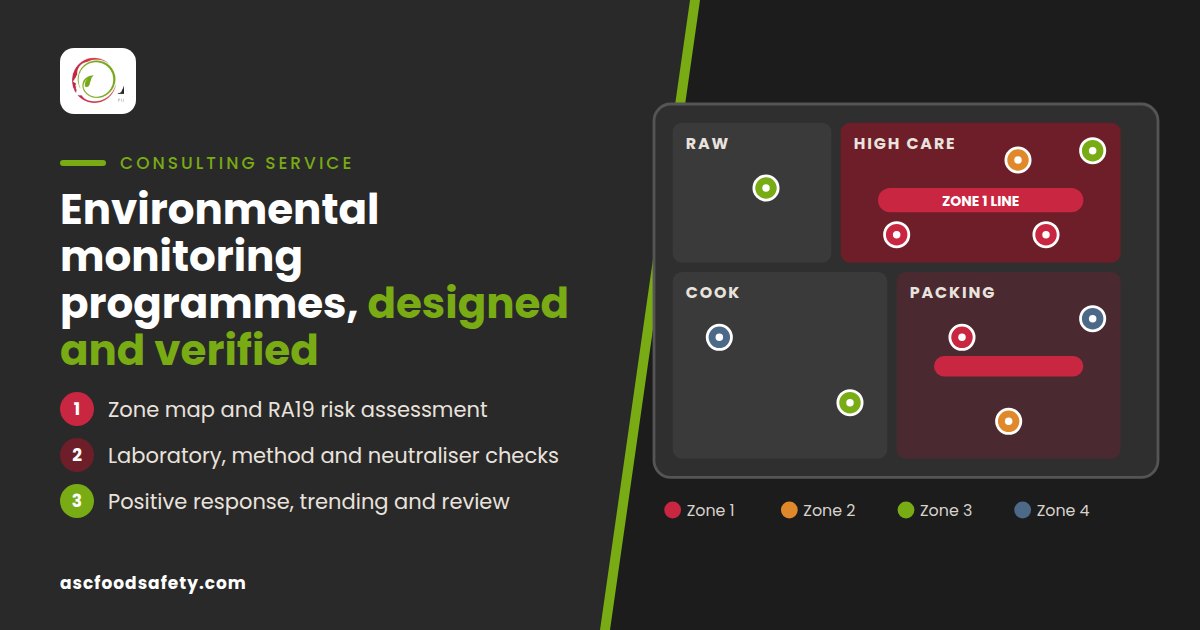
We walk production and sanitation during a shift, mark Zones 1 to 4 on your site drawing, and look for the places organisms live: drains, hollow frames and rollers, condensation, damaged floors, door seals, cleaning equipment, and the traffic routes between raw and ready to eat areas. Where pests or harbourage are part of the picture, we say so.
Risk assessment in the RA19 structure
Every site, zone and organism becomes a line in a scored register: the hazard, what causes it, the controls you can prove, inherent and residual scores, and the frequency the residual score sets. The organism justification is written from your product and process, not copied from a textbook.
Schedule, budget and sampling method
We turn the register into a four week sampling schedule that rotates shifts and days, samples during production as well as after cleaning, and fits a weekly swab budget you can defend to management. Sponge or swab, sample area, compositing rules and timing are written down.
Laboratory, methods and neutraliser
We check your laboratory’s accreditation scope against the methods you need (for example ISO 11290-1 for Listeria, ISO 6579-1 for Salmonella and ISO 21528-2 for Enterobacteriaceae), the turnaround, transport conditions and isolate retention, check your sampling technique against ISO 18593, and match the neutralising broth on the sponge to the sanitiser used in each area.
Action levels, hold and release
We write alert, action and escalation levels per zone with the response to each, the product hold rule for a food contact surface positive, and a release rule with both halves: product test results and a run of negative production days on the surface.
Positive response and investigation
When a result comes back positive we help contain it, plan vector (star burst) sampling around the site in every direction, intensify cleaning at the right moment, and work the finding through to a root cause that is a design or system cause rather than “cleaning failure”.
Trend review, annual and trigger reviews
We set up the monthly trend review (positive rate by zone, repeat sites, counts against limits) and the review log for the annual review and the five triggers in FSSC 22000 clause 2.5.7 (d), and we can run those reviews with you as retained verification.
Sampler training and competence
We train your samplers on site, observe their aseptic technique and chain of custody, and record their competence. Your technical team can go further on the online EMP course.
Four ways to work with us
| Engagement | Best for | What you get |
|---|---|---|
| Programme design | A new certification, a new high risk line, or a programme that needs rebuilding | The full set of deliverables and trained samplers, with a review of your first month of results if you want one |
| Investigation call out | A first positive, repeat positives at the same site, or the weeks after a recall | Containment support, a vector sampling plan, root cause analysis, corrective and preventive actions and a verification plan |
| Retained verification | Sites that want an outside eye on the trend through the year | Periodic results and trend reviews, sampler observation, annual and trigger reviews and audit preparation |
| Training plus tool | Technical teams with the capacity to run the programme themselves | The EMP course, the Automated EMP tool or the RA19 template, and consultant time for a design review |
Not sure which one you need? Book a virtual consultation from our homepage. Bring your swab list, six months of results and your latest audit report, and we will tell you plainly whether you need a redesign, an investigation, verification or better training. A virtual consultation is R480 per hour (about USD 29 · EUR 26 · GBP 22 · AED 108).
When do sites call in an EMP consultant?
The programme that never finds anything
Months of negative results can mean a clean site. More often they mean the swabs are taken after cleaning, on smooth surfaces that are easy to clean, with a broth that does not neutralise the sanitiser. FSSC 22000 lists no positive results over an extended period as a trigger to review the programme. We move sampling into production, into the places organisms live, and check the method before anyone relaxes.
The same site keeps coming back positive
Repeat detections at one site usually point to a harbourage point that cleaning does not reach: a hollow leg, a worn belt, a cracked floor joint, a drain. We plan the vector sampling, ask the laboratory to keep the isolates for typing, and work with engineering on the fix, because repeated deep cleans often fail to remove a strain that has settled in a harbourage point.
An auditor raised a nonconformity
Typical findings are a programme with no risk basis, no organism justification, no neutraliser, no trend analysis or no review. We close them with evidence the certification body accepts, and we explain the four schemes side by side in our guide to environmental monitoring audit nonconformities.
A dry plant with a wet cleaning habit
Water is what lets Salmonella multiply and spread in a dry plant. We tighten the dry zones, the controlled wet cleaning, the dust and vacuum sampling and the Enterobacteriaceae trend. Our guide to environmental monitoring in dry food plants sets out the approach.
Tools and training that go with the service
Automated EMP tool
R1 450 per site per year (about USD 89 · EUR 77 · GBP 66 · AED 326). With a one hour onboarding call, R1 950 (about USD 120 · EUR 104 · GBP 89 · AED 439).
- The programme builder in the RA19 structure, saved to your workspace
- Results log with positive result alert emails graded by zone
- Trend charts, repeat site list and review triggers
- The full RA19 style Excel workbook for the audit file
RA19 Environmental Monitoring Risk Assessment
R690 (about USD 42 · EUR 37 · GBP 31 · AED 155), instant download, lifetime access
- Scored risk register in Excel
- The governing procedure
- A step by step completion guide and a read me
- Zones, organisms, sampling points and timing, action limits, trending and the five review triggers
Online EMP course
Practical Pathogen Environmental Monitoring (EMP) and Surface Swabbing, advanced, 9 hours, R1 750 (about USD 108 · EUR 93 · GBP 80 · AED 394)
- Zone mapping, swabbing protocols and aseptic technique
- Chain of custody to the laboratory
- Trending, trigger levels, vector sampling, root cause and CAPA
- Delegates build their own programme in the RA19 structure
Also useful: Advanced Food Microbiology, R1 750 (about USD 108 · EUR 93 · GBP 80 · AED 394); Root Cause Analysis One-Day, R1 250 (about USD 77 · EUR 67 · GBP 57 · AED 281); Hygienic Design Essentials, R2 400 (about USD 147 · EUR 128 · GBP 110 · AED 540); the RA14 Microbiological Contamination Risk Assessment, R690 (about USD 42 · EUR 37 · GBP 31 · AED 155); and the TK11 Basic Food Safety Document Templates Toolkit, R699 (about USD 43 · EUR 37 · GBP 32 · AED 157). Sites that want the rest of their records on a phone use ASCloud, our paperless compliance system, and drains, flies and rodents are handled by ASC Pest Control in Gauteng and the Eastern Cape.
Who this work suits
- Ready to eat manufacturers: chilled meals, deli meats, dairy, salads, sandwiches, cut fruit, smoked fish and sauces.
- Dry and low moisture plants: spices, flour and milling, cereals and snacks, nuts and nut butters, confectionery, milk powders and infant foods.
- Packers, cold stores and co packers who need to show a brand owner their environmental results for its line.
- Caterers, franchise kitchens and retailers with food preparation areas that want a proportionate, practical programme.
- Export sites whose customers or destination rules expect a documented, risk based programme.
Where ASC stops
ASC designs, verifies and supports the programme. We are not your laboratory and we do not issue test results; your accredited laboratory does. We do not certify your site; your certification body does. We do not make the product release decision for you; your food safety team does, using the rules we help you write. Where a positive could involve product already on the market, involve your food safety team, your customers and the relevant authority without delay.
Frequently asked questions
What does an environmental monitoring programme consultant do?
We design, fix and verify the programme: a site walk and zone map, organism justification from your product and process, a scored risk assessment in the RA19 structure, a sampling schedule and swab budget, a laboratory and neutraliser check, action and release rules, a positive response plan, trend and review set up, and sampler training.
How much does EMP consulting cost?
ASC quotes per site after a scoping call, because the work depends on the number of lines and rooms, the scheme, travel and urgency. A virtual consultation costs R480 per hour (about USD 29 · EUR 26 · GBP 22 · AED 108). The Automated EMP tool costs R1 450 per site per year (about USD 89 · EUR 77 · GBP 66 · AED 326) and the RA19 template R690 (about USD 42 · EUR 37 · GBP 31 · AED 155).
Which standards is the programme written to?
FSSC 22000 clause 2.5.7 (a) to (d) and clause 2.5.1 (a), ISO 22000:2018 clauses 8.8 and 9.1, BRCGS Food Safety Issue 9 clause 4.11.8, SQF Edition 9 clause 2.4.8 (Edition 10 audits are expected from 2 January 2027) and IFS Food Version 8 clause 5.6.2. Codex CXG 61-2007 Annex I and CXC 75-2015 are the international guidance, and R638 of 2018 is the South African food hygiene law. Whether the programme is adequate for your site is judged by your food safety team and, at audit, your certification body.
Which organisms should we monitor?
The product and process decide. Chilled ready to eat sites usually monitor Listeria spp. as the indicator for Listeria monocytogenes; dry plants monitor Salmonella with Enterobacteriaceae as the hygiene indicator; powdered infant formula plants add Cronobacter spp. Aerobic plate counts or ATP verify cleaning of food contact surfaces.
What happens when we get a positive result?
Contain first: follow your action level, hold product from a food contact surface that tested positive, and sample around the site in every direction before the intensified clean. Then find the root cause, fix it, verify with a run of negative results and review the programme. ASC can support the investigation on site.
Can you help us close an audit nonconformity on environmental monitoring?
Yes. We work out what the auditor saw, which requirement it breaks and what evidence closes it, then help you produce that evidence for the certification body, usually a revised risk assessment, a schedule, a trend review and a review record. Tell us the closure deadline when you call.
Do you do the laboratory testing?
No. Your laboratory tests the samples and issues the results. We check that its accreditation scope and methods fit your programme, which is what FSSC 22000 clause 2.5.1 (a) looks for, and we can help you choose a laboratory.
Do you work outside South Africa?
Yes, virtually. Programme design, document review and trend review can be done online wherever your site is, and the programme follows the same international references. Ask us about a site visit outside South Africa before you plan on one.
Request an environmental monitoring quote
Tell us what you make, your certification scheme, where the site is, and why you are looking at the programme now (a new line, a positive, an audit finding or a review). Attach nothing yet; we will ask for the swab plan and results once we have spoken. Prefer to talk first? WhatsApp +27 61 483 0381 or email info@ascfoodsafety.com.
Build a programme that finds things before your auditor does
Book a scoping call, buy the Automated EMP tool for R1 450 per site per year (about USD 89 · EUR 77 · GBP 66 · AED 326), or start with the RA19 template at R690 (about USD 42 · EUR 37 · GBP 31 · AED 155).