
By Mthokozisi Nkosi, Food Safety Specialist & Lead Auditor, ASC Food Safety · 11 min read
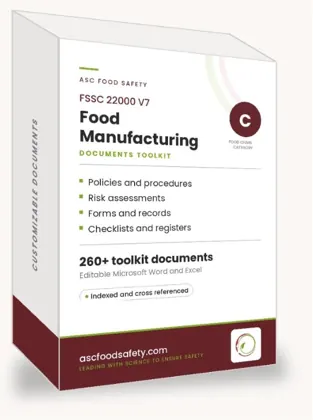
FSSC 22000 is one of the most demanding food safety certifications a South African manufacturer can pursue, and one of the most rewarding. It opens doors to major local retailers and export markets, but it also asks you to build and document a complete food safety management system. An FSSC 22000 document templates toolkit gives you that entire system already written and structured to the scheme, so you can spend your time implementing and improving rather than authoring from a blank page.
At a glance
- Standard
- FSSC 22000 (GFSI-recognised certification scheme)
- Built on
- ISO 22000 + sector PRPs (ISO/TS 22002 series) + FSSC additional requirements
- Best for
- Manufacturers, packers and suppliers seeking GFSI-level certification
- Format
- Fully editable Microsoft Word & Excel, instant download, yours to keep
- Sectors covered
- Manufacturing, packaging, catering, retail, transport, feed, biochemicals
In this guide
- What is FSSC 22000?
- Why your documented system matters
- What is inside the toolkit
- Which sector version you need
- Building from scratch vs a toolkit
- How it helps your business
- How to implement it, step by step
- Common mistakes to avoid
- Who needs FSSC 22000 in SA
- Why choose the ASC toolkit
- Frequently asked questions
What is FSSC 22000?
FSSC 22000 is a certification scheme recognised by the Global Food Safety Initiative (GFSI). It is not a single standard but a combination of three layers: the ISO 22000 management-system requirements, a set of sector-specific prerequisite programmes (the ISO/TS 22002 series), and a list of FSSC additional requirements covering issues such as food fraud, food defence, allergen management and environmental monitoring. To certify, you have to show an accredited auditor a documented system that satisfies all three layers.
The scheme is maintained by the FSSC Foundation and is updated periodically. The current release, Version 7, sharpens the requirements around food safety culture, quality, and the management of the system across multiple sites. Because it is GFSI-recognised, an FSSC 22000 certificate is accepted by retailers and buyers around the world as proof that your food safety system meets an international benchmark, which is why so many South African manufacturers pursue it.
The ASC Food Safety and Quality Culture Pack runs anonymous worker and manager questionnaires on a QR code, a manager dashboard for training, feedback, inspections, indicators and maturity, and a one click audit ready report with an action plan, for R750 per site per year. The method behind it is set out in how to measure food safety culture.
The toolkit is a ready-made version of that documented system. It contains the manuals, procedures, policies, prerequisite programmes, HACCP and food safety plans, forms and registers a certification body expects to see, all mapped to the clauses and requirements of the current Version 7 scheme. You open the templates, add your company, sites, products and processes, and you have a working FSSC 22000 system instead of a stack of blank pages.
Why your documented system is everything
It is worth being blunt about this: in a certification audit, the auditor assesses your documented system and the evidence that you follow it. If a requirement is not written down, defined and being recorded, it effectively does not exist as far as the audit is concerned. This is why the documentation is not busywork; it is the backbone of the entire certification, the thing that turns good intentions into a defensible, repeatable system.
If it is not documented, it did not happen. A toolkit gives you the documentation right, so your good practice is finally auditable.
Building that documentation from a blank page is where most of the time, cost and risk of certification sit. Miss a clause and you collect non-conformances. Write procedures that do not link to your records and the auditor loses confidence in the whole system. A toolkit removes that risk by giving you a complete, internally consistent set of documents that already covers every requirement, so your effort goes into implementing real controls rather than interpreting the standard.
What is inside the toolkit
- A food safety manual and food safety policy aligned to FSSC 22000
- The full set of ISO 22000 management-system procedures: document control, management review, internal audit, corrective action, control of nonconforming product and continual improvement
- Prerequisite programmes (PRPs) written to the ISO/TS 22002 category for your sector, covering hygiene, cleaning, pest control, maintenance, personal hygiene and more
- HACCP and hazard-analysis templates, including CCP and OPRP determination and validation
- The FSSC additional-requirement procedures: food fraud (VACCP), food defence (TACCP), allergen management, environmental monitoring, product labelling and formulation, and management of services and equipment
- Traceability, product recall, emergency preparedness and crisis management procedures
- Forms, registers, logs and internal-audit checklists to generate and keep the records that prove the system runs
Which sector version do you need?
FSSC 22000 applies different prerequisite programmes to different parts of the food chain, so ASC offers the toolkit in sector-specific versions. Choose the one that matches your operation:
Building from scratch vs starting with a toolkit
| From a blank page | With the ASC toolkit | |
|---|---|---|
| Time to a documented system | Weeks to months of specialist writing | Ready to personalise in days |
| Clause coverage | Easy to miss requirements → non-conformances | Every clause and PRP covered by design |
| Consistency | Mixed formats, gaps between documents | One consistent, professional structure |
| Cost | High consulting fees to author everything | A fraction of the cost of bespoke authoring |
| Audit readiness | Certification delayed while paperwork catches up | Move to audit and certification far sooner |
How the toolkit helps your business
How to implement the toolkit, step by step
- Choose your sector versionDownload the toolkit that matches how your business handles food, so the prerequisite programmes fit from the start.
- Personalise the core documentsAdd your company details, scope, sites and organogram to the manual, policy and management-system procedures.
- Build your HACCP studyDescribe your products, map your process flows, complete the hazard analysis and confirm your CCPs and OPRPs.
- Roll out the PRPs and additional requirementsPut the hygiene, food fraud, food defence and allergen procedures into daily practice and start keeping records.
- Run an internal auditUse the built-in checklists to test your own system and close any gaps before the certification body arrives.
- Go to certificationFace your Stage 1 and Stage 2 audits with a complete, consistent, evidence-backed system.
Common mistakes to avoid
Copying a manual without adapting it to your real process; documenting controls you do not actually perform; forgetting the FSSC additional requirements (food fraud and food defence are commonly missed); and leaving records blank so there is no evidence the system runs. A toolkit removes the first risk entirely and structures the rest, but the records still have to be genuine.
Who needs FSSC 22000 in South Africa?
For many South African manufacturers, FSSC 22000 is no longer optional. Major retailers increasingly require GFSI-recognised certification from their private-label and branded suppliers, and buyers in the European Union, the Middle East and other export markets expect it as a baseline. It sits above the legal minimum set by Regulation R638, giving customers confidence that your food safety system is independently audited to an international benchmark.
You are a strong candidate for the toolkit if you supply or want to supply national retail chains, if you export or plan to, or if a customer has asked you to become GFSI-certified. It is equally useful for a business moving up from an existing HACCP or ISO 22000 system that now needs the full FSSC structure.
Why choose the ASC toolkit
ASC Food Safety works with South African manufacturers every day, from small processors to national suppliers, so the templates are written for how food businesses here actually operate and audit. The documents are practical, current with Version 7, and fully yours to keep and adapt. And because ASC also trains and consults, you can add exactly the help you need, from a quick review to a full pre-audit, without paying to have the whole system written from zero.
Start with our plain-English guide to what a food safety document toolkit is, then come back and pick your sector version.
Related toolkits, guides and training
Frequently asked questions
Is the FSSC 22000 toolkit up to date with Version 7?
Will the toolkit get me certified on its own?
Do I need the ISO 22000 toolkit as well?
Which sector version should I choose?
How long does it take to get certified with a toolkit?
Can ASC help us implement it?
Key takeaways
- FSSC 22000 combines ISO 22000, sector PRPs and FSSC additional requirements into one GFSI-recognised scheme.
- The certification stands or falls on your documented system, which is the slowest and riskiest part to build from scratch.
- The ASC toolkit gives you that whole system, in your sector version, ready to personalise in days.
- You still implement the controls and keep genuine records, but you skip months of authoring and avoid missed clauses.
Get your FSSC 22000 system ready to certify
Start from a complete, audit-ready foundation instead of a blank page.
Browse the FSSC 22000 toolkits Talk to a consultantPublished by ASC Food Safety, South African food safety and quality consultants. This article is general guidance and not a substitute for certification-specific advice.