
A Food Safety and Quality Culture Tool for R750 a Year: Inside the ASC Culture Pack
By Mthokozisi Nkosi, Food Safety Specialist & Lead Auditor, ASC Food Safety · 13 min read
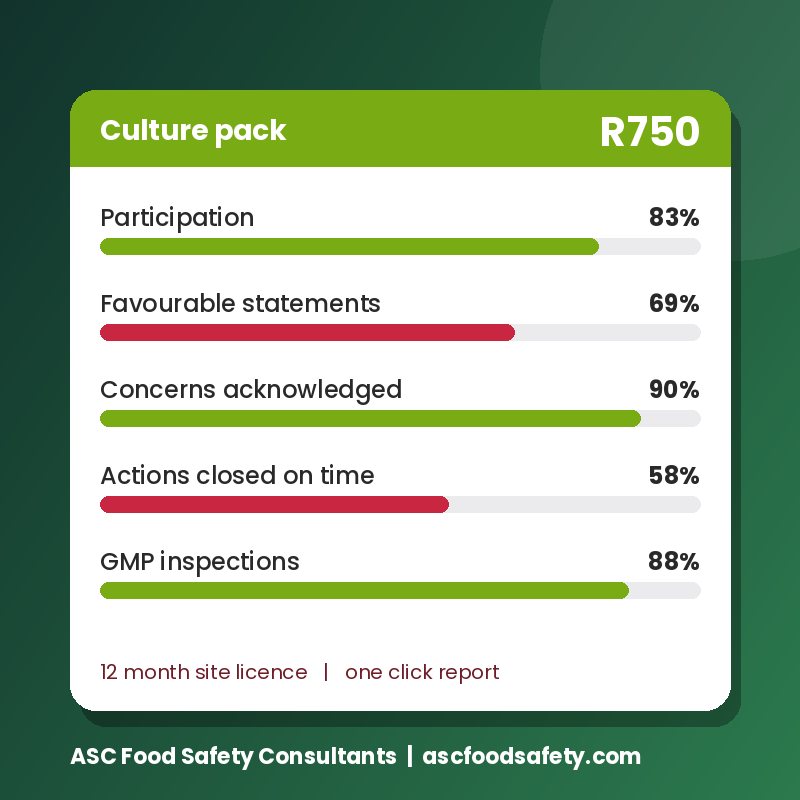
The Food Safety and Quality Culture Pack is a food safety culture tool that runs in a browser on ascfoodsafety.com. It collects anonymous worker and manager questionnaires through a QR code, gives the QA or technical manager a dashboard for training, feedback, inspections, indicators and maturity, drafts the action plan from the evidence, and produces the audit ready report in one click. It costs R750 per site for 12 months, and this article explains exactly what it does, what it does not do, and how a site uses it from purchase to audit day.
At a glance
- What it is
- An automated food safety and quality culture measurement tool: questionnaires, feedback channel, manager dashboard, suggested actions and a one click report
- Price
- R750 per site for 12 months, about USD 44, renewable. Unlimited responses, records and reports
- Who uses it
- The site administrator (who receives every response by email), the QA, technical or SHEQ manager (who reviews the dashboard and receives the report), and every worker and manager on site (who answer on their own phones)
- Built on
- FSSC 22000 clause 2.5.8, BRCGS Food Safety Issue 9 clause 1.1.2, SQF Edition 9, IFS Food Version 8 and the GFSI position paper A Culture of Food Safety Version 2.0 (2026)
- Where it runs
- In your browser, on ascfoodsafety.com. Nothing to install, no IT project, no per user fees
- Where to buy
- The culture pack product page, paid by card, Instant EFT, SnapScan or Zapper through PayFast
Buy it now and have the QR posters up on the next shift
The welcome email carries your dashboard link. Fifteen minutes of setup, print three posters, and the first responses arrive in your inbox the same day.
Buy the Food Safety and Quality Culture Pack, R750 Read the user guide (PDF)
In this article
- Why we built a tool instead of another template
- What happens in the first fifteen minutes after you buy it
- How anonymity is built in, and why that decides whether the data is worth anything
- What the manager dashboard measures, tab by tab
- Suggested actions, objectives and the plan the auditor reads first
- The report: one click, three formats, one signature
- How it maps to FSSC 22000, BRCGS, SQF, IFS and GFSI V2.0
- R750 a year: what that buys and what it replaces
- Who it is for, and who should call us instead
- Audit day with the culture pack
- The first 30 days: a plan you can follow
- Frequently asked questions
Why we built a tool instead of another template
ASC has sold food safety document toolkits for years, and every FSSC 22000 and BRCGS toolkit we sell carries a culture procedure, a survey template and a culture plan. They work. The problem is what happens after the templates are downloaded. The survey goes out once on paper, somebody spends three days typing the answers into a spreadsheet, the chart goes into a management review pack, and then nothing happens until an auditor asks for the second round and there is not one.
We saw the same pattern on client sites across South Africa: not a lack of intent, a lack of a system that made repeating the measurement easy enough that it actually got repeated. Enterprise culture software exists, but it is priced per employee in dollars for multinationals, and a 150 person site in Gqeberha or Polokwane is not going to sign that contract. So we built the tool we kept wishing our clients had, priced it at less than an hour of consulting time, and put it on our own website so there is nothing to install.
The culture clause is not failed by sites that do not care. It is failed by sites that measured once and could not face doing it again by hand.
What happens in the first fifteen minutes after you buy it
- CheckoutBuy the pack on the product page and pay through PayFast by card, Instant EFT, SnapScan, Zapper or any of the other South African options. International cards are charged the rand amount at your bank’s rate.
- Welcome emailYour workspace is created automatically and the welcome email carries your dashboard link. Log in with the email address you used at checkout.
- Setup tabEnter the site name as it must appear on the report. Enter the admin email that must receive every response. Enter the name and email of the reviewer, your QA manager, technical manager or SHEQ executive, who must receive the report. Edit the departments, shifts, employment types and languages so the questionnaire matches your site. Label the round, for example 2026 baseline. Send a test email to confirm delivery.
- Questionnaires tabPrint three QR posters: workers, managers and supervisors, and anonymous feedback. Copy the links for WhatsApp groups and notice boards.
- Tell the siteAt the shift meeting: it is anonymous, results are for groups only, results will be shared within 30 days, and the point is to fix what is not working. Participation above 80 percent is the target.
How anonymity is built in, and why that decides whether the data is worth anything
A culture questionnaire that people believe can be traced back to them measures fear. Every score comes back at 9 out of 10 and the exercise proves that nobody trusts the process. So anonymity in the pack is not a setting, it is the design.
- No name, employee number, email address or login is asked for on either questionnaire or on the feedback link.
- No device identifier is stored. A phone that has already submitted in the round is warned before it sends again, and that is all the tool remembers.
- The optional grouping questions (department, shift, employment type, tenure, language) exist so results can be compared between groups. Results are only ever shown for groups.
- The admin’s per response email carries the department, shift, average score and any comment, and nothing that identifies the person.
- The raw responses in the Excel workbook carry the same grouping fields only, so the auditor can see the data without anyone being exposed.
Say all of this at the shift meeting before the round opens, and put it on the poster. The single biggest driver of participation we have measured on client sites is whether people believed the anonymity promise, and the second biggest is whether they saw the results from the last round.
What the manager dashboard measures, tab by tab
Suggested actions, objectives and the plan the auditor reads first
The part of the culture clause that decides the audit outcome is not the survey. It is what the site did about the survey. The pack drafts that for you, from the evidence, so the plan is never a blank page.
Every statement under 80 percent favourable, every indicator off target, every maturity criterion at level 1 or 2, every observed behaviour under 80 percent compliance, every competency gap and every concern not acknowledged in time becomes a suggested action with a timeframe. The suggestions come from ASC’s action library, the same one we use when we write culture plans on client sites, and they are specific: a flagged hand washing observation proposes a sink and supplies audit and a supervisor check at shift start, not “retrain staff on hygiene”.
You accept the actions you agree with, set the owner and the due date, and close each one with the evidence of completion and an effectiveness check. The objectives sit above the plan in the eight part format the schemes expect: objective, baseline, target, measure, owner, deadline, sections reached, review.
The QA or technical manager opens the actions tab once a week, filters by overdue, and chases owners. Once a quarter the objectives, the indicators and the open actions go to management review and the minutes record the discussion. That routine, more than any score, is what an auditor recognises as a working culture programme.
The report: one click, three formats, one signature
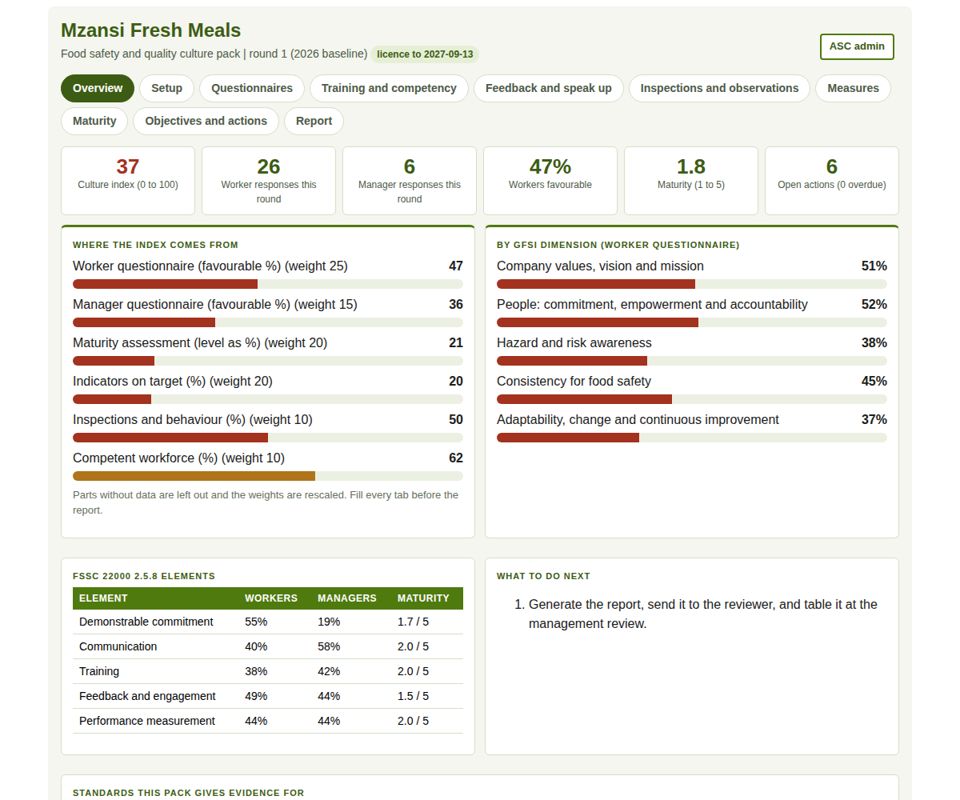
The Report tab builds the full culture report from whatever is on the dashboard: culture index, results by element and dimension, both questionnaires with the perception gap, maturity with evidence, training and competency, feedback and speak up, inspections and observations, the sixteen indicators with trends, the objectives, the action plan with due dates and status, an evidence map for the auditor, and a sign off block for the site head and the reviewer.
Print it to PDF for the file, download the Excel workbook with the raw anonymous responses and every record, or email both to the reviewer and the admin with one click. Sent reports are listed on the tab with their dates, so the second round can be laid beside the first.
How it maps to FSSC 22000, BRCGS, SQF, IFS and GFSI V2.0
| Requirement | Where the pack answers it |
|---|---|
| FSSC 22000 2.5.8: senior management commitment and culture objectives | Objectives tab (eight part format), senior management floor walk log, manager questionnaire commitment element, sign off block on the report |
| FSSC 22000 2.5.8: communication | Worker and manager statements tagged to the communication element, shift meeting indicator, feedback within 30 days recorded as an action |
| FSSC 22000 2.5.8: training | Training and competency tab by position, training events with effectiveness checks, competence pass rate indicator |
| FSSC 22000 2.5.8: feedback from employees and engagement | Anonymous questionnaires, anonymous feedback link, speak up log with acknowledgement times, participation rate |
| FSSC 22000 2.5.8: performance measurement | Sixteen lead and lag indicators with targets and twelve month trends, GMP inspection scores per department, behavioural observation compliance |
| BRCGS Food Safety Issue 9, 1.1.2: a plan with defined activities, timescales and a review of effectiveness, involving all sections of the site | Action plan with owners, due dates, timeframes, evidence and effectiveness checks; results by department, shift and employment type including agency and contractors; sent reports listed by round |
| SQF Edition 9, 2.1.1: management commitment and food safety culture | Same evidence with SQF clause references in the evidence map |
| IFS Food Version 8, 1.1 and 1.2: culture elements documented and reviewed | Same evidence with IFS clause references in the evidence map |
| GFSI position paper Version 2.0 (2026): two foundations and three manifested essentials | Every questionnaire statement tagged to a dimension; results by dimension in the report |
The maturity criteria and the action library come from ASC’s FSSC 22000 culture toolkit, the same documents we install on client sites, so the pack and the toolkit speak the same language. If you already own the toolkit, the pack is the measurement engine that its culture procedure describes.
R750 a year: what that buys and what it replaces
| What you would otherwise do | Typical cost in South Africa | With the pack |
|---|---|---|
| Paper questionnaire, spreadsheet capture and hand built charts | Two to three days of a QA manager’s time per round, twice a year | Responses arrive already captured; charts and the report are built for you |
| Consultant led culture survey with a report | R15,000 to R60,000 per round depending on site size | R750 for the year, unlimited rounds; ASC can still run the first round and present the findings if you want that |
| Enterprise culture software | Priced per employee per year in US dollars, plus onboarding | One flat price per site, no per user fees, no IT project |
| Writing the action plan from scratch | A day of drafting, and often a plan with no owners or dates | Suggested actions drafted from the evidence, with timeframes, ready to accept |
| Building the audit file | An afternoon before every audit, every year | One click report with the evidence map and sign off block |
The licence is one site for 12 months with unlimited questionnaire responses, unlimited records and reports, and email notifications. Renewal is the same price and extends the current licence from its expiry date. A group buys one pack per site so that each site has its own workspace, QR codes and report, which is also what a multi site auditor expects to see.
Less than one hour of consulting time, for a year of measurement
R750 buys the questionnaires, the dashboard, the suggested actions and the report for 12 months. Renew for the same price and lay the second round beside the first.
Who it is for, and who should call us instead
It is built for
- Sites certified or preparing for FSSC 22000, BRCGS, SQF or IFS that need evidence of culture measurement for the next audit.
- QA, technical and SHEQ managers who own the culture clause and have no budget line for it.
- Group technical managers who need the same measurement, in the same format, from every site.
- Consultants running culture programmes for several clients, who want a repeatable method and a report that looks the same every time.
- Sites that bought ASC’s culture toolkit or completed the FS320202 culture course and now need the measurement engine.
Call us instead if
- Senior management has not yet agreed that culture is a priority. A tool cannot create the commitment; a workshop with the site head sometimes can, and ASC runs those.
- The site is in the middle of a serious incident or a major non conformance. Fix the incident first; the culture programme comes after.
- You want somebody to run the first round, present the findings to management and write the culture plan. ASC does that, and the pack is the tool we use to do it.
Audit day with the culture pack
Open the report before the auditor arrives and print it. Walk them through it in this order: the objectives with baselines and targets, the action plan with owners, dates and closure evidence, the questionnaire results by department and shift with participation figures, the observation and inspection records, the indicators, the maturity assessment with its evidence fields, and the management review minutes that discussed all of it. Then hand over the evidence map and let them cross reference.
Two things to have ready alongside the report. The signed one page note explaining that rising near miss and speak up counts are the programme working, and the previous round’s report if you have one. A site with two reports and a trend has a culture programme. A site with one has a baseline, which is still a conformance if the plan and the review are there.
The first 30 days: a plan you can follow
- Day 1Buy the pack, complete the Setup tab, send the test email, print the posters.
- Days 2 to 5Shift meetings on every shift: why, anonymity, timing, feedback promise. Posters up. Links in every group. Tablet at the shift meeting for people without data.
- Days 5 to 14Round open. Check participation daily by department. Chase the departments behind 50 percent. Enter the training and competency headcounts while you wait.
- Days 14 to 21Close the round. Enter the last three months of indicators, the last GMP inspection scores, and do the maturity assessment from records with the QA team.
- Days 21 to 25Review the suggested actions with the site head. Accept, assign owners and dates. Write two to four objectives in the eight part format.
- Days 25 to 30Build the report, email it to the reviewer, table it at management review, and put the three lowest statements with their actions and owners on every shift board. Book the next round.
Frequently asked questions
What is the Food Safety and Quality Culture Pack?
How much does the culture pack cost and what does the licence cover?
Is the questionnaire really anonymous?
Who receives the responses and the report?
Which standards does the report cover?
Can it be used by a site outside South Africa?
Does it replace our culture policy, procedure and plan documents?
What happens when the licence expires?
Key takeaways
- The Food Safety and Quality Culture Pack is a browser based culture measurement tool on ascfoodsafety.com: anonymous questionnaires on a QR code, an anonymous feedback link, a manager dashboard, suggested actions and a one click audit ready report.
- Every response is emailed to the admin address you enter, and the report goes to the QA, technical or SHEQ manager you name, with the Excel workbook attached.
- It is structured on FSSC 22000 2.5.8 and mapped to GFSI Version 2.0, with the evidence map referencing BRCGS 1.1.2, SQF 2.1.1 and IFS 1.1 and 1.2.
- R750 per site for 12 months, unlimited responses and reports, renewable, one pack per site for a group.
- It replaces the paper survey, the spreadsheet, the hand built plan and the audit file. It does not replace your culture policy and procedure, and it does not replace management commitment.
- Buy it here, and if you want ASC to run the first round, say so on the contact form.
Put the posters up this week
Buy the pack, set it up in fifteen minutes, and have the first report at your next management review. Renew next year and show the auditor the trend.
Buy the Food Safety and Quality Culture Pack, R750 per site per year Ask ASC to run the first round
Published by ASC Food Safety, South African food safety and quality consultants. This article is general guidance and not a substitute for certification-specific advice.