
By Mthokozisi Nkosi, Food Safety Specialist & Lead Auditor, ASC Food Safety · 10 min read
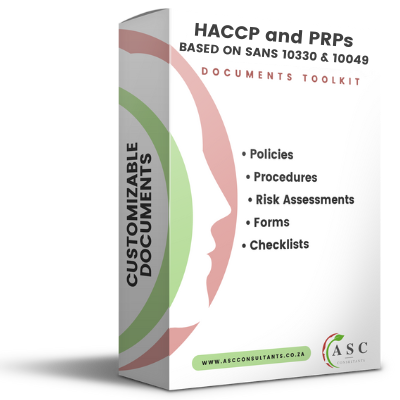
HACCP is the foundation of food safety, and in South Africa it underpins everything from Regulation R638 compliance to the most advanced certification schemes. A HACCP document templates toolkit built on SANS 10330, together with prerequisite programmes based on SANS 10049, gives you a complete, ready-to-use HACCP system without having to write the plan and every supporting procedure from scratch.
At a glance
- Based on
- SANS 10330 (HACCP) and SANS 10049 (hygiene / prerequisite programmes)
- Approach
- Codex HACCP principles: the seven principles and twelve steps
- Best for
- Any food business building or formalising a HACCP system
- Great for
- R638 readiness and as a foundation for FSSC, ISO or BRCGS
- Format
- Fully editable Microsoft Word & Excel, instant download, yours to keep
In this guide
What is HACCP and the PRPs?
HACCP (Hazard Analysis and Critical Control Points) is the internationally recognised method for managing food safety hazards. In South Africa, SANS 10330 sets out the HACCP requirements and SANS 10049 covers hygiene and the prerequisite programmes, the good manufacturing and hygiene practices that HACCP depends on. Prerequisite programmes are the foundation; HACCP is the structured risk analysis that sits on top. Together they form the practical base of a food safety system.
The toolkit provides that base, fully documented. It contains the HACCP plan and hazard-analysis templates, the prerequisite programme procedures, and the forms and records needed to run and prove the system. You add your products, process steps and controls, and you have a working HACCP system aligned to SANS 10330 and SANS 10049.
Why your documented system is everything
Whether it is an environmental health practitioner checking a Certificate of Acceptability, a retail auditor or a certification body, the assessor looks for a documented HACCP-based system and the records that prove it runs. Verbal assurances that you control temperatures or clean properly count for little without procedures and records behind them. The documentation is what turns your practice into evidence.
Good hygiene without records is invisible to an auditor. A HACCP toolkit makes your controls visible and verifiable.
Writing a full HACCP study and every supporting procedure from a blank page is a real project. A toolkit removes most of that work by giving you the plan, the prerequisite programmes and the records already structured, so you focus on your actual process and controls.
What is inside the toolkit
- A HACCP plan template following the seven principles and twelve steps
- Hazard-analysis and CCP determination worksheets
- Prerequisite programmes: cleaning, personal hygiene, pest control, maintenance, calibration and more
- Product descriptions, process flow diagrams and verification procedures
- Corrective action, traceability and product recall procedures
- Monitoring forms, registers and internal-audit checklists
Where HACCP fits with certification
HACCP is not just a standalone standard; it is the mandatory core of every GFSI scheme. If you later certify to FSSC 22000, ISO 22000 or BRCGS, the same HACCP thinking carries straight through. Building a solid HACCP system now is therefore never wasted work; it is the platform every higher standard is built on.
Building from scratch vs starting with a toolkit
| From a blank page | With the ASC toolkit | |
|---|---|---|
| Time to a HACCP system | Weeks of study and procedure writing | Ready to personalise in days |
| Completeness | Easy to miss PRPs or verification steps | Plan, PRPs and records covered by design |
| R638 readiness | Hard to evidence a documented system | Documented, inspection-ready system |
| Cost | High consulting fees to author everything | A fraction of the cost of bespoke authoring |
| Growth path | Rework to reach GFSI schemes | Carries straight into FSSC, ISO or BRCGS |
How the toolkit helps your business
How to build your HACCP system, step by step
- Put the prerequisite programmes in placeAdopt the hygiene, cleaning, pest control and maintenance procedures as your foundation.
- Describe your products and processComplete the product descriptions and map your process flow diagrams.
- Do the hazard analysisWork through the hazards at each step and confirm your critical control points.
- Set limits, monitoring and corrective actionsDefine critical limits, how you monitor them and what you do when they are breached.
- Verify and keep recordsUse the verification procedures and monitoring forms to prove the system runs.
- Audit yourselfRun an internal audit with the included checklists and close any gaps.
Common mistakes to avoid
Jumping to CCPs before the prerequisite programmes are solid; hazard analysis that does not justify the CCPs chosen; monitoring records that are filled in after the fact; and no verification to confirm the system actually works. A toolkit gives you the right structure, but the monitoring and verification records must be genuine.
Who needs a HACCP system in South Africa?
Almost every food business needs HACCP in some form. It is the expectation behind Regulation R638 and the Certificate of Acceptability process, it is what many retailers ask their smaller suppliers to demonstrate, and it is the mandatory core of every GFSI scheme such as FSSC 22000 and BRCGS. If you are formalising food safety for the first time, or you need a documented HACCP system before moving up to a full certification, this toolkit is the right starting point.
Why choose the ASC toolkit
ASC Food Safety builds HACCP systems for South African food businesses of every size, so the templates reflect SANS 10330 and SANS 10049 as they are actually applied and inspected here. The documents are practical, clear enough for a small team to keep up with, and fully yours to keep and adapt. ASC consultants can help you build or review your HACCP plan wherever you want support.
Read our plain-English guide to what a food safety document toolkit is, then start on your HACCP system.
Related toolkits, guides and training
Frequently asked questions
What standards is the toolkit based on?
Is HACCP enough on its own, or do I need FSSC or BRCGS?
Does this help with R638 and a Certificate of Acceptability?
What is the difference between a PRP and a CCP?
Will the toolkit get me certified on its own?
Can ASC help us build the HACCP plan?
Key takeaways
- HACCP (SANS 10330) plus prerequisite programmes (SANS 10049) are the practical base of food safety in SA.
- The toolkit gives you the HACCP plan, the PRPs and the records already structured, ready to personalise in days.
- A documented HACCP system supports R638 and Certificate of Acceptability readiness.
- The same HACCP core carries straight into FSSC 22000, ISO 22000 and BRCGS when you grow.
Build your HACCP system without the blank page
Start from a complete SANS 10330 and SANS 10049 foundation.
Get the HACCP & PRPs toolkit Talk to a consultantPublished by ASC Food Safety, South African food safety and quality consultants. This article is general guidance and not a substitute for certification-specific advice.