

Improper temperature control can lead to foodborne illnesses, spoilage, and a loss of product quality. This article aims to provide a detailed exploration of food temperature control in Spaza shops, its challenges, and practical steps for improving safety and quality.
Food temperature control involves maintaining food within specific temperature ranges to prevent the growth of harmful bacteria, preserve nutritional value, and ensure the overall quality of the products.
The Importance of Temperature Control
When addressing temperature control concerns, focusing on key temperature points critical to food safety is important. The key temperature points are:
Danger Zone
The danger zone is temperatures between 5°C 60°C. In this temperature range, bacteria such as Salmonella or E. coli can multiply rapidly, leading to foodborne illnesses. The stipulated temperatures are suitable for bacteria growth because they are not cold enough to stop their growth or hot enough to kill them.
Food should never be stored or displayed in this range for extended periods. For example, if perishable items like meat or dairy products are stored in a refrigerator set at 8°C instead of the required 0°C to 5°C, they will enter the “danger zone”.
Safe Temperature Ranges
Safe temperature ranges for food storage also exist and vary for different kinds of food. The shop owner should regularly check refrigeration and freezer temperature settings to ensure safe storage. The table below shows the temperature requirements for different foods. Controlling these temperature ranges is important for Spaza shops, as they often lack the advanced equipment and infrastructure of larger, formal grocery stores.
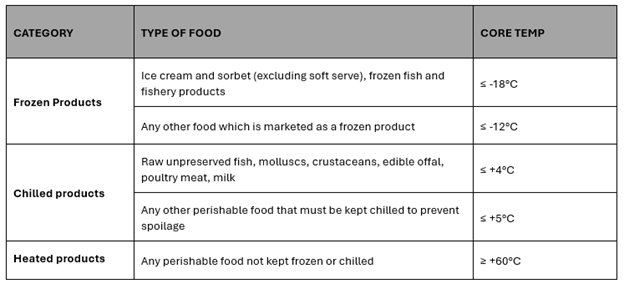
The Battle for Proper Temperature Control in Spaza Shops
Spaza shops face several unique challenges in maintaining proper food temperature control. These challenges are often due to the informal nature of the business, financial constraints, and limited resources. Some of the common issues include:
Limited Space and Infrastructure
Spaza shops often operate in limited spaces, such as converting a single-car garage into a Spaza shop. The small, cramped space makes it less conducive to maintaining the required temperature for different kinds of food.
The Spaza shop is overcrowded with stock and food on the shelves, which blocks the airflow. This results in poor ventilation and affects the food quality in the store. To prevent this, the shop owner can create dedicated zones for different types of food, ensure that refrigeration units are not blocked by shelves or other stock, and leave adequate space between items to allow for proper ventilation.
Low Investment in Equipment
Spaza shops, being small businesses, may not have the capital to support the necessary infrastructure to ensure foods are stored in the best refrigeration systems; instead, they rely on second-hand units that are not working well. To address this challenge, a strategy could be for the shop owner to seek government programs, small business loans, or partnerships that offer financial support for upgrading equipment.
The Risks of Improper Temperature Control in Spaza Shops
Maintaining the proper storage conditions for perishable food items in Spaza shops is crucial to ensuring safety and quality. Improper refrigeration can lead to the growth of harmful bacteria, increasing the risk of foodborne illnesses, spoilage, and compromised product quality. To avoid these risks, it is essential for Spaza shop owners to invest in reliable refrigeration systems and regularly monitor temperatures to keep food fresh, safe, and of high quality for consumers. This includes maintaining refrigeration units at the optimal temperature range to protect vulnerable groups, prevent spoilage, and preserve the integrity of sensitive products.
Foodborne Illnesses: A Hidden Danger
Bacteria can thrive in the danger zone, increasing the risk of foodborne illnesses. These bacteria can cause severe illnesses such as gastrointestinal diseases and, in the worst cases, even death, particularly in vulnerable groups such as children, the elderly, and people with weakened immune systems. To prevent this, the Spaza shop should ensure that perishable items are stored in refrigeration units that maintain a temperature below 5°C.
Spoilage and Its Toll on Freshness
Perishable food items, such as meat, dairy, and fresh produce, spoil quickly when not kept at the proper temperatures. Spoiled Food presents a health hazard and leads to financial losses as the goods become unsellable. To prevent spoilage, the shop should store all perishable items, including fruits, vegetables, meat, and dairy, in refrigerated storage units with temperature controls set between 0°C and 5°C.
Product Quality in Jeopardy
Some foods are sensitive to temperature fluctuations, and a slight change in temperature affects their quality attributes, such as taste, texture, and appearance. Yoghurts, for example, will separate once they have been exposed to different temperature changes. To maintain the quality of temperature-sensitive products, the shop should ensure its refrigeration units are regularly checked for proper functionality and set to a consistent temperature range (0°C to 5°C).
How Can You Ensure Food Temperature Control in Spaza Shops?
While the Spaza shop may face challenges in temperature control, practical solutions can also be applied to ensure the safety of the foods in the store. The following are some of the recommendations to control temperature in Spaza shops:
Invest in Reliable Refrigeration for Freshness
Although there is limited capital, investing in a good-quality fridge or freezer ensures that perishable goods are stored at the correct temperatures. Shop owners can start small by investing in a reliable second-hand fridge and gradually scale up as their business grows. A well-maintained fridge or freezer can extend the shelf life of food, reduce waste, and protect customers’ health.
Mastering Regular Temperature Monitoring
This is one of the simplest but most reliable ways to maintain consistent temperatures in Spaza shops. Spaza shop owners use thermometers to monitor the unit’s temperature and hot-holding equipment for food safety. Investment in ventilation must also be considered to allow proper airflow in the food premises.
Ensure Safety Through Training and Awareness
It is vital to train employees on the importance of food safety and temperature control. To do this, a Spaza shop owner can hold monthly training sessions for their staff, teaching them about the risks of improper food storage and the correct temperatures for storing meat, dairy, and perishables throughout the day.
Conclusion
While these shops face numerous challenges, such as limited resources, there are practical steps they can take to improve temperature management. By investing in proper equipment, monitoring temperatures consistently, training staff, and maintaining a clean and organised environment, Spaza shop owners can enhance the safety and quality of the food they provide to their communities.
Recommended Food Safety Training for Spaza Shop Owners

Related Articles for Spaza Shops
Do you own a Spaza shop?



Related Articles for Start-up Food Businesses
Do you want to start a food business?




Comments
Do you have any questions, comments, or suggestions? We’d love to hear from you! Please share your thoughts in the comments section below.
Feedback from our website visitors is always appreciated.
Accredited online training
Train your team for R638
The EHP will ask who is in charge and how your staff were trained. Our accredited online courses cover both, and your people can start today. Teams of 5 or more get 10% off, and 10 or more get 15% off, on one invoice.
See all online courses and prices or WhatsApp us for a team quote
Key facts
- The temperature danger zone is 5°C to 60°C, where bacteria such as Salmonella and E. coli multiply rapidly because the food is neither cold enough to stop growth nor hot enough to kill them.
- Perishable items like meat, dairy, and fresh produce should be stored in refrigeration set between 0°C and 5°C, not above 5°C, to prevent spoilage and illness.
- Spaza shops face real barriers to good temperature control, including cramped spaces that block airflow and limited capital that leads to reliance on poorly working second-hand units.
- Improper temperature control risks foodborne illness, food spoilage and financial loss, and reduced product quality such as yoghurt separating after temperature changes.
- Practical fixes include investing in a reliable fridge or freezer (even a good second-hand one to start), regular temperature monitoring with thermometers, and training staff on safe storage.
- Owners can seek government programmes, small business loans, or partnerships to fund equipment upgrades, and hold monthly staff training on food safety.
Frequently asked questions
What is the temperature danger zone for food in a spaza shop?
The danger zone is between 5°C and 60°C. In this range harmful bacteria such as Salmonella and E. coli multiply rapidly because the food is not cold enough to stop their growth or hot enough to kill them. For example, storing meat or dairy in a fridge set at 8°C instead of 0°C to 5°C pushes the food into the danger zone.
At what temperature should spaza shops store perishable food like meat and dairy?
Perishable items such as meat, dairy, fruits, and vegetables should be stored in refrigerated units set between 0°C and 5°C. Keeping food below 5°C helps prevent bacterial growth, spoilage, and foodborne illness. Owners should regularly check that fridge and freezer settings stay within this safe range.
Why is temperature control so difficult in spaza shops?
Spaza shops often operate in limited, cramped spaces, such as a converted single-car garage, which makes it hard to maintain the right temperatures and can block airflow when shelves are overcrowded. Many are small businesses without the capital for proper equipment, so they rely on second-hand units that may not work well. Poor ventilation and overcrowding further reduce food quality.
How can a spaza shop owner improve temperature control on a limited budget?
Start small by investing in a reliable second-hand fridge or freezer and scale up as the business grows. Owners can also seek government programmes, small business loans, or partnerships that offer financial support for upgrading equipment. Creating dedicated zones for different foods and leaving space for ventilation also helps.
What are the risks of poor temperature control in a spaza shop?
Poor temperature control lets bacteria thrive in the danger zone, raising the risk of foodborne illnesses like gastrointestinal disease and, in severe cases, death, especially in children, the elderly, and people with weakened immune systems. It also causes perishable food to spoil quickly, leading to financial losses from unsellable stock. Temperature fluctuations can degrade quality too, such as yoghurt separating.
How can spaza shop staff help maintain safe food temperatures?
Staff should be trained on the importance of food safety and correct storage temperatures for meat, dairy, and other perishables throughout the day. Owners can hold monthly training sessions covering the risks of improper storage. Using thermometers to regularly monitor fridge and hot-holding equipment is one of the simplest and most reliable ways to keep temperatures consistent.