
Home›Toolkits›Development Program assessment
FSSC Development Program · Assessment
What the assessor asks to see
A practical guide to the FSSC Development Program Version 2.0 assessment for food and feed manufacturing: the 182 numbered clauses in three parts, the five steps every site has to go through, the four places assessments are won and lost, and how to find your own gaps before the assessor does.
The short answer. The FSSC Development Program Version 2.0 Assessment Requirements for Food and Feed Manufacturing (May 2025) contain 182 numbered clauses in three parts: Part 1 Food Safety System (clauses 1.1 to 1.12), Part 2 Prerequisite Programmes (clauses 2.1 onward) and Part 3 HACCP Control (clauses 3.1 to 3.4). A licensed conformity assessment body assesses the site against them. On the day, the assessor wants to trace any clause to the document that closes it, follow a HACCP study built on your own process flow, see monitoring records filled in over real weeks of production, and see a system you have already checked against the requirements yourself.
The three parts the assessor works through
| Part | Clauses | What it asks for |
|---|---|---|
| 1. Food Safety System | 1.1 to 1.12 | Leadership and commitment, legal registration and food safety law, roles, externally developed elements, document and record control, competence, communication, supplier and outsourced process control, nonconformity and improvement |
| 2. Prerequisite Programmes | 2.1 onward | Buildings, utilities and hygienic design; cleaning, pest control and waste; personal hygiene; allergen, rework and chemical control; food defence, food fraud and traceability |
| 3. HACCP Control | 3.1 to 3.4 | Food safety team and preliminary steps, hazard analysis, CCP and OPRP determination, critical limits, monitoring, corrections and corrective action, verification, monitoring devices, and unsafe or nonconforming product |
The five steps, and the one sites skip
- Get the written system. Policies, procedures, forms and registers for all three parts.
- Make it yours. Put in your company details, products, processes and site layout, and have management approve them.
- Work the HACCP study against your own process flow, verified on site.
- Build real records over real weeks of production. This is the step every rushed site tries to skip, and no assessor accepts a system that started yesterday.
- Be assessed. Appoint a licensed conformity assessment body and book the assessment.
Steps 1 and 2 done in days, not months. 247 documents written to the Version 2.0 clause tree, each procedure naming who, what, when, the criterion and the record the assessor will ask for, plus a gap analysis and self assessment workbook. R3,750.
Where assessments are won and lost
1. Clause mapping: trace a clause to a document and back
When the assessor reads out a clause number, someone on your team has to open the right document in seconds. A mapping document at the root of each part, listing every requirement against the documents that meet it and the evidence expected, turns that into a ten-second answer instead of a hunt through folders.
2. The HACCP study: a matrix an assessor can follow
Assessors challenge the reasoning, not the formatting. Rating Salmonella on a dry ingredient line, Listeria monocytogenes in chilled ready-to-eat product, or Bacillus cereus where cooked starch sits warm is the kind of hazard reasoning that survives a challenge. Be honest about control points: a study worked to a realistic handful of CCPs and OPRPs holds up, while twelve control points look impressive on paper and collapse when the assessor asks for the monitoring records behind each one.
3. Monitoring records: filled in on the spot, not on Friday
Day-to-day, a site runs on its control forms and records, mostly shift-level checks that take minutes. The assessor will look at whether they were completed at the time, by the person named, with corrections recorded when a limit was missed. Records written up at the end of the week are easy to spot.
4. Self-assessment before the assessor arrives
The FSSC self-assessment tool for the sector sets out every clause row, and the Program recommends a preliminary self-assessment before applying. Work it honestly before the assessment and you find your own gaps first, which is the whole point of a gap audit. A site that walks in with a completed, dated self-assessment and actions against its gaps starts the day in a far stronger position.
Common gaps on a first assessment
- A generic HACCP plan copied from another site rather than built on your own verified process flow.
- Too few weeks of records, or records clearly completed in one sitting.
- Prerequisites on paper only: a cleaning schedule with no verification, an allergen matrix nobody updates.
- Wrong language. The outcome is a conformity statement from a conformity assessment body. Calling it certification in your own documents is a sign the system was not read.
- Version 1.1 documents carried forward. Version 1.1 assessments ended on 31 May 2026, and 2.0 has one set of requirements with no tiers.
What the ASC toolkit gives you for the assessment
- 247 controlled documents, FDPM001 to FDPM247, in the same three sections as the Assessment Requirements, plus a Program and scope folder.
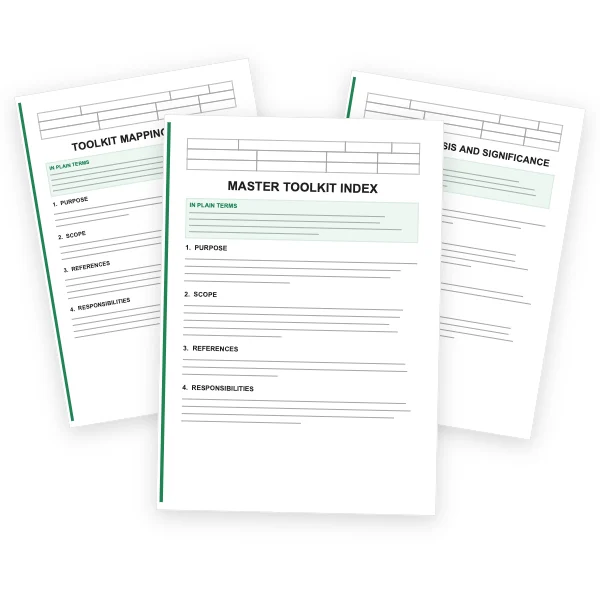
- A clause-mapped master index and a mapping document at each part root.
- A gap analysis and self assessment workbook with every clause and the documents that close it.
- An eight sheet HACCP workbook (how to use, study, significance matrix, Annex 3 decision tree, CCP and OPRP summary, risk register, matrixes and action tracker) worked to 2 CCPs and 4 OPRPs for the example bakery.
- 172 forms, records and checklists, 10 risk assessment workbooks, and food fraud and food defence workbooks.
- One hour of consultation with one of our consultants: spend it on your category and on which control points are genuinely critical.
Not sure about the route itself? Start with what the FSSC Development Program is, or compare it with FSSC 22000.
Walk into your assessment with every clause mapped. Food and Feed Manufacturing R3,750, Catering and Food Service R3,750, lifetime licence, editable Word and Excel, no VAT.
Questions people ask
Frequently asked questions
How many requirements are in the FSSC Development Program V2.0 for food and feed manufacturing?
The Assessment Requirements for Food and Feed Manufacturing V2.0, published May 2025, contain 182 numbered clauses in three parts: Part 1 Food Safety System (clauses 1.1 to 1.12), Part 2 Prerequisite Programmes (clauses 2.1 onward) and Part 3 HACCP Control (clauses 3.1 to 3.4).
Who carries out an FSSC Development Program assessment?
A licensed conformity assessment body carries out the assessment, unaccredited. A successful assessment results in a conformity statement and an entry in the public FSSC Register of conforming organizations.
What does the assessor ask to see in an FSSC Development Program assessment?
The assessor traces clauses to the documents that close them, follows the HACCP study built on the site’s own verified process flow, checks that monitoring records were completed at the time over real weeks of production, and can ask how the site checked itself against the requirements before applying.
Can a site be assessed straight after writing its documents?
No assessor accepts a system that started yesterday. After the documents are adapted and the HACCP study is worked, the site needs real weeks of production records before booking the assessment.
Is there a toolkit for the FSSC Development Program assessment?
ASC Food Safety Consultants sells an FSSC Development Program V2.0 toolkit for Food and Feed Manufacturing with 247 documents mapping all 182 numbered clauses, a gap analysis and self assessment workbook and one hour of consultation for R3,750, and a Catering and Food Service toolkit with 257 documents, also R3,750.