
Home›Toolkits›Development Program vs FSSC 22000
FSSC Development Program · Decision
Development Program or FSSC 22000?
Both come from Foundation FSSC, both start with a written food safety system, and they give your customer very different things. Here is how to tell which one your customer actually asked for, what each costs you in documents and time, and how to start on one without wasting the work when you move to the other.
The short answer. If your customer’s specification names FSSC 22000 or asks for a GFSI-recognised certificate, only FSSC 22000 certification answers it. If your customer wants proof of a documented food safety system with an independent third-party position, the FSSC Development Program answers it: an unaccredited assessment by a licensed conformity assessment body, a conformity statement, and an entry in the public FSSC Register of conforming organizations. The Development Program is the smaller first step and is designed as a staging post towards FSSC 22000.
The difference, side by side
| FSSC Development Program V2.0 | FSSC 22000 Version 7 | |
|---|---|---|
| What it is | Voluntary assessment model for sites not yet ready for certification | Full certification scheme |
| Who assesses | Licensed conformity assessment body, unaccredited | Accredited certification body |
| What you get | Conformity statement and public register entry | Certificate |
| GFSI recognition | No | Yes |
| Requirements | One set per sector; 182 numbered clauses for food and feed manufacturing | ISO 22000:2018, sector PRP standard and FSSC additional requirements |
| ASC toolkit | R3,750 (manufacturing) or R3,750 (catering) | R6,350 per category |
How to read what your customer asked for
Go back to the email, the supplier questionnaire or the specification and look for the words.
- “FSSC 22000”, “GFSI-recognised” or “accredited certificate”. Only certification answers this. A conformity statement will not.
- “A documented food safety system”, “HACCP-based system” or “third-party verification”. The Development Program answers this, and a register entry your customer can look up is stronger than a self-declaration.
- “A plan to get to FSSC 22000 by” a date. The Development Program now, with FSSC 22000 as the stated next step, is often exactly what the buyer wants to see.
If the wording is vague, ask. One email to the buyer costs less than building the wrong system.
Customer wants a system now, certification later? Start with the Development Program toolkit, with 247 documents, every clause mapped, a gap analysis and self assessment workbook and an hour with one of our consultants, for R3,750.
When FSSC 22000 is the right call straight away
- A retailer or brand owner contract names FSSC 22000 or a GFSI scheme.
- You export into a market where buyers expect GFSI certification as standard.
- You already run a working food safety system and the gap to certification is small.
Note the version timing if you go that way: FSSC 22000 Version 7 is the version to build to, Version 6 remains in audit use until 30 April 2027, and Version 7 upgrade audits run from 1 May 2027 to 30 April 2028. Confirm your own dates with your certification body. Our FSSC 22000 Version 7 toolkits cover each food chain category at R6,350.
Starting on one without wasting the work
The ASC Development Program toolkits use the same three-part spine, clause-mapped index and risk assessment format as our FSSC 22000 Version 7 toolkits. The step up extends what your people already know rather than replacing it. The toolkit also includes a Development Program to FSSC 22000 Version 7 bridge document that sets out what has to be added when you move on, so the records you build for your conformity statement become the history your certification audit looks for.
Which Development Program toolkit do you need?
- Factories, feed mills, packhouses and ingredient makers in categories BIII, C, D and K: Food and Feed Manufacturing toolkit, R3,750.
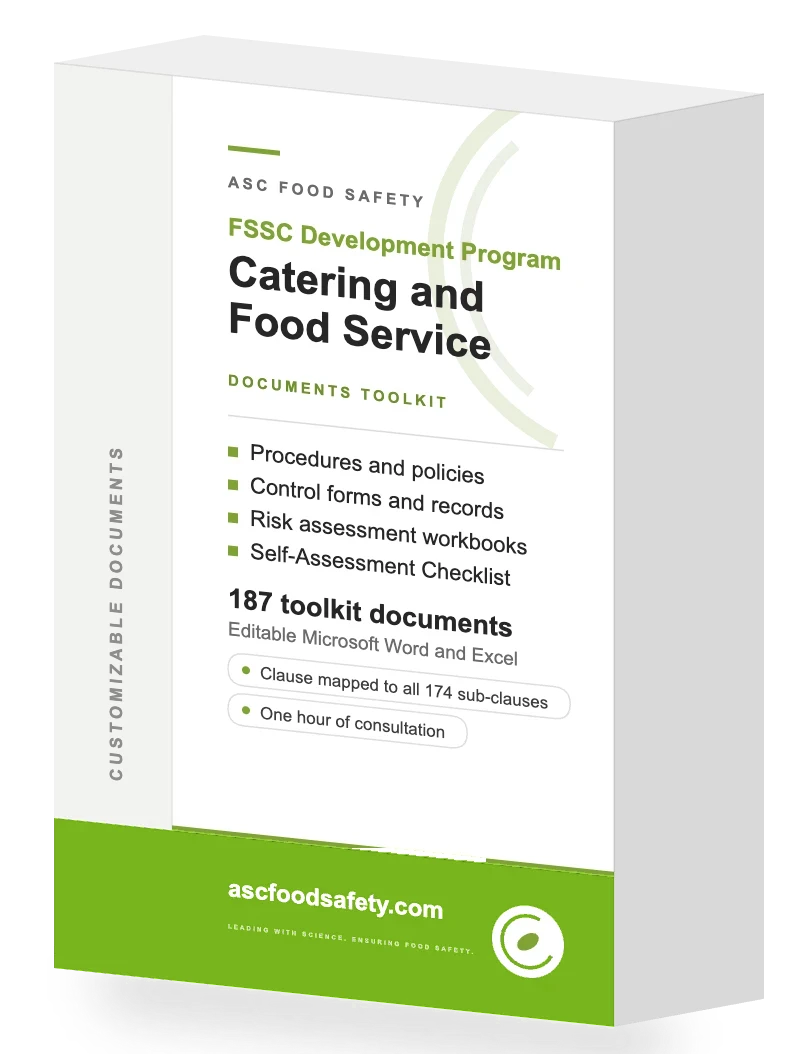
- Restaurants, hotels, canteens, cafeterias, coffee shops, food trucks and event catering in category E: Catering and Food Service toolkit, R3,750.
- Off-site catering kitchens making food not for immediate consumption sit in category C, so the manufacturing toolkit is yours.
Pick your route today. Development Program R3,750, FSSC 22000 Version 7 from R6,350. Every toolkit is editable Word and Excel with a lifetime licence and an hour of consultation, and no VAT is added.
Questions people ask
Frequently asked questions
What is the difference between the FSSC Development Program and FSSC 22000?
FSSC 22000 is an accredited, GFSI-recognised certification scheme that results in a certificate. The FSSC Development Program is a voluntary assessment model in which a licensed conformity assessment body assesses a site unaccredited, resulting in a conformity statement and a public entry in the FSSC Register of conforming organizations, not a certificate.
Will my customer accept the FSSC Development Program instead of FSSC 22000?
It depends on what the customer asked for. A request for a documented food safety system with a third-party position is answered by the conformity statement and register entry. A specification naming FSSC 22000 or a GFSI-recognised certificate is not.
Is the FSSC Development Program GFSI recognised?
No. The FSSC Development Program is not GFSI recognised and does not give FSSC 22000 status. It is designed as a staging post towards FSSC 22000 certification.
Can I move from the FSSC Development Program to FSSC 22000 later?
Yes. The Development Program is intended as a step towards FSSC 22000. ASC’s Development Program toolkits are built to the same house standard as its FSSC 22000 Version 7 toolkits and include a Pathway to FSSC 22000 Certification guide that lists what a site adds to make the move.
How much do FSSC Development Program and FSSC 22000 toolkits cost?
ASC Food Safety Consultants sells the FSSC Development Program V2.0 toolkits for Food and Feed Manufacturing and for Catering and Food Service at R3,750 each, and FSSC 22000 Version 7 toolkits at R6,350 per category, with no VAT added.