
Home›Toolkits›FSSC Development Program
FSSC Development Program · Version 2.0
What is the FSSC Development Program?
The FSSC Development Program is Foundation FSSC’s route for food and feed businesses that need to prove a food safety system to a customer but are not ready for full FSSC 22000. Here is what Version 2.0 is, who it is for, what a successful assessment gives you, what it does not, and the fastest way to get the written system in place.
The short answer. The FSSC Development Program is a voluntary assessment model run by Foundation FSSC for organisations in the food and feed supply chain. Version 2.0, published in May 2025, has one set of assessment requirements per sector, linked to the ISO 22003-1:2022 food chain categories. A licensed conformity assessment body assesses your site unaccredited, and a successful assessment gives you a conformity statement and an entry in the public FSSC Register of conforming organizations that your customer can look up. It is not FSSC 22000 certification, not a certificate and not GFSI recognition. It is a staging post on the way there.
For a South African factory, feed mill or packhouse that has been told by a retailer or an export customer to “show us your food safety system”, the Development Program is often the right first answer. It is smaller than FSSC 22000, it is built for sites with no system yet, and it gives the customer something independent to check rather than a self-declaration.
Who is the FSSC Development Program for?
Sites that need a documented, independently assessed food safety system now, and cannot yet carry a full FSSC 22000 audit. In practice the buyers we see fall into four groups:
- A supplier with a deadline. A retailer has set a date to have a system in place, and nobody on site has written one before.
- An exporter asked for a position. An overseas customer wants a third party position on file, and a self-declaration will not answer it.
- A factory after a bad customer audit. You came out with findings and you need a system, not another folder of forms.
- A new plant. A site being commissioned, or a group site that cannot carry FSSC 22000 yet, setting habits before bad ones set in.
It is the wrong route if you already hold FSSC 22000. Then the FSSC 22000 Version 7 toolkits are your set.
Which food chain categories does it cover?
Version 2.0 sets its requirements by sector. The manufacturing and feed set covers:
| Category | What it covers | ASC toolkit |
|---|---|---|
| BIII | Pre-process handling of plant products kept whole, such as a packhouse that washes, sorts, grades or packs | Food and Feed Manufacturing, R3,750 |
| C | Food processing and packaging, from primary conversion of animal carcasses through perishable products to ambient stable products | |
| D | Processing of feed material and feed mixtures for animals not kept in households | |
| K | Production of processing aids, additives, gases, minerals, bio-cultures and enzymes | |
| E | Catering and food service: restaurants, hotels, canteens, cafeterias, coffee shops, food trucks and event catering | Catering and Food Service, R3,750 |
One trap: an off-site catering kitchen or an industrial kitchen making food that is not for immediate consumption sits in category C, not E.
What changed in Version 2.0?
Version 2.0 replaced the tiered levels some people remember from Version 1.1 with a single set of normative requirements per sector. Version 1.1 assessments were allowed only until 31 May 2026, so from 1 June 2026 every assessment is against Version 2.0, and the remaining Version 1.1 conformity statements leave the public register after 31 May 2027. If your site was assessed under 1.1, your documents need rebuilding to the 2.0 clause tree before your next assessment.
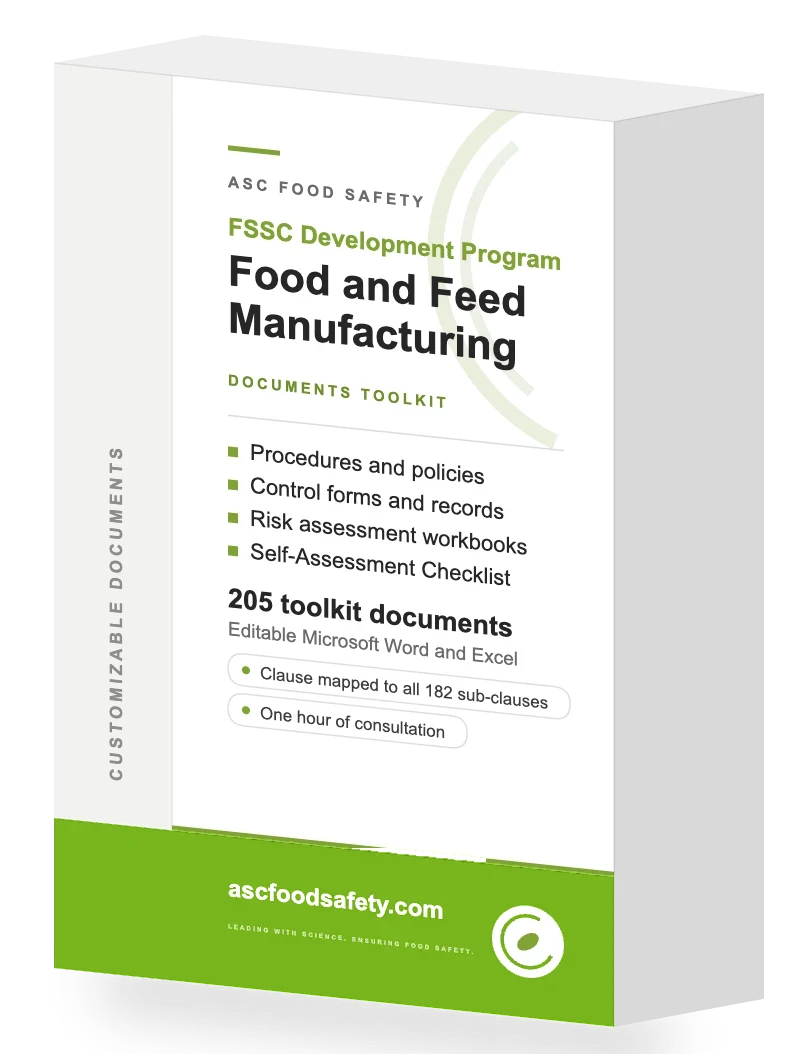
Get the written system on your screen today. 247 editable documents that map all 182 numbered clauses of the Version 2.0 Assessment Requirements for Food and Feed Manufacturing, with a gap analysis and self assessment workbook and an hour with one of our consultants. R3,750, no VAT.
What does a site actually have to do?
- Get the written system. The documented half is the part that takes months from nothing.
- Make it yours. Your details, products, processes and site layout, approved by your management.
- Work the HACCP study against your own process flow.
- Build real records over real weeks of production. No assessor accepts a system that started yesterday, and this is the step rushed sites try to skip.
- Be assessed by a licensed conformity assessment body.
We walk through what the assessor asks to see in the assessment, step by step.
What is in the ASC Development Program toolkit?
247 controlled documents, FDPM001 to FDPM247, in folders that follow the Assessment Requirements’ own clause tree, so a clause number leads straight to a folder:
- Part 1, Food Safety System (78 documents, clauses 1.1 to 1.12): leadership and resources, roles and deputies, competence and training packs, communication and CAB notification, specifications and release, documented information, traceability, incidents and recall, corrective action and complaints.
- Part 2, Prerequisite Programmes (126 documents, clauses 2.1 to 2.20): buildings, layout and zoning, utilities, waste, equipment and maintenance, purchased materials, cross contamination, allergens, cleaning, pests, personal hygiene, rework, warehousing, testing, labelling, logo use, food defence, food fraud and PRP verification.
- Part 3, HACCP Control (27 documents, clauses 3.1 to 3.4): an eight sheet HACCP workbook worked honestly to 2 CCPs (baking, on three ovens, and metal detection) and 4 OPRPs, plus validation, monitoring, verification and calibration.
That is 60 procedures, policies, guides and training packs, 172 forms, records, registers and checklists, and 15 Excel workbooks. Every procedure names who does what, when, against which criterion and on which record, and every form is pre-filled with the check points of a worked example bakery so the team can see how it is completed. It also ships with a gap analysis and self assessment workbook covering every clause, a clause-mapped index, and a Development Program to FSSC 22000 Version 7 bridge document for when you step up.
The fastest honest route to a conformity statement. R3,750 each for Food and Feed Manufacturing and for Catering and Food Service. Lifetime licence, editable Word and Excel, one hour of consultation included.
Questions people ask
Frequently asked questions
What is the FSSC Development Program?
The FSSC Development Program is a voluntary assessment model run by Foundation FSSC for food and feed businesses not yet ready for full FSSC 22000 certification. Version 2.0 was published in May 2025. A licensed conformity assessment body assesses the site unaccredited, and a successful assessment results in a conformity statement and a public entry in the FSSC Register of conforming organizations.
Is the FSSC Development Program the same as FSSC 22000 certification?
No. The Development Program gives a conformity statement and a register entry from an unaccredited assessment. It is not FSSC 22000 certification, not a certificate and not GFSI recognition. It is designed as a staging post towards FSSC 22000.
Is FSSC Development Program Version 1.1 still valid?
Version 1.1 assessments were allowed only until 31 May 2026. From 1 June 2026 all assessments are against Version 2.0, and remaining Version 1.1 conformity statements are withdrawn from the public register after 31 May 2027.
Which categories does the FSSC Development Program cover?
Version 2.0 sets assessment requirements per sector, linked to the ISO 22003-1:2022 food chain categories. The food and feed manufacturing set covers categories BIII, C, D and K, and catering and food service is category E with its own assessment requirements.
Where can I get FSSC Development Program V2.0 documents?
ASC Food Safety Consultants sells an FSSC Development Program V2.0 document templates toolkit for Food and Feed Manufacturing (categories BIII, C, D and K) with 247 editable documents mapping all 182 numbered clauses, and a Catering and Food Service toolkit (category E) with 257 documents, each for R3,750, both with one hour of consultation and no VAT added.