
Home›Toolkits›Development Program catering
FSSC Development Program · Catering and food service
Buffets, takeaway and events, under control
The kitchen is usually the easy part. Catering sites often pick up their nonconformities with food that has left it, onto a self service counter, into a takeaway pack or into the back of a van. This is how to control that food and prove it.
The short answer. For category E, the requirements that matter most once food leaves the kitchen are 2.8 allergen management, with 2.8.4 on special meals, 2.14.1 on allergen information for guests, 2.15.1 on labelling food you pack, 2.12 on storage and transport, 1.9 on traceability to the date food was used, and 2.17.2 on vulnerable points such as an open buffet. You close them with a matrix that matches the recipe cards, a card on every buffet dish, an attendant on the counter, display food probed every 2 hours and discarded above 5 °C, sealed and probed event boxes, and batch codes that tie every container to a date.
Which requirements apply outside the kitchen
The catering Assessment Requirements number section 2 differently from the manufacturing set. There is no rework requirement, so 2.12 is warehousing, covering storage and transport, 2.14 is product information and 2.15 is labelling. Quote the catering numbers on the day, not a manufacturing checklist. The forms named below are from the Catering and Food Service toolkit (TKDP-C).
| Requirement | In short | Main records |
|---|---|---|
| 1.9 Traceability | Supplier lot to the dates used, decanted food identified (1.9.4), tested both ways yearly (1.9.5) | Daily Production and Batch Cooking Record, Event Catering Menu and Production Record, Traceability Test Record |
| 2.8 Allergen management | A programme, legal and customer requirements, cross contact, special meals (2.8.4), cleaning, segregation, protective clothing and dedicated tools (2.8.5) | Menu Allergen Matrix, Special Meal and Allergen Request Form, Allergen Order Kitchen Handover Checklist |
| 2.12 Warehousing | Storage and transport that protect food, clean suitable vehicles, temperature control, a transport procedure | Event Transport Temperature Record, Catering Vehicle and Hot Box Hygiene Checklist, Event Site Food Safety Checklist |
| 2.14.1 Information | Allergen and ingredient information when a guest asks | Front of House Allergen Information Folder Template, Buffet and Display Allergen Card Template |
| 2.15.1 Labelling | Packed food labelled to the law of the country of sale | Takeaway and Grab and Go Label Template and Check, Packing Start-up and Changeover Label Check Record |
| 2.17.2 and 2.17.3 Food defence | Extra control at vulnerable points, a plan for tampered food | Buffet and Self Service Supervision Checklist, Suspected Tampering Response Record |
Display temperature sits under the HACCP requirements. In the example plan it is OPRP 2, allergen orders and buffet information are OPRP 5, takeaway packing is OPRP 6 and hot holding is CCP 4. If the Program is new to you, start with Version 2.0 explained.
The buffet and salad bar
The example business runs a self service breakfast and lunch buffet with a salad bar for about 250 office park staff a day. Guests serve themselves, so the counter is a temperature risk, a cross contact point and a food defence risk at once.
Temperature and time on display
The attendant probes one item from each cold container at set up and every 2 hours, writes the time it left refrigeration on its label, and records both on the Cold Display and Salad Bar Temperature and Time Log. Food above 5 °C, or above 4 °C for milk and seafood, comes off at once and is discarded, never served and never put back in the fridge. Every container is also discarded 4 hours after it left refrigeration, whatever its temperature, as a house limit on top of the legal one. Dishes are replaced, never topped up. The hot side runs under CCP 4 at 63 °C, checked hourly.
Plan for load shedding. A display that loses power follows the same discard rule. Food in the cold room is decided on the Power and Refrigeration Failure Decision Record, where food above its limit is used the same day only if the last good reading was no more than 2 hours earlier and it is not above 8 °C.
Allergen cards and information
Every dish carries a card from the Buffet and Display Allergen Card Template that matches the Menu Allergen Matrix, checked at set up and at every dish change. The card says cross contact between self service dishes cannot be ruled out and invites guests with an allergy to ask staff, so the kitchen can plate a meal for them. Nut and seed toppings sit in a separate well at the end of the salad bar, and every dish has its own utensil. When a guest asks, staff read the dish page in the front of house allergen folder with them, and never call a dish safe when the page is missing or out of date. Cover the allergens declared under R.146, plus the EU list of 14 where customers or export markets require it.
Supervision and food defence
The Buffet and Self Service Supervision Checklist opens with a set up check covering a named attendant for the whole service, clean sneeze guards, a utensil for every dish, small batches, sauces in portion packs or dispensers, guest hand sanitiser and working CCTV. The attendant walks the counter at least every hour. If anyone puts something into food, or a dish looks wrong, the dish and utensil are removed and kept, and the manager completes the Suspected Tampering Response Record.
End of service
Everything that went out to a guest area is discarded at the end of service, whatever its temperature and however full the container, and recorded on the Food Waste and Leftover Disposal Log. It is never cooled, reheated or reused.
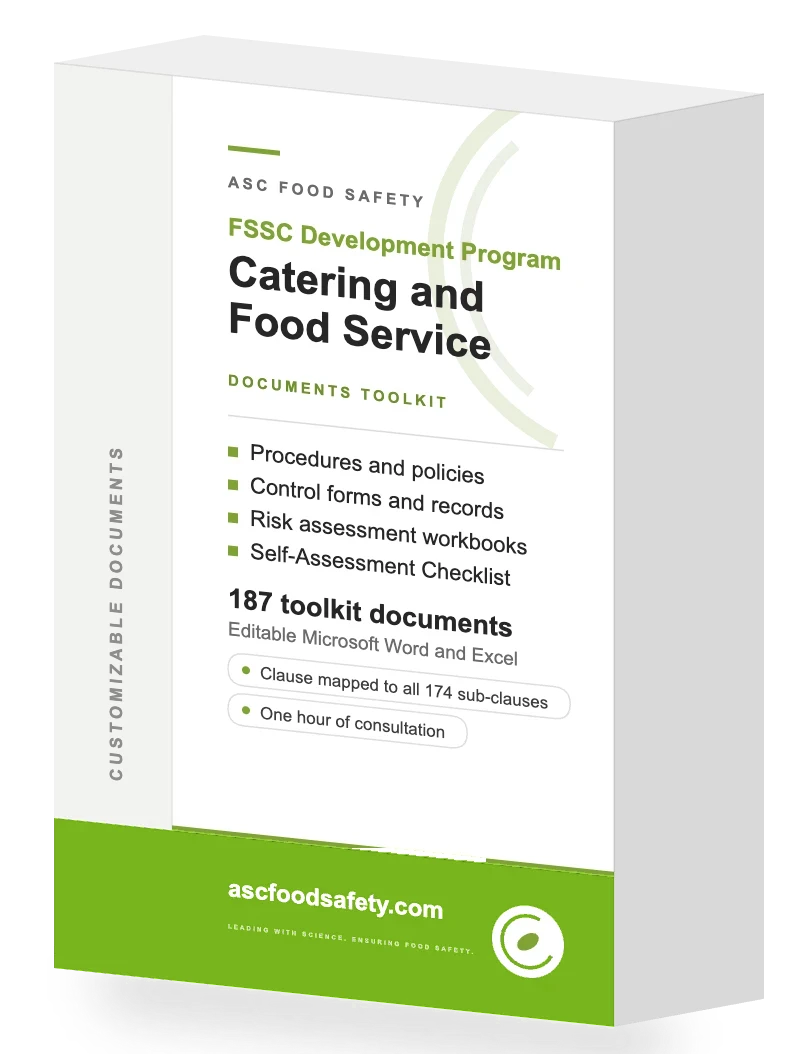
Buffet, takeaway and event forms, ready to print. The Catering and Food Service toolkit has 257 editable documents, 182 of them forms, records, registers, checklists and templates, built around one kitchen serving a restaurant, a buffet, a takeaway counter and events. R3,750, with an hour of consultation included.
The takeaway counter
Sandwiches, wraps and salads packed on the premises for sale the same day are where requirement 2.15.1 applies. Check which provisions and exemptions of R.146 apply to them and record the decision in the Legal and Customer Requirements Register. The example label carries the name, the allergens emphasised, the use by date and the storage instruction.
- Start up and changeover. The first pack and label are checked against the Takeaway and Grab and Go Label Template and Check and recorded on the Packing Start-up and Changeover Label Check Record.
- Wrong label. Stop packing, relabel or discard every pack since the last good check, and recall any pack sold.
- Chiller and close. Food at 5 °C or below (4 °C for milk and seafood), probed every 2 hours. Unsold packs are discarded at close on the day made.
Special meals and allergen orders
Requirement 2.8.4 asks for a process wherever special meals are offered. In the example, every request starts on the Special Meal and Allergen Request Form, taken with the Restaurant Manager or chef on duty. The dish, sauce, garnish and side are checked against the matrix and recipe card, and if the kitchen cannot make it safely the guest is offered something else. The chef reads the request back and completes the Allergen Order Kitchen Handover Checklist before release. The plate is carried on its own and confirmed with the guest by name and allergen. One planned mystery order a month tests the process. For events, the client sends the special meal list at least 3 working days ahead, and each meal is packed separately, labelled with the guest or table, the allergens avoided and the event number.
Event catering, from van to venue
- Plan and check. Boxes, journey and service times go on the Event Catering Menu and Production Record. The van, preheated hot boxes, cool boxes and the marked raw food cool box are checked on the Catering Vehicle and Hot Box Hygiene Checklist. The van carries food and event equipment only.
- Probe and seal at dispatch. Hot food at 63 °C or above, chilled food at 5 °C or below (4 °C for milk, seafood and raw poultry). Each box gets a numbered tamper evident seal and each chilled dish a discard by time 4 hours after dispatch, on the Event Transport Temperature Record. No hot box stays sealed longer than 2 hours.
- Drive straight there. No stops with food on board and boxes not opened on the way.
- Check the venue and seals. The Event Site Food Safety Checklist covers hand washing, the service area, pests and holding equipment. A box with a broken or wrong seal is not served.
- Probe during service. Hot food every hour, cold food every 2 hours, buffet rules throughout.
- Keep samples. At least 100 g of each dish, chilled for 72 hours after the event, on the Event Food Sample Retention Log.
- Come home clean. Food set out at the venue never returns to stock and hot box food is discarded. The van and boxes are cleaned on the day of return.
Traceability that survives a buffet
The catering version of requirement 1.9 does not ask you to trace a dish to the guest who ate it. The minimum is the date each ingredient was used. The example gives every batch a code of the date, a station letter and a number, so 2210B02 is the second buffet batch on 22 October. Buffet refills come only from batches on the Daily Production and Batch Cooking Record, and the event record links each event to the batch codes dispatched. Decanted food carries a label with the supplier lot and original date mark, under the Decanting and Date Labelling Instruction, and unlabelled food is discarded at the morning check. Test the system backward and forward at least once a year on the Traceability Test Record, including an event and a high risk ingredient such as smoked salmon.
Not sure whether your client wants the Program or full certification? Read FSSC Development Program vs FSSC 22000.
Close the catering requirements with forms built for catering. Editable Word and Excel, lifetime access and a lifetime licence for one legal entity, delivered as a download after payment. R3,750, about USD 231 · EUR 200 · GBP 172 · AED 843. No VAT is added.
Questions people ask
Frequently asked questions
Does the FSSC Development Program require us to trace food to each guest?
No. The catering requirements ask for traceability from the supplier lot to the dates the food was used. Recording the client and venue for each event still makes an investigation much faster.
Can buffet food that is still cold go back in the fridge after service?
No. Food that went out to a guest area is discarded at the end of service whatever its temperature. Only back up containers that never left the kitchen may be kept, within their use by date.
Which allergens should our buffet cards cover?
The allergens declared under R.146, plus the EU list of 14 where customers or export markets require it. Keep the cards matched to the matrix at every dish change.
How long can hot food stay sealed in a hot box?
In the example plan, no more than 2 hours from dispatch to opening, with each hot box model validated at full load to hold 63 °C or above for that time. For longer journeys, send the food chilled and reheat it at the venue.
Is the Development Program the same as FSSC 22000 certification?
No. A licensed conformity assessment body assesses the site, and a conforming site gets a conformity statement valid for one year and a listing on the FSSC Register of conforming organizations. It is a pathway towards certification, not certification itself.