

The Food Safety System Certification 22000 (FSSC 22000) requires organizations to ensure implementation and continual review of Food Safety Culture. The requirement is that the organisation needs to show evidence that the senior management is committed to ensuring implementation, maintenance, and continual improvement of the food safety management system, and this evidence shall include the elements of food safety culture, which are:
New: automated culture measurement tool
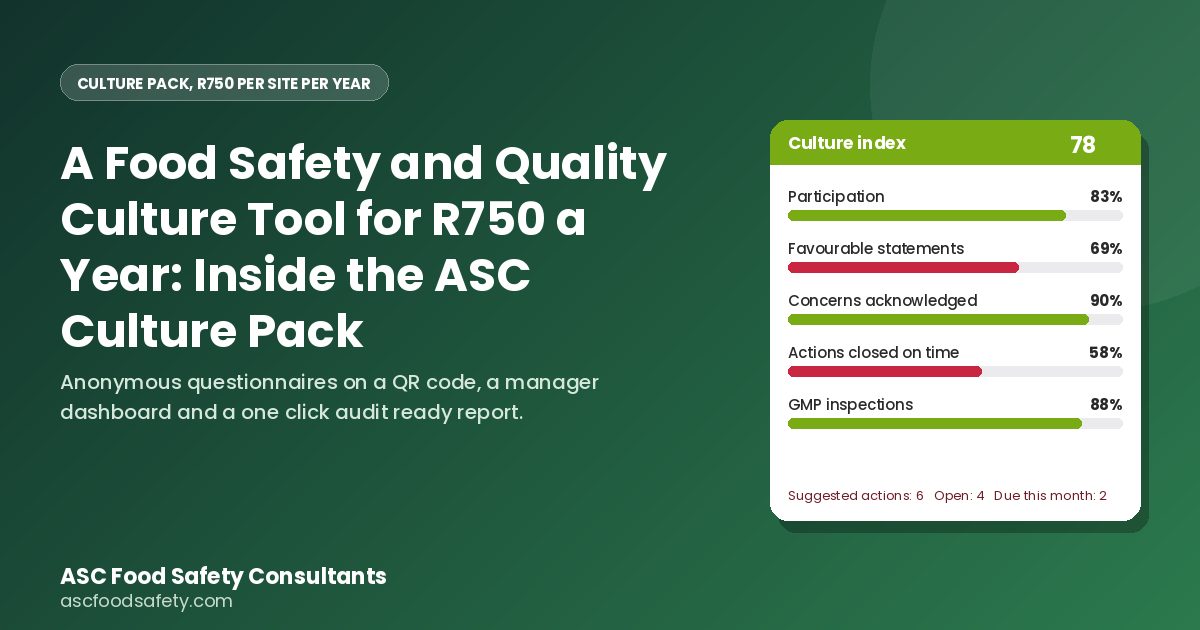
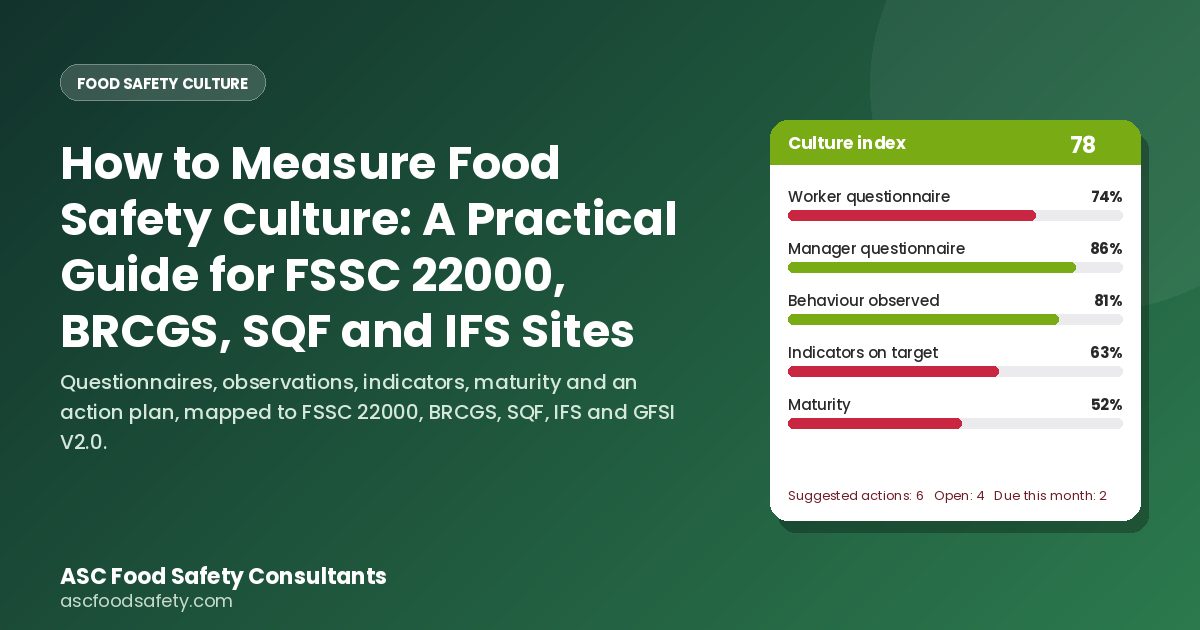
Measure your food safety and quality culture for R750 a year. The ASC Food Safety and Quality Culture Pack gives you anonymous worker and manager questionnaires on a QR code, a manager dashboard for training, feedback, GMP inspections, indicators and maturity, and a one click audit ready report with an action plan. Built for FSSC 22000 2.5.8, BRCGS 1.1.2, SQF and IFS and mapped to the GFSI culture position paper Version 2.0.
See the culture pack Read how to measure food safety culture
- Communication
- Training
- Feedback from employees, and
- Performance measurement on food safety-related activities
The following are 10 steps organisations could follow to implement a strong food safety culture.
1. Leadership must walk the talk
- Leaders should demonstrate a solid commitment to food safety
- Enforce rules and protocols
2. Be inclusive and get buy-in from the majority of employees
- Include every staff member irrespective of role
- Avoid the “my way or the highway” attitude
3. Provide Ongoing Refresher training
- Food safety training and education should be an ongoing effort
- Training and empowerment should be the top priority
4. Ensure fairness and consistency
- Discourage unfairness, discrimination, and bias
- Apply same rules irrespective of position and/or demographics
5. Keep records of all important controls
- Insist on the paper trail, SOPs and records for key processes
- Records to be an accurate reflection on factory operations
6. Have a supplier and raw material approval process
- Source products from trusted suppliers
- The procurement team should know your supplier approval SOP
7. Stay updated
- Beware of new and emerging risks
- Know potential risks posed by your products or industry
8. Request feedback from employees (Communication)
- Verify the effectiveness of your systems and processes
- Conduct employee food safety culture surveys
- Request honest feedback
9. Review Employee feedback
- At least annually review what employees feel about the organisation
- Make an effort to improve on aspects employees complain about
10. Incentivise strong food safety culture
- Have a reward system in place for those who do well
- Take decisive action against those who have a negative food safety culture
In conclusion, a strong food safety culture improves company performance and ensures the production of safe food, which ultimately benefits the consumer. Should you be interested in doing our food safety culture courses, please contact us.
Related Articles
Check out our other related articles for more tips!
Related ASC guides
- Context, interested parties and strategic risks. The clause 4 trio that most sites pick up findings on.
- Food defence threat assessment (TACCP). The threat assessment most sites only half finish.
- The 24 risk assessments a GFSI audit expects. Every assessment a BRCGS or FSSC auditor looks for, in one place.
Key facts
- A strong food safety culture starts with leadership that walks the talk, demonstrating solid commitment and enforcing food safety rules and protocols.
- FSSC 22000 requires organisations to show senior management commitment through four elements: communication, training, feedback from employees, and performance measurement.
- Buy-in must be inclusive, engaging every staff member regardless of role, and rules must be applied fairly and consistently across all positions and demographics.
- Ongoing refresher training, accurate record-keeping, and a supplier and raw material approval process are core to sustaining the culture.
- Organisations should request and review employee feedback at least annually through food safety culture surveys and act on the results.
- Incentivising strong performers and taking decisive action against negative-culture actors reinforces the culture and improves company performance and safe food production.
Frequently asked questions
What is a food safety culture and why does it matter?
A food safety culture is the shared commitment to food safety demonstrated across an organisation, from leadership down to every staff member. The article explains that a strong food safety culture improves company performance and ensures the production of safe food, which ultimately benefits the consumer. It is built through leadership commitment, training, communication, and consistent application of rules.
How do you implement a strong food safety culture?
The article outlines 10 steps: leadership must walk the talk, be inclusive and get employee buy-in, provide ongoing refresher training, ensure fairness and consistency, keep records of key controls, have a supplier and raw material approval process, stay updated on emerging risks, request feedback from employees, review that feedback, and incentivise strong food safety culture. Together these steps embed food safety into daily operations at every level.
What does FSSC 22000 require regarding food safety culture?
FSSC 22000 requires organisations to demonstrate senior management commitment to implementing and continually improving the food safety management system. According to the article, this evidence must include four culture elements: communication, training, feedback from employees, and performance measurement on food safety-related activities.
What role does leadership play in food safety culture?
Leadership plays a central role by walking the talk, showing solid commitment to food safety, and enforcing the rules and protocols. The article lists this as the first implementation step and stresses that leaders should avoid a 'my way or the highway' attitude, instead being inclusive and securing buy-in from the majority of employees.
How should companies gather and use employee feedback on food safety?
Companies should request honest feedback from employees, for example through food safety culture surveys, to verify how effective their systems and processes are. The article advises reviewing what employees think about the organisation at least annually and making an effort to improve on the aspects they complain about.
Does ASC Food Safety Consultants offer food safety culture training in South Africa?
Yes. ASC Food Safety Consultants is SAATCA-accredited and FoodBev SETA-accredited in South Africa and offers related training, including the Food Safety and Quality Culture Course (FS32). This supports the article's emphasis on ongoing training and empowerment as a top priority for building a strong food safety culture.