
IFS Broker Certification in South Africa: Rollout Order, Realistic Timelines and What the Auditor Asks to See
By Mthokozisi Nkosi, Food Safety Specialist & Lead Auditor, ASC Food Safety · 12 min read
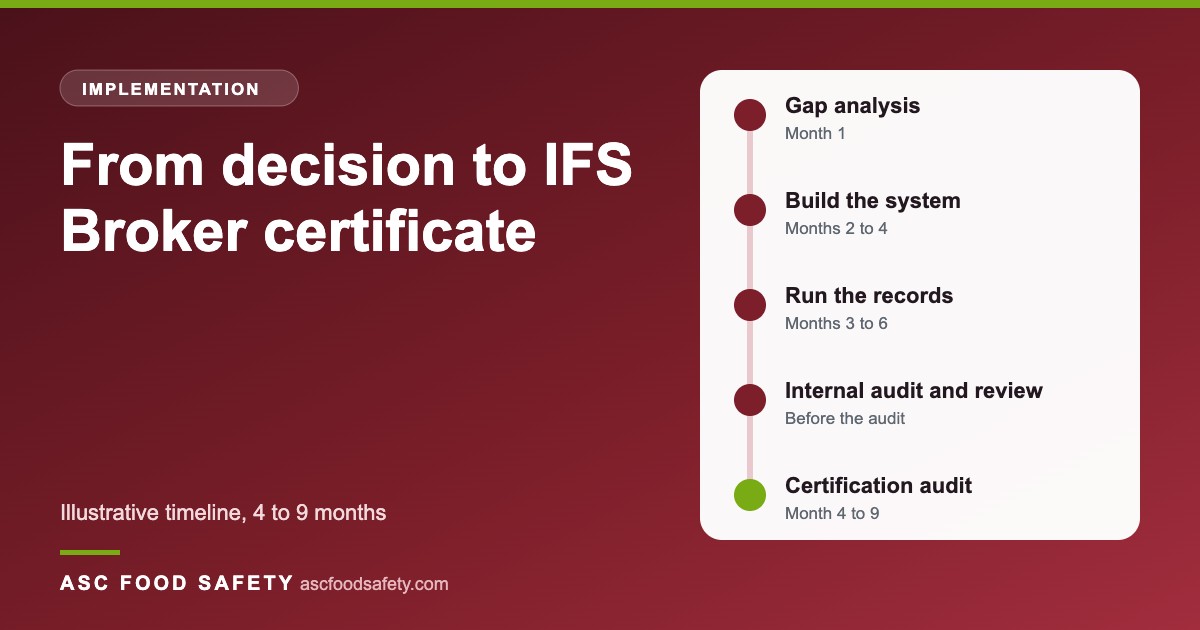
IFS Broker certification in South Africa takes most trading companies about four to nine months from the decision to the first audit, as an illustration, and the critical path is supplier evidence and customer sign-off rather than writing documents. You roll out in a set order, complete the annual reviews and tests before the first audit, book an ISO/IEC 17065 accredited certification body for a date inside your trading season, and return the action plan within four weeks of the provisional report. This guide sets out each stage and what the auditor asks to see, using the plan built into ASC’s IFS Broker Version 3.2 Document Templates Toolkit.
At a glance
- Typical time to first audit
- About 4 to 9 months, illustrative, depending on the starting point
- Before the first audit
- Every annual review and test done and recorded
- Certification body
- Accredited to ISO/IEC 17065 for IFS Broker, with an IFS contract
- Minimum audit time
- Six hours on site
- After the audit
- Action plan within four weeks, certificate six weeks target, eight weeks maximum
- Unannounced option
- Register four weeks before a window of 16 weeks before to 2 weeks after the due date
Follow a rollout plan that already exists
TK18 includes an implementation guide and rollout plan, a gap analysis with IFS scoring, a readiness checklist and 191 other documents. R4,700, about USD 289 · EUR 251 · GBP 215 · AED 1,057. ASC does not charge VAT.
In this article
- Is IFS Broker the right standard for your business?
- How long does IFS Broker certification take?
- In what order should you roll out the system?
- What should you configure first?
- Which annual reviews must be done before the first audit?
- How do you choose a certification body and book the audit?
- What does the auditor ask to see on the day?
- What happens between the audit and the certificate?
- Should you take the unannounced audit option?
- Frequently asked questions
Is IFS Broker the right standard for your business?
IFS Broker fits a company that trades food, household and personal care products or packaging from an office, without taking physical possession of the goods. Many South African fruit exporters, nut and dried fruit traders and importers work this way, with packhouses, contract packers, cold stores and forwarders doing the physical work. If you hold stock yourself, that storage needs IFS Logistics or an exclusion statement. If you process, it needs IFS Food, HPC or PACsecure or an exclusion statement. Record the decision on IFSB005 Logistics and Processing Activities Scope Decision Record before anything else, because it fixes the scope and the audit duration.
Your customers often decide the scheme. If a buyer asks for BRCGS rather than IFS, ASC’s BRCGS toolkits hub covers the alternatives. The whole IFS Standard is summarised in our IFS Broker 3.2 requirements guide.
How long does IFS Broker certification take?
The figures below are illustrative. The real driver is how fast suppliers return certificates and questionnaires, how fast customers sign specifications and acceptances, and how many weeks of records you can show running on the new forms.
| Starting point | Time to first audit | What drives the time |
|---|---|---|
| No formal system, specifications and supplier information in email | 7 to 9 months | Building the supplier register from scratch, signed customer specifications, a first hazard analysis, at least two months of records |
| Customer driven controls in place, some certificates and residue results on file | 5 to 7 months | Formalising what exists, filling gaps in development, food fraud and product defence, running the annual tests |
| An existing certified system, or staff experienced in a GFSI scheme | 4 to 5 months | Mapping to IFS Broker and adding the broker specific requirements such as 4.4.4, 4.6, 4.7 and chapter 6 |
Writing the documents is rarely what holds a broker back. Waiting for a customer to sign a specification is.
In what order should you roll out the system?
The phases overlap, but phase 1 must be approved before anything that depends on it is issued, because every later document names the roles and follows the document rules set there.
- FoundationScope, policy, organisation chart and deputies, the Product Safety Team, document control and a controlled folder.
- Risk managementProduct and service descriptions, a verified flow diagram, the hazard analysis, control measures and limits. Our risk assessment guide covers the method.
- Supply chain controlsContracts and specifications, supplier and service provider approval, certification status, customer acceptance for uncertified suppliers, logistics agreements and packaging.
- Traceability, testing and fraudTraceability register, testing plan, laboratory approval, food fraud vulnerability assessment and product defence.
- Product developmentA complete development file for every own or customer branded product.
- Incidents and improvementComplaints, incidents, withdrawal and recall, non-conforming product and corrective action.
- TrainingEveryone trained for their role, with signed records and an effectiveness check.
- VerificationAnnual tests and reviews, an internal audit of every requirement, management review.
- CertificationCertification body contract, optional pre-audit, audit and action plan.
What should you configure first?
Configuring a document means replacing the illustrative defaults with your own values, removing what does not apply and having the owner approve it. Start with the documents that others depend on, or that have long lead times.
- The scope decision record and the certification scope statement (IFSB005 and IFSB004).
- Responsibilities and deputies, and the risk management team appointment (IFSB029 and IFSB060).
- Document and record control and the master document register (IFSB050 and IFSB051).
- The approved supplier and certification status registers (IFSB111 and IFSB113). These take longest, because certificates and questionnaires take weeks to come back.
- The customer requirements register and product specifications (IFSB091, IFSB096, IFSB097). Signed customer specifications are the clearest evidence for KO 4.2.2, and 4.2.3 requires formal agreement wherever the customer asks for it.
- The hazard analysis (IFSB064), which sets the frequencies other documents use.
- The operating parameter schedule (IFSB017), filled in as each default is confirmed.
- The traceability system and register (IFSB129 and IFSB130), started early so there is real data for the pre-audit trace.
Which annual reviews must be done before the first audit?
The IFS Broker Version 3.2 Doctrine (version 3, April 2026) confirms that requirements carrying an annual review or test must already be implemented before the first audit. The Standard sets 1.3.1, 2.3.9, 4.6.2, 4.7.4, 5.1.2 and 5.5.4 at least yearly. Flow diagram verification, training content review, supplier assessment and the safety culture review are regular reviews that TK18 sets yearly by default, and an auditor will expect each to have run once. Plan them into the rollout rather than the first year of certification.
| Review or test | Requirement | TK18 record |
|---|---|---|
| Management review with all nine inputs | 1.3.1 | IFSB047 |
| Risk assessment review | 2.3.9 | IFSB070 |
| Flow diagram verification | 2.3.5 | IFSB063 |
| Training content review | 3.4 | IFSB079 |
| Supplier and service provider assessment | 4.4.6 | IFSB116 |
| Traceability test with quantities | 4.6.2 | IFSB131 |
| Food fraud vulnerability assessment review | 4.7.4 | IFSB138 |
| Internal audit of every requirement | 5.1.1, 5.1.2 | IFSB152 |
| Withdrawal and recall test | 5.5.4 | IFSB178 |
| Product safety culture plan review | 1.1, ANNEX 1 | IFSB023 |
Each must be a real exercise with a dated, signed record. A recall test held as a desk discussion with no clock will not satisfy the auditor, and neither will an internal audit that skipped requirements. Why that matters is explained in our guide to the IFS Broker KO requirements.
How do you choose a certification body and book the audit?
Part 1 section 5.2 puts the check on you. The certification body must be accredited to ISO/IEC 17065 for IFS Broker and hold a contract with IFS, and the auditor must be approved for IFS Broker. The list of approved certification bodies by country is on the IFS website. The contract must state the scope, the audit duration and the reporting requirements, and refer to the IFS Integrity programme, which can send unannounced on-site checks to certified companies.
- Book early. In the illustrative six month plan the contract is signed in month two, because certification bodies fill up before the fruit season.
- Book inside the season. The audit must take place when the broker services in scope can be fully assessed, with live consignments to sample.
- Expect at least six hours on site. The certification body adds time for development work, product volume, the number of origin and destination countries, staff numbers and earlier findings.
- If you want a pre-audit, it is for your own use only, and the auditor who does it cannot do your initial audit.
- Tell the certification body if you have held IFS certification before, so the old action plan can be reviewed.
Train the team while the documents go live
ASC’s Implementation of IFS Broker Version 3.2 for Trading Companies course (R5,500) follows this rollout with the toolkit open. Directors take the management course, and ASCloud, ZeroPaper by ASC, holds the records once the system runs.
What does the auditor ask to see on the day?
| Audit stage | What the auditor asks for |
|---|---|
| Opening meeting | Scope, company profile, changes since the last audit, the previous report and action plan for a renewal |
| Management and system | Policy, objectives and status, organisation and deputies, resources, management review, internal audits |
| Risk management | Flow diagrams and their verification, the hazard analysis, control logic, validated limits, monitoring, annual review |
| Product sampling | A customer branded product and products traded in small and large quantities, each followed from specification to delivery |
| Traceability test | A trace chosen by the auditor, upstream and downstream, with quantities, completed during the audit |
| Supply chain | Supplier risk assessment, approvals, customer acceptance, sourcing areas, logistics agreements, temperature records, fraud and defence |
| Incidents and improvement | Recall test, contact list, complaints, non-conforming product decisions, corrective actions |
| Interviews and closing | Staff explain their roles and how they would react to a failed check. Senior management attends the closing meeting |
The hazards the auditor will probe during product sampling are covered in our guide to food safety for fruit exporters and traders.
What happens between the audit and the certificate?
- Two weeksThe certification body sends the provisional report and action plan.
- Four weeksYou return the action plan with corrections, corrective actions, owners, dates and evidence of the corrections. Late return means a full new audit.
- Two weeksThe certification body reviews the plan and decides. The target from audit to certificate is six weeks, the maximum eight.
- CertificateValid until one year and eight weeks after the last day of the initial audit, less one day, and that end date stays the same every year.
- RenewalThe audit due date is the anniversary of the last day of the initial audit. The renewal audit falls between eight weeks before and two weeks after it.
Corrective actions that need longer can run past the certificate date if justified, but must be in place before the renewal audit. No certificate is issued until every correction is done.
Should you take the unannounced audit option?
Part 5 allows a full unannounced audit in place of the scheduled renewal, and a company may even start with one. A site audited unannounced gets the IFS Star Status on its certificate and in the IFS Database. The rules are strict.
- Choose the option for each renewal and register with the certification body at least four weeks before the audit window opens.
- The window runs from 16 weeks before to two weeks after the audit due date.
- You may name up to ten operational days when the office is unavailable, in no more than three periods, with reasons.
- Give the names of the people the auditor should ask for on arrival, and keep a minimum document set ready at all times.
- Refusing access, other than force majeure, leads to suspension of the certificate, an invoice for the audit and an announced audit next time.
Part 5 itself notes the option may not suit small brokers whose office is not permanently manned. TK18 covers the decision and readiness in IFSB013 Unannounced Audit Option and Readiness and IFSB014 Unannounced Audit Readiness Checklist.
ASC works with trading companies from offices in Gqeberha, Johannesburg and Cape Town. Contact the team for implementation support or an independent internal audit. The Introduction to IFS Broker Version 3.2 Course (R1,195) suits staff new to the Standard, the Food Fraud Tool and Food Defence Tool are R750 each, more templates are in the ASC shop, and ASC Pest Control looks after offices and warehouses.
Frequently asked questions
How long does IFS Broker certification take in South Africa?
Which certification bodies can audit IFS Broker?
Can we have the audit outside the export season?
Do the annual reviews have to be done before the first audit?
Is a pre-audit required?
Can a small broker choose unannounced audits?
What does ASC charge for help?
Key takeaways
- Plan four to nine months, as an illustration, and start supplier and customer paperwork in the first month.
- Approve the foundation documents first, because everything else refers to them.
- Every annual review and test must be done before the first audit.
- Book an ISO/IEC 17065 accredited certification body early, for a date inside your trading season.
- Return the action plan within four weeks, and treat the unannounced option as a choice for a mature system.
Start the rollout with the plan already written
TK18 gives you the implementation guide, month by month plan, gap analysis, readiness checklist and every document the auditor will ask for. See the full list on the TK18 product page.
Published by ASC Food Safety, South African food safety and quality consultants. This article is general guidance and not a substitute for certification-specific advice.