
IFS Broker Risk Assessment for Traders: Building the Hazard Analysis of Broker Services and the Supplier Approval Behind It
By Mthokozisi Nkosi, Food Safety Specialist & Lead Auditor, ASC Food Safety · 14 min read
An IFS Broker risk assessment is a HACCP based hazard analysis of the steps your company is responsible for as a broker, from contract and specification through supplier approval, release and logistics, scored for likelihood and severity, with a control measure, a limit, monitoring and a record for every significant hazard. It sits under KO requirement 2.3.1 and requirements 2.3.2 to 2.3.9, and it drives the risk based supplier approval in 4.4.3. This guide shows you how to build both without buying anything. If you want the finished workbook, it is in ASC’s IFS Broker Version 3.2 Document Templates Toolkit.
At a glance
- Requirements
- 2.3.1 (KO n° 2) to 2.3.9, plus 4.4.2, 4.4.3 and 4.4.6 for suppliers
- Who does it
- A multidisciplinary team with enough product and service knowledge
- Hazards
- Physical, chemical and biological, allergens included (2.3.6). TK18 also screens radiological hazards
- Review
- At least yearly and whenever the broker services change
- TK18 workbook
- IFSB064 Hazard Analysis and Risk Assessment of Broker Services, Excel
Skip the build, keep the method
TK18 includes the broker hazard analysis workbook, the supplier risk assessment and 13 other Excel workbooks, all with worked rows. R4,700, about USD 289 · EUR 251 · GBP 215 · AED 1,057. ASC does not charge VAT.
In this article
- What does IFS Broker require from the risk assessment?
- Who should do the risk assessment?
- How do you describe the services and draw the flow diagram?
- How do you score likelihood and severity?
- Where does the control sit when you never touch the product?
- How do you set and validate limits a broker can check?
- How does supplier approval connect to the risk assessment?
- What should you check on a supplier certificate?
- When must the risk assessment be reviewed?
- Frequently asked questions
What does IFS Broker require from the risk assessment?
Requirement 2.3.1, KO n° 2, asks for product safety control built on a fully implemented, systematic and comprehensive risk management system. The requirements that follow describe how. The assessment covers every process the company is responsible for, allowing for different products and service levels (2.3.3). A multidisciplinary team does it (2.3.4), from complete descriptions and a flow chart (2.3.5). It analyses physical, chemical and biological hazards, allergens included, for likelihood and severity (2.3.6), chooses control measures by a logic you can demonstrate and validates limits (2.3.7), sets monitoring and corrective action (2.3.8), and is reviewed at least yearly and on change (2.3.9). Separately, 2.3.2 asks you to make sure suppliers run their own risk management, with Codex based HACCP at food manufacturers.
Food fraud (4.7) and product defence (chapter 6) have their own assessments, but they feed the same supplier decisions, and the Doctrine on 4.4.3 says the supplier risk assessment must include product defence.
Who should do the risk assessment?
Requirement 2.3.4 asks for a team with enough knowledge of the services, products and hazards. In a trading company, that is the Quality and Technical Manager leading, with the Commercial Manager who knows the customer requirements, the Procurement and Sourcing Manager who knows the suppliers, the Logistics Coordinator who knows the cold chain, and the Quality Controller who sees the product at the packhouse or packer. Where nobody on the team knows a hazard well, for example mycotoxins in nuts, bring in a competent outsider and record it. Appoint the team in writing with terms of reference, and keep each member’s competence evidence. The auditor will ask.
How do you describe the services and draw the flow diagram?
Start with a description of each product group: what it is, origin, destination markets, intended use and consumer, packaging, storage and transport conditions and shelf life. Then describe the service level, because a broker selling fruit free on board is responsible for fewer steps than one delivering to the destination port.
The flow diagram shows the broker steps, not the supplier’s factory steps. For a fresh fruit exporter it might run like this.
- Customer enquiry and contractDestination, customer code of practice and residue requirements confirmed before acceptance.
- Specification agreementSpecification signed by the customer, with the market list of permitted treatments.
- Supplier and service provider approvalPackhouses, farms, cold stores, forwarder, shipping lines, laboratories.
- Sourcing programme and purchase orderOrder names specification version, market and allowed production units.
- Packing at the packhouse (outsourced)The supplier’s HACCP plan controls the step. The broker verifies it.
- Pre-shipment consignment check and document checkInspection, residue results and documents checked, then release or hold.
- Export inspection, cold store, port and sea freightExport certification, temperature instructions and records reviewed.
- Customer receiptArrival reports, claims and complaints followed up.
A customer branded dried fruit and nut mix adds product development, label approval, ingredient supplier and contract packer approval, pre-despatch release and road haulage. Verify the diagram against reality, by document walk-through and by seeing outsourced steps on site, and sign the verification. A diagram nobody checked is the first thing an auditor tests under 2.3.5.
How do you score likelihood and severity?
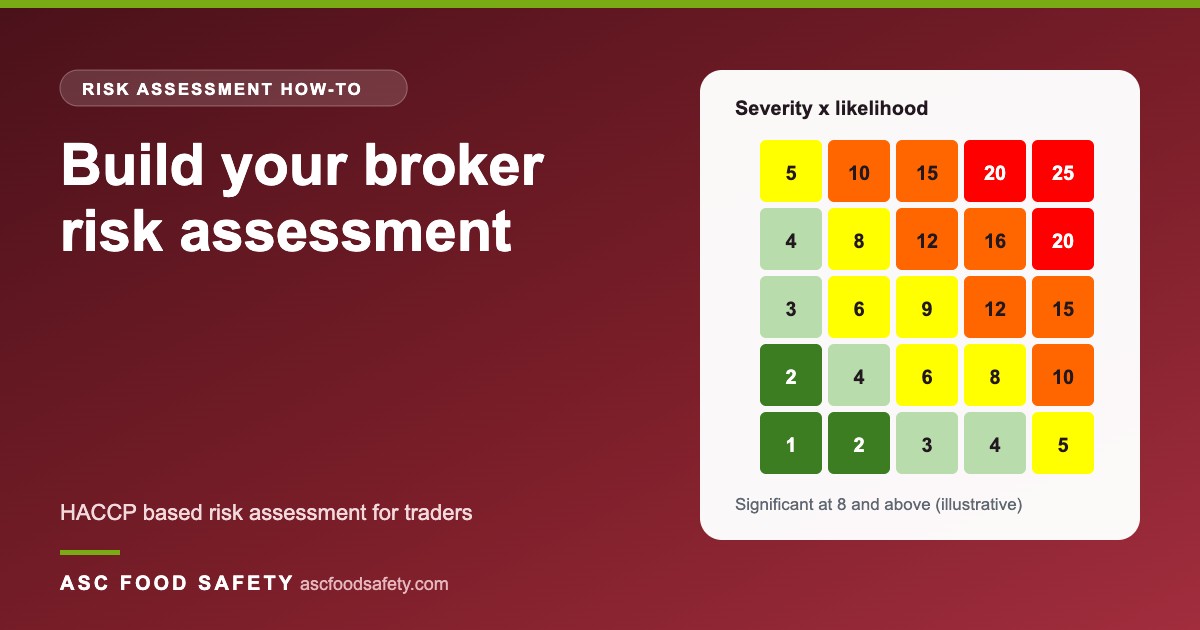
The Standard leaves the method to you, but it must be defined and used consistently. A five by five matrix works well for brokers because likelihood can be tied to evidence you already hold: alerts, results and supplier history.
| Score | Likelihood | Severity |
|---|---|---|
| 1 | Rare, not known for this product, origin or step | Negligible, quality only |
| 2 | Unlikely, known in the category, no occurrence in your chain in three seasons | Minor, short lived discomfort, no treatment |
| 3 | Possible, occasional alerts for this product and origin, or one occurrence in three seasons | Moderate, illness that may need treatment, or a legal limit breached with no illness expected |
| 4 | Likely, recurring alerts or an occurrence last season | Major, serious illness, or a contaminant of chronic concern above its legal maximum |
| 5 | Almost certain without the control | Critical, life threatening, for example anaphylaxis or Listeria monocytogenes in vulnerable consumers |
Score before the specific control in the row is applied, assuming the supplier’s general hygiene prerequisites are in place. In the TK18 workbook a hazard is significant at a score of 8 or more, an illustrative threshold the company confirms. A severity 5 hazard scored at likelihood 1 needs a written justification and is re-examined at every review. Keep the hazards below the threshold on the sheet too, so the reasoning is visible next year.
Where does the control sit when you never touch the product?
This is the part most broker risk assessments get wrong. For each significant hazard, ask four questions in order.
- Is it controlled at a supplier step?For example the metal detection CCP at the contract packer. If yes, you verify that control and define the evidence you need at release.
- Does the supplier control need a broker action to work?A specification, a market list of permitted treatments, an approval criterion. That action is your control measure.
- Can you detect loss of control before the product leaves the supplier?A record check, a result, an inspection. That check is your monitoring and your release gate.
- If none of these is possible, escalateThe supply is not approved until a control is in place.
| Hazard and step | Where controlled | Broker control | Record |
|---|---|---|---|
| Pesticide residues on fruit, supplier approval | Farm, verified by the broker | Valid certificate and residue programme, residue result per production unit and variety checked against the destination MRL and any customer limit | Residue results and MRL compliance log |
| Post-harvest fungicide residues on citrus, packing | Packhouse, verified by the broker | Market list issued, treatment records checked, verification sampling of packed fruit | Consignment document check and release record |
| Salmonella in nuts, ingredient approval | Nut supplier, verified by the broker | Specification requires a validated pathogen reduction step or lot testing, certificate of analysis per lot reviewed before release | Analysis results log |
| Undeclared tree nut or sulphite allergen, label approval | Broker office and contract packer | Label checked against the recipe and destination law, signed proof before print | Label compliance review checklist |
| Aflatoxins in almonds and cashews, ingredient approval | Nut supplier, verified by the broker | Certificate of analysis per lot from an accredited laboratory, against the destination maximum level | Analysis results log |
| Temperature abuse in sea freight | Shipping line, verified by the broker | Carrying temperature on the booking, logger download reviewed on arrival | Cold chain and temperature record review |
A broker’s control measures live in contracts, approvals and release decisions. If your hazard analysis lists washing and metal detection as your own steps, it is describing someone else’s factory.
Fraud and defence assessments, ready to use
Requirement 4.7 and chapter 6 need their own assessments. ASC’s Food Fraud Tool and Food Defence Tool are R750 each, and the risk assessment templates in the ASC shop cover other areas of your system.
How do you set and validate limits a broker can check?
A limit must tell a person, without judgement, whether the step is in or out of control (2.3.7). For a broker, limits look like this: no contract accepted until every customer residue requirement is recorded, no fruit released for a market without a compliant residue result for each production unit, no mix lot despatched until the certificates of analysis for pathogens, mycotoxins and sulphites are on file and conform.
Take legal limits from the regulation of the destination market on the day you check, never from memory or last season’s list. For the EU that means Regulation (EC) No 396/2005 for pesticide residues and Commission Regulation (EU) 2023/915 for contaminants. In South Africa, R.246 of 1994 covers pesticide residues and R.1145 of 2004 covers mycotoxins. Validation is the evidence that the limit and control actually work: the regulation itself, the customer’s code of practice, laboratory accreditation scopes, and your own residue and test history over several seasons.
Then set the monitoring (who checks, how often, on what record) and the corrective action for a failure, including what happens to product already shipped (2.3.8). In TK18, every numeric frequency is an illustrative default the company confirms and records on IFSB017 Operating Parameter Schedule.
How does supplier approval connect to the risk assessment?
Requirement 4.4.3 asks for supplier approval and monitoring that is risk based, using defined criteria such as audit results, certificates of analysis, reliability, complaints including fraud, and required performance. The hazard analysis tells you how much harm a product can do. The supplier’s status tells you how much assurance you have. Together they set a risk class.
| Risk class | Typical profile | Approval route | Monitoring |
|---|---|---|---|
| Low | Certified for the scope, clean record over the last season | Questionnaire and certificate verification | Annual assessment, document check on every consignment |
| Medium | Certified but higher hazard product, or first season, or minor issues | Questionnaire, certificate check and an audit in the first season | Annual and end of season assessment, routine checks and testing |
| High | Not certified (customer acceptance needed), recent Major or suspension, fraud incident, repeated rejections | Full audit before approval, trial consignments under hold | Assessment at least six monthly, increased checks and testing on every consignment |
The frequencies above are illustrative defaults. An approval file then needs the questionnaire, the verified certificate, the risk rating signed off by the quality lead, the audit where the route requires one, the signed specification and quality agreement, product defence and food fraud evidence from the supplier (4.7.5, 6.1 and 6.2), and increased checks on the first consignments. Assess every supplier regularly (4.4.6), by default at least yearly, and straight away after a safety complaint, a certificate suspension or a failed check.
What should you check on a supplier certificate?
- Scope: the products and processes named cover what the supplier actually sends you, from the site that sends it.
- Validity: in date for the whole period of supply, with the next audit window known.
- Status: confirmed on the scheme owner’s database. A PDF alone is not proof, because suspended certificates keep circulating.
- Recognition: GFSI recognition applies to a specific programme, version and scope. Check the GFSI website at approval and record the date.
- Fruit: for fruit and vegetables, the GFS edition of GLOBALG.A.P. IFA version 6 is the one benchmarked by GFSI. The GGN identifies the producer, not each production unit, so check the registered units too, and confirm the packhouse is covered for handling.
- Social add-ons such as GRASP or a SIZA audit are customer requirements, not food safety certificates.
Where a product supplier has no recognised certificate, requirement 4.4.4 allows it only with the customer’s explicit acceptance, and the Doctrine requires that acceptance to be active and evidenced. Where supplier status is unknown, the Doctrine on 4.4.7 expects more frequent and wider testing, justified in writing.
When must the risk assessment be reviewed?
At least once a year and whenever the broker services change (2.3.9). The first annual review must be done before your first certification audit. Triggers worth writing into the procedure:
- A new product, origin, destination market or customer.
- A new supplier, contract packer or logistics provider.
- A change in the law or an MRL in a destination market.
- An incident, recall, complaint trend or border rejection.
- A new alert or emerging risk from horizon scanning.
Record what changed, which rows were rescored, and the knock-on changes to the control plan, testing plan and supplier classes. The sector hazards behind these rows are in our guide to food safety for fruit exporters and traders, and the KOs these assessments protect are in our guide to the IFS Broker KO requirements. For the place of the risk assessment in the full rollout, read IFS Broker certification in South Africa, and for the whole Standard, the requirements chapter by chapter. To learn the method with a trainer, ASC’s Implementation of IFS Broker Version 3.2 for Trading Companies course (R5,500) builds the assessment with you. If your own office or sample store needs a pest control contract, ASC Pest Control covers offices and warehouses.
Frequently asked questions
Does a broker need a HACCP plan under IFS Broker?
Who should be on the risk management team?
What threshold makes a hazard significant?
Is a supplier’s GLOBALG.A.P. certificate enough for fruit?
Can we use a supplier that is not certified?
How often must the risk assessment be reviewed?
Do I need the toolkit to do this?
Key takeaways
- Assess your broker steps, not your supplier’s factory steps.
- For each significant hazard, decide whether the control is at the supplier, needs a broker action, or needs a broker check before release.
- Limits must be usable without judgement and taken from the current destination regulation.
- Supplier risk class combines product hazard with supplier assurance, and it sets approval and monitoring.
- Do the first annual review before the first audit.
Get the finished workbooks
TK18 includes the broker hazard analysis, supplier, sourcing area and product defence risk assessments, already worked for fruit and nut mix trading. Want help tailoring them? Talk to ASC, or see the full list on the TK18 product page.
Published by ASC Food Safety, South African food safety and quality consultants. This article is general guidance and not a substitute for certification-specific advice.