
IFS Broker 3.2 Requirements, Chapter by Chapter, and the Documents That Close Each One
By Mthokozisi Nkosi, Food Safety Specialist & Lead Auditor, ASC Food Safety · 13 min read
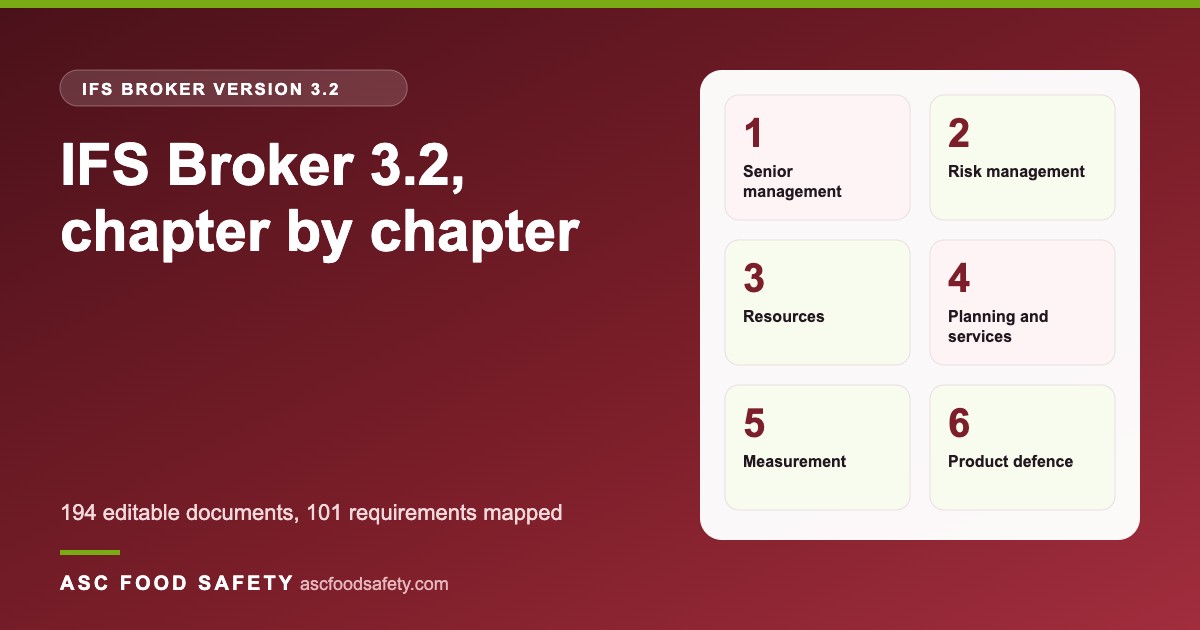
IFS Broker 3.2 requirements are the 101 audit requirements in Part 2 of IFS Broker Version 3.2, grouped into six chapters: senior management, the management system, resources, planning and services, measurement and improvement, and product defence. Eight are KO requirements, and a trading company also carries Part 1 and Part 5 obligations on scope, certification body notifications, the action plan and the unannounced option. Below, chapter by chapter, is what each one asks, what the auditor wants to see, and which documents in ASC’s IFS Broker Version 3.2 Document Templates Toolkit close it.
At a glance
- Standard
- IFS Broker Version 3.2, in force for audits from 1 July 2024
- Who it is for
- Brokers, agents, traders and importers that typically do not take physical possession of product
- Requirements
- 101 in Part 2, eight of them KOs
- Pass marks
- 75 percent foundation level, 95 percent higher level, no Major and no KO
- ASC toolkit
- TK18, 194 editable Word and Excel documents, R4,700
Start from a mapped system, not a blank page
TK18 gives you 194 editable documents, numbered IFSB001 to IFSB194 and filed by chapter, with all 101 Part 2 requirements mapped to the documents that close them. R4,700, about USD 289 · EUR 251 · GBP 215 · AED 1,057. ASC does not charge VAT.
In this article
- Does IFS Broker 3.2 apply to your company?
- How is IFS Broker Version 3.2 laid out and scored?
- What does chapter 1 ask of senior management?
- What does chapter 2 require for documents, records and risk?
- What does chapter 3 expect on training?
- What does chapter 4 cover, from contracts to logistics?
- What does chapter 5 require on audits, testing and recalls?
- What does chapter 6 ask on product defence?
- Which Part 1 and Part 5 obligations sit outside the checklist?
- How do the toolkit documents map to the requirements?
- Frequently asked questions
Does IFS Broker 3.2 apply to your company?
IFS Broker covers companies that trade food, household and personal care products or packaging but typically never take physical possession of them: brokers working for a commission, sales agents, traders and importers. They may own the goods. What they do not have is a warehouse, a packing station or a truck fleet.
That settles most scope questions. Own storage needs a combined IFS Broker and IFS Logistics audit, or the set exclusion statement on the certificate (Part 1 section 4.3). Own processing belongs under IFS Food, HPC or PACsecure, combined or excluded the same way (Part 1 section 4.4). Arranging storage and transport through contracted providers stays inside the broker scope and cannot be carved out, and customer branded products can never be excluded. Record the decision on IFSB005 Logistics and Processing Activities Scope Decision Record, and the wording on IFSB004 Certification Scope Statement. The scope names product categories and their IFS scope numbers, never brands, PDO, PGI or organic labels.
When a broker scope goes wrong, it is almost always because nobody wrote down what the company physically touches and what it only arranges.
How is IFS Broker Version 3.2 laid out and scored?
Part 1 is the audit protocol, Part 2 the 101 requirements, Part 3 the rules for certification bodies, Part 4 the report format and Part 5 the unannounced protocol. IFS also publishes a Doctrine that interprets specific requirements. The current one is version 3, April 2026, and auditors apply it.
Regular requirements score A (20 points), B (15), C (5) or D (minus 20). A KO can only score A (20), B (0) or D, and a D subtracts 50 percent of the possible total and stops certification at that audit. Any regular requirement can be raised as a Major, which subtracts 15 percent. N/A is not allowed on a KO, except 5.2.2.
| Chapter | Requirements | KOs | Toolkit folder |
|---|---|---|---|
| 1 Senior management responsibility | 12 | 1.2.2 | C1, IFSB019 to IFSB049 |
| 2 Quality and product safety management system | 17 | 2.3.1 | C2, IFSB050 to IFSB071 |
| 3 Resource management | 4 | None | C3, IFSB072 to IFSB088 |
| 4 Planning and services process | 38 | 4.2.2, 4.6.1 | C4, IFSB089 to IFSB148 |
| 5 Measurements, analyses, improvements | 28 | 5.1.1, 5.2.2, 5.5.2, 5.7.2 | C5, IFSB149 to IFSB188 |
| 6 Product defence assessment | 2 | None | C6, IFSB189 to IFSB194 |
What does chapter 1 ask of senior management?
Twelve requirements in three blocks. Block 1.1 asks for a corporate policy covering customer focus, sustainability, commitment to a product safety culture and product requirements, communicated to everyone and broken into measurable objectives, with product safety, quality and authenticity information reaching the right people without delay. The Doctrine makes safety culture auditable: show how responsibilities are communicated, how staff are trained, how they raise concerns and how performance is measured.
Block 1.2 covers the organisation chart and deputies, KO 1.2.2 on senior management responsibility and resources, monitoring of responsibilities, consistent processes, legislation monitoring, customer notification of specification problems and authority findings, and certification body notification under 1.2.7. Under the Doctrine, a recall or withdrawal for a safety or fraud reason where the broker is legally responsible, or an authority visit ending in mandatory action for a safety hazard, is reported within three working days. Block 1.3 is the management review, at least yearly, with nine named inputs.
Toolkit: IFSB019 to IFSB028 for policy, objectives, safety culture and communication, IFSB029 to IFSB044 for structure, resources, legislation and notifications (with a three working day clock), and IFSB045 to IFSB048 for management review.
What does chapter 2 require for documents, records and risk?
Seventeen requirements. Blocks 2.1 and 2.2 cover document control and records: one documented system, current versions where they are used, records that are genuine, protected against later alteration and, when electronic, open only to authorised people, kept as long as law and customers require, or at least a year past the shelf life where neither sets a period.
Block 2.3 holds KO 2.3.1 and nine requirements in all. Product safety control must rest on a fully implemented risk management system. You confirm that suppliers run their own, reflecting the law of the producing and destination countries, with Codex HACCP at manufacturers (2.3.2). Your own assessment is done by a multidisciplinary team (2.3.4) from product and service descriptions and a flow chart (2.3.5), covers physical, chemical and biological hazards including allergens (2.3.6), chooses control measures by a logic you can show with validated limits (2.3.7), sets monitoring and corrective action (2.3.8), and is reviewed at least yearly (2.3.9).
A broker has no factory CCPs. Its steps are contract, specification, supplier approval, purchase order, consignment check, release, logistics and customer receipt. Our guide to the IFS Broker risk assessment works through it step by step.
Toolkit: IFSB050 to IFSB058 for documents and records, IFSB059 to IFSB070 for risk management, including IFSB064 Hazard Analysis and Risk Assessment of Broker Services in Excel.
What does chapter 3 expect on training?
Four requirements: competence set from the hazard analysis (3.1), documented programmes and a training matrix (3.2), records of every event with signatures, date, duration, content and trainer, plus proof that training works (3.3), and regular review of content (3.4). In a small broker office the auditor usually interviews whoever signs consignment releases. If their answer to a late residue result or a lapsed certificate matches the procedure, that is your effectiveness evidence.
Toolkit: IFSB072 to IFSB080 and IFSB087, plus six training packs, IFSB081 to IFSB086. For the people who need the Standard explained first, ASC runs the Introduction to IFS Broker Version 3.2 Course and the IFS Broker Version 3.2 for Management Course, R1,195 each.
What does chapter 4 cover, from contracts to logistics?
Chapter 4 has 38 requirements and carries the largest share of a broker’s points.
Four Doctrine points change how this chapter is audited. On 4.4.4, customer acceptance of a supplier without IFS or other GFSI recognised certification must be active and evidenced, by a signed specification, contract, email or letter, never general terms and conditions. On 4.4.7, where a supplier’s status is not available, testing is increased in frequency and scope and the exception is justified in writing. On 4.4.3, the supplier risk assessment includes product defence. On 4.6, all safety and quality information must be assignable to the product, bulk and unlabelled consumer units included. Claims on origin, production method or composition also need evidence. The hazards behind all of this are in our guide to food safety for fruit exporters and traders.
What does chapter 5 require on audits, testing and recalls?
Twenty-eight requirements in seven blocks, with four KOs.
- 5.1 Internal audits, KO 5.1.1A programme covering every requirement, critical activities at least yearly, independent auditors. IFSB149 to IFSB154.
- 5.2 Product analyses, KO 5.2.2Risk based sampling, customer special analyses in a testing plan, ISO/IEC 17025 laboratories preferred, trend review. IFSB155 to IFSB163.
- 5.3 and 5.4 Release and complaintsSupplier hold systems, a defined release procedure, and complaint handling that prevents recurrence. IFSB164 to IFSB170.
- 5.5 Incidents and recall, KO 5.5.2A trained crisis team, contacts reachable at all times, immediate customer notice, an annual test. IFSB171 to IFSB179.
- 5.6 and 5.7 Non-conformities and corrective action, KO 5.7.2No out of specification product under a brand without the brand owner’s written approval, and corrective actions with owners, timescales and effectiveness checks. IFSB180 to IFSB187.
How each KO is tested, and the Majors that brokers pick up beside them, is covered in our guide to the IFS Broker KO requirements.
What does chapter 6 ask on product defence?
Two requirements: suppliers’ product defence responsibilities are clearly defined (6.1), and suppliers and logistics providers have a documented threat assessment and a plan (6.2). Toolkit: IFSB189 to IFSB193, including an office and information security checklist. If you only need the assessments, ASC’s Food Defence Tool and Food Fraud Tool are R750 each, and stand-alone risk assessment templates are in the ASC shop. Where you keep retained samples at the office, ASC Pest Control can look after the office and sample store.
Which Part 1 and Part 5 obligations sit outside the checklist?
These are not scored in Part 2 but will stop or delay a certificate if missed. The toolkit maps them alongside the 101 requirements.
- Agree the scope with the certification body before the audit (Part 1 section 4.2).
- Review every requirement before the audit and keep the current Standard at the office on the day (section 5.1).
- Confirm the certification body is accredited to ISO/IEC 17065 for IFS Broker and holds an IFS contract (section 5.2).
- Notify the certification body within three working days of changes affecting your ability to conform (section 2.2), and immediately of new products or services outside scope (section 3.4).
- Return the action plan within four weeks of the provisional report (section 5.7).
- Keep the IFS Broker logo off final product packaging (section 10).
- For unannounced audits, register at least four weeks before the window opens (Part 5).
These sit in the C0 Scheme and Scope folder, IFSB002 to IFSB018, with IFSB009 Gap Analysis and Self Assessment Checklist carrying the IFS scoring rules. Timelines are in our guide to IFS Broker certification in South Africa.
Run the system on ASCloud instead of binders
Once the documents are configured, ASCloud, ZeroPaper by ASC, keeps your registers and records online. If you want a trainer beside you for the rollout, the implementation course is built on the same system.
How do the toolkit documents map to the requirements?
IFSB007 Clause Mapping lists every requirement and company obligation against the documents that close it. All eight KOs are flagged with the evidence an auditor asks for.
| KO requirement | What the auditor samples | Key toolkit documents |
|---|---|---|
| 1.2.2 | Signed policy, objectives, approved resources, review decisions | IFSB034, IFSB035, IFSB047 |
| 2.3.1 | Hazard analysis, verified flow diagram, annual review | IFSB059, IFSB064, IFSB063 |
| 4.2.2 | A sampled product against its signed specification | IFSB100, IFSB119, IFSB159 |
| 4.6.1 | A trace chosen by the auditor, with quantities | IFSB129, IFSB130, IFSB131 |
| 5.1.1 | Programme covering every requirement | IFSB149, IFSB150, IFSB151 |
| 5.2.2 | Customer special analyses and results | IFSB157, IFSB159 |
| 5.5.2 | Recall procedure, contacts, last test | IFSB171, IFSB173, IFSB178 |
| 5.7.2 | Corrective actions with owners and timescales | IFSB184, IFSB185, IFSB186 |
Every document is written for one worked example, a trader exporting fresh citrus and pome fruit that also sells customer branded dried fruit and nut mixes, so each form shows how it is completed. You replace the example values with your own and confirm every default on IFSB017 Operating Parameter Schedule. The full list is on the TK18 product page. If you are still choosing between schemes, the BRCGS toolkits hub covers the alternatives.
Frequently asked questions
How many requirements are in IFS Broker Version 3.2?
Which requirements are KO requirements in IFS Broker 3.2?
Does IFS Broker still apply if we use a contracted cold store?
What score does a broker need to pass?
Is the ASC toolkit approved by IFS?
What format are the TK18 documents in?
Key takeaways
- IFS Broker Version 3.2 has 101 Part 2 requirements in six chapters, eight of them KOs, plus Part 1 and Part 5 obligations.
- Decide the scope first. Arranged logistics stays in, own storage or processing needs another IFS standard or an exclusion statement.
- Chapter 4 carries 38 requirements. Read the Doctrine on 4.4.3, 4.4.4, 4.4.7 and 4.6 before you write anything.
- A D on any KO subtracts 50 percent of the possible total and stops certification at that audit.
Know where you stand before the auditor does
The TK18 gap analysis scores every requirement with the IFS rules built in, so you see your starting point the day you download. Want help applying it to your trade? Talk to ASC.
Published by ASC Food Safety, South African food safety and quality consultants. This article is general guidance and not a substitute for certification-specific advice.