

When to review your HACCP plan: the triggers and how to run the annual reassessment
The changes that should trigger a HACCP review, how change control catches them, and how to run an annual reassessment that stands up at audit.
ASC Food Safety Consultants
Leading with Science. Ensuring Food Safety.
Helpful information dedicated to HACCP training for HACCP or Food Safety teams.
The changes that should trigger a HACCP review, how change control catches them, and how to run an annual reassessment that stands up at audit.
The four things that must happen after every CCP deviation, who may release held product, and worked examples from a cooker, chiller and metal detector.
Who should sit on a HACCP team in a small food business, what training each member needs, and the competence records auditors ask to see.

We take five South African products through the Codex decision tree to show what is a CCP, what a PRP can carry and how to record the decision.

The flow diagram is the foundation of the hazard analysis. Here is how to scope it, what inputs to include, how to number steps and how to verify it on the floor.
Validation and verification are the two HACCP words most often mixed up at audit. We work through four real controls and the records each one should produce.
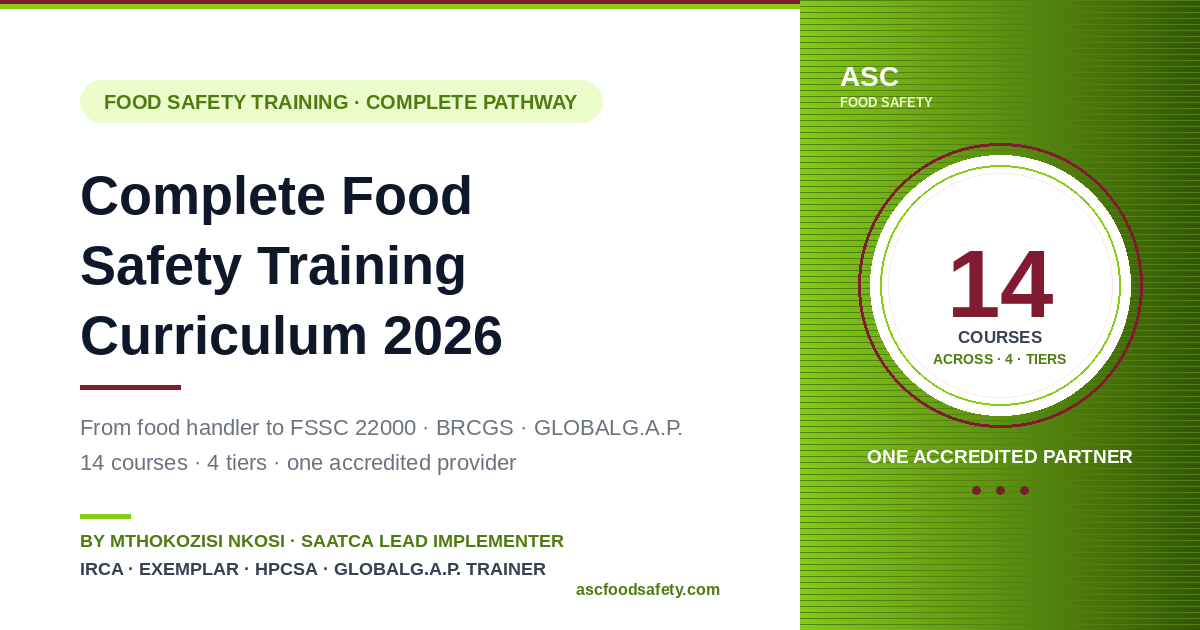
FOOD SAFETY TRAINING CURRICULUM · 2026 PATHWAY GUIDE Most food safety training providers cover one or two rungs of the certification ladder. ASC covers fourteen courses across four tiers: from a R249 entry-level food handler course for the dishwasher in a township kitchen all the way up to FSSC 22000 …
HACCP TRAINING · 2026 COMPREHENSIVE GUIDE HACCP is the most important food safety methodology of the last 70 years. It is also the most commonly mis-trained, courses that skim the Codex 7 principles, instructors who haven’t audited a HACCP plan in years, certificates that don’t carry weight at certification audit. …
The course is structured to build true competence through a progression of clear, practical, and relevant modules. From the start, we establish a strong foundation in food safety management systems.
Without this advanced competence, HACCP plans become outdated or misaligned with regulatory requirements, and organizations struggle during audits. Complex hazards, high-risk processes, allergen management, and environmental pathogen risks demand advanced analytical skills.

This HPCSA accredited HACCP course will teach the learner to effectively implement a HACCP system from scratch. The focus is on implementing the 12 Steps of HACCP and an understanding of advanced Food Microbiology.

This HPCSA accredited HACCP course will provide the learner with a thorough understanding of the concepts and requirements of a Hazard Analysis Critical Control Points (HACCP) system. The focus is on leadership, food microbiology basics and the steps to implement an effective HACCP system.

This HPCSA accredited HACCP course will provide the learner with a thorough understanding of the requirements of a HACCP system specifically in relation to the 12 Stages of HACCP.

This basic-level Introduction to HACCP course teaches the learner the basic concepts and structure of an effective HACCP system without going into too much detail. The course aims to create HACCP awareness and is suitable for all employees in a food handling environment.