
How to train new kitchen staff on day one: a food safety induction plan
A new starter should not touch food before a short, structured induction. Here is a timed first day plan with a sign off that counts as a training record.
ASC Food Safety Consultants
Leading with Science. Ensuring Food Safety.
A new starter should not touch food before a short, structured induction. Here is a timed first day plan with a sign off that counts as a training record.
Validation and verification are the two HACCP words most often mixed up at audit. We work through four real controls and the records each one should produce.
An EHP has written findings against your food premises. Here is how the person in charge sorts them, writes a corrective action plan the EHP can sign off and prepares for the follow up visit.
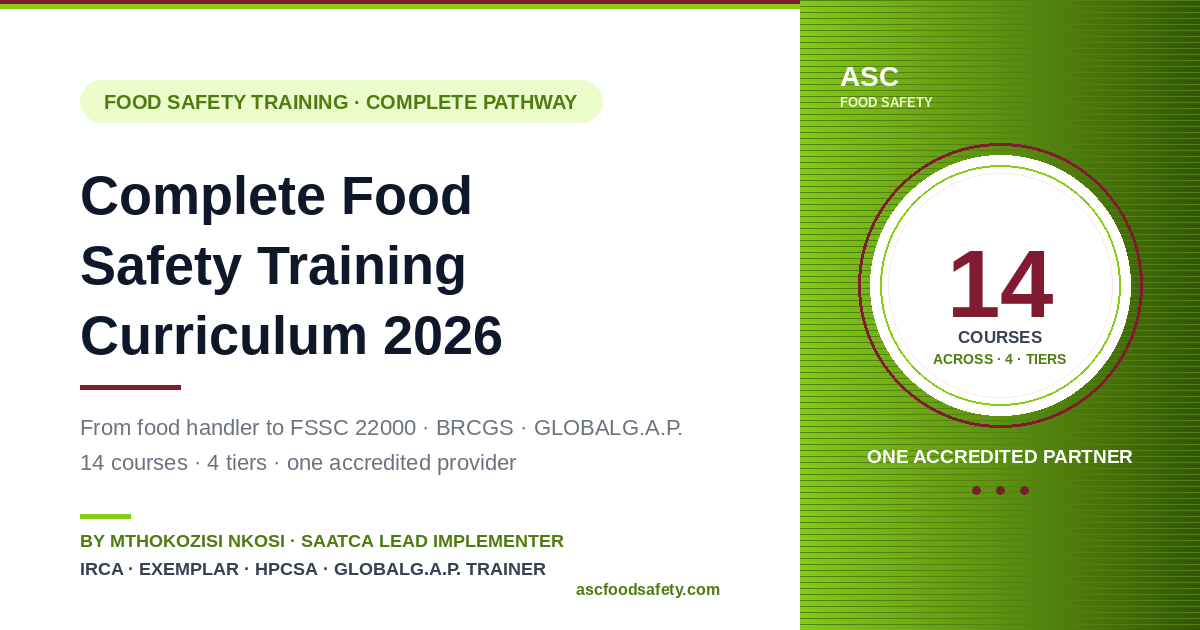
FOOD SAFETY TRAINING CURRICULUM · 2026 PATHWAY GUIDE Most food safety training providers cover one or two rungs of the certification ladder. ASC covers fourteen courses across four tiers: from a R249 entry-level food handler course for the dishwasher in a township kitchen all the way up to FSSC 22000 …
RESTAURANT STARTUP · COMPLIANCE GUIDE · 2026 South Africa’s restaurant industry is one of the most exciting hospitality markets on the African continent, Sandton fine dining, Cape Town bistros, Durban curry houses, Stellenbosch wine-estate restaurants, V&A Waterfront seafood, and a fast-growing dark-kitchen sector. This guide explains exactly how to start …

HPCSA accredited Food Safety training for Spaza shops, vendors, and informal traders. This basic-level course introduces the fundamentals of Food Safety and Good Manufacturing Practices to the learner.

This Transition to FSSC 22000 V6 course will teach the learner the new FSSC 22000 Version 6 requirements. The training is applicable to all food chain categories.

Our GLOBALG.A.P. IFA Version 6 implementation course is accredited by GLOBALG.A.P. and presented by our GLOBALG.A.P. registered trainer. This course will teach the learner to effectively implement and maintain the GLOBALG.A.P. IFA Version 6 standard

This Introduction to FSSC 22000 course will teach the learner the basic requirements of FSSC 22000 V6 for Food Manufacturing.

This Introduction to ISO 22000 course will teach the learner the basic requirements of the ISO 22000 Food Safety Management System standard.

This introduction to BRCGS for Packaging Materials course will teach the learner the basic requirements of Issue 7, including the audit protocol.

This Introduction to BRCGS for Food Safety course will teach the learner the basic requirements of Issue 9. The key differences between Issues 8 and 9 are also discussed, as well as the audit protocol.

This Transition to BRCGS for Food Safety Issue 9 course will provide the learner with a thorough understanding of the key changes in Issue 9, as well as an overview of all the requirements of the Issue 9 clauses.

This HPCSA accredited HACCP course will teach the learner to effectively implement a HACCP system from scratch. The focus is on implementing the 12 Steps of HACCP and an understanding of advanced Food Microbiology.

This HPCSA accredited HACCP course will provide the learner with a thorough understanding of the concepts and requirements of a Hazard Analysis Critical Control Points (HACCP) system. The focus is on leadership, food microbiology basics and the steps to implement an effective HACCP system.

This basic-level Introduction to HACCP course teaches the learner the basic concepts and structure of an effective HACCP system without going into too much detail. The course aims to create HACCP awareness and is suitable for all employees in a food handling environment.

This 4-hour basic-level course provides a brief overview of the Food Safety practices and hygiene requirements for food handling premises.

This HPCSA accredited course will teach the learner to effectively implement Good Manufacturing Practices in a food handling environment and is mainly based on the requirements referred to in the SANS 10049: 2019 standard.

HPCSA accredited Food Safety training for Food Handlers. This basic-level course introduces the fundamentals of Food Safety and Good Manufacturing Practices to the learner.

This course is designed to teach you how to implement a mature Food Safety and Quality Culture programme in your organisation aligned with the latest GFSI requirements. (Templates included)